NIH AI Policy for Grant Applications 2026

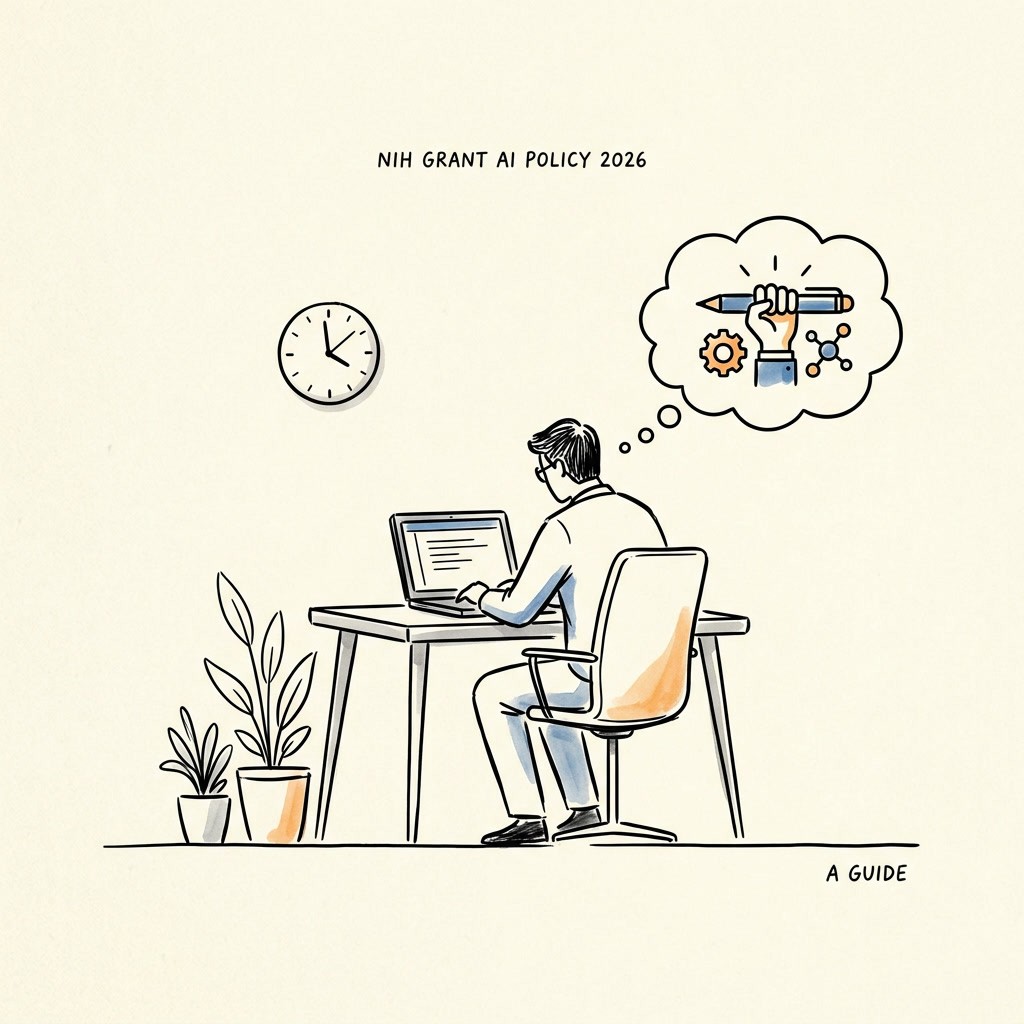
Principal Investigators (PIs), multi-PI (MPI) teams, research development offices, and institutional Authorized Organizational Representatives (AORs) require a structured scientific governance protocol regarding the integration of artificial intelligence. The National Institutes of Health (NIH) policy establishes a rigid boundary centered on human authorship: applications, or narrative components, determined to be substantially developed by AI are disqualified from funding consideration on the grounds that they fail to meet federal benchmarks for applicant-led originality.
Under the statutory provisions of Notice NOT-OD-25-132, algorithmic text generation shifts from an informal drafting shortcut to a clear institutional risk management concern. Applications, or application sections, that NIH determines were substantially developed by AI may be treated as non-original.
Discoveries of substantial AI development at the post-award stage carry severe administrative and financial liabilities under federal research regulations. The NIH maintains authority to retroactively institute enforcement actions, including the systematic disallowance of expended costs, award suspension, or total grant termination, alongside formal referrals to the HHS Office of Research Integrity (ORI). To safeguard institutional portfolios, investigative teams must enforce a rigorous pre-submission workflow that dictates strict prompt boundaries, preserves data confidentiality, and verifies authorship provenance before an application enters institutional routing.
This guide explains what NIH currently says about AI use in grant applications, what changed for applications submitted to the September 25, 2025 receipt date and beyond, how the six-application PI limit fits into the same policy logic, and what PIs should document before submission. It also clarifies how NIH’s prohibition on generative AI use in peer review affects researchers who move between applicant and reviewer roles.
Key Takeaways: NIH AI Grant Policy in 2026
For NIH applicants and institutional grant teams, three policy points now shape proposal workflows:
The Originality Standard: NIH will not consider applications, or sections of applications, substantially developed by AI to be the original ideas of the applicant. Limited AI assistance may be lower risk when it supports researcher-authored text, but the scientific argument, aims, study design, evidence, and final claims must remain under the applicant team’s control.
The Six-Application PI Limit: For applications submitted to the September 25, 2025 receipt date and beyond, NIH limits each individual PD/PI or MPI to six covered applications per calendar year. The March 2026 NIH Grants Policy Statement lists T activity codes, R25 Research Education Grants, and R13 Conference Grants as exceptions to the six-application limit, so PIs and Sponsored Programs Offices should verify activity-code status before routing.
The Peer Review Ban: NIH prohibits scientific peer reviewers from using generative AI tools to analyze applications or formulate critiques. Reviewer materials are confidential and cannot be uploaded into external AI systems.
What NIH Currently Says About AI Use in Grant Applications
NIH’s current position centers on originality. NIH NOT-OD-25-132 sets the boundary clearly: applications, or sections of applications, that are substantially developed by AI will not be considered the original ideas of the applicants.
For PIs, co-PIs, research development staff, and Sponsored Programs Offices, the central question is whether the applicant team retained intellectual control over the scientific argument. That includes the aims, rationale, study design, evidence, interpretation, and final claims. AI may support limited preparation tasks, but the research plan should remain traceable to the applicant team’s expertise and judgment.
NIH’s 2026 Grants Policy Statement Confirms the Current Position
The temporary provisions originally outlined in temporary funding notices have transitioned into permanent regulations within the March 2026 revision of the NIH Grants Policy Statement (NIHGPS). This formal integration places AI oversight directly into standard institutional compliance audits. Under Section 2.3.7.13 ("Appropriate Use of AI"), the NIHGPS explicitly codifies that while algorithmic tools may be deployed for limited, minor aspects of text preparation, any application displaying substantial machine development will be disqualified as a non-original submission..
The Grants Policy Statement repeats the core position: AI tools may be appropriate for limited aspects of application preparation, but applications or sections substantially developed by AI will not be considered original applicant ideas. It also warns that AI use may result in plagiarism, fabricated citations, or other research misconduct concerns. For a 2026 article, this matters because the policy is no longer only a standalone 2025 notice. It is now reflected in NIH’s broader grants policy framework.
NIH Allows Limited AI Support, But Originality Stays With the Applicant
NIH acknowledges that AI tools may be appropriate for limited aspects of application preparation or in specific circumstances. In practice, lower-risk uses may include grammar review, formatting support, readability checks, or feedback on researcher-authored text, provided the tool, input material, and data-handling terms align with institutional policy.
That flexibility has limits. Researchers should treat AI output as material that requires verification, not as text, evidence, or citations that can be inserted into an application without review. The closer AI use moves toward generating the proposal’s scientific substance, the greater the originality risk.
Post-Award AI Concerns Can Lead to NIH Enforcement Action
NIH also addresses post-award concerns. Under NIH NOT-OD-25-132, NIH may refer a matter to the Office of Research Integrity to determine whether research misconduct occurred. NIH may also take enforcement action, including cost disallowance, withholding future awards, suspension, or possible termination.
The May 2026 NIH and HHS Office of Research Integrity reminder gives more detail on the kinds of AI-related conduct that can raise research integrity concerns. These include presenting AI-generated data as empirically obtained, altering images with AI without disclosure, presenting nonexistent AI-generated references as real, copying substantial AI-generated text without disclosure, and fully generating grant applications or papers using AI tools. See NIH and ORI guidance on AI and research integrity.
How This Fits With Broader Funder AI Policy
NIH’s position belongs to a wider shift in research governance. Across funders, AI policy is becoming a way to define who owns the scientific argument, who protects confidential material, and who remains accountable for submitted claims.For a broader comparison, see our guide to funding agency AI policies.
What Changed in NIH AI Grant Policy After September 25, 2025
NIH’s applicant-side AI policy became operational for applications submitted to the September 25, 2025 receipt date and beyond. Under NIH NOT-OD-25-132 two changes now shape NIH proposal workflows: applications or sections substantially developed by AI will not be considered original applicant ideas, and each individual PD/PI or MPI is limited to six covered applications per calendar year.
NIH’s Office of Extramural Research explained the policy rationale in Apply Responsibly: Policy on AI Use in NIH Research Applications and Limiting Submissions per PI. The article states that NIH introduced the policy to support originality, creativity, and fairness in the research application process. It also notes NIH’s concern that some PIs were submitting unusually high numbers of applications, some of which may have been prepared using AI tools.
The Effective Date Applies to Receipt Dates, Not Informal Drafting Timelines
The key date is September 25, 2025. NIH states that the policy is effective for applications submitted to that receipt date and beyond. For PIs and SPOs, current NIH proposal workflows should treat the policy as active for relevant receipt dates.
This date also matters for internal planning. Research teams should decide how AI may be used before drafting begins, especially when multiple contributors are preparing different sections of the same application.
Structural Planning Under the Six-Application Submission Cap
The annualized volume restriction limits individual investigators—whether listed as a sole Contact PI or within a Multiple Principal Investigator (MPI) configuration—to a maximum of six covered submissions per calendar year. This cap applies across all cumulative Advisory Council review rounds within a single year and encompasses new, renewal, resubmission, and revision applications.
Crucially, an application only counts against this cap after it clears initial administrative intake and proceeds to formal peer review. Senior faculty must note an important discrepancy between early guidelines and current codified rules: while the initial 2025 notice exempted only T-series and R13 mechanisms, the definitive March 2026 NIH Grants Policy Statement explicitly adds R25 Research Education Grants to the exemption list.
For 2026 guidance, use the current NIH Grants Policy Statement and NIH FAQs when checking activity-code exceptions, because institutional summaries and the original July 2025 notice may not capture every later clarification.
This change should be read alongside the AI originality rule. NIH explicitly connects AI use to application volume, noting evidence that AI tools enabled some PIs to submit more than 40 distinct applications in a single application submission round. For grant-active researchers, the policy favors a more selective submission strategy: fewer applications, stronger scientific justification, clearer reviewer fit, and tighter institutional tracking before routing.
Quick Reference: What Changed Under NIH AI Grant Policy
Policy Element | NIH Position | Practical Meaning for PIs and SPOs |
Effective date | Applies to applications submitted to the September 25, 2025 receipt date and beyond | Current NIH proposal workflows should treat the policy as active |
AI-developed applications or sections | NIH will not consider substantially AI-developed applications or sections to be original applicant ideas | Do not use AI to generate the proposal’s scientific substance |
Six-application limit | NIH will accept up to six covered applications per individual PD/PI or MPI per calendar year | PIs and SPOs need submission tracking before routing |
Covered applications | New, renewal, resubmission, and revision applications | Track competing submissions across teams |
Current exceptions | T activity codes, R25 Research Education Grants, and R13 Conference Grants | Verify the current activity-code exception before assuming exemption |
Post-award AI concerns | NIH may refer the matter to ORI and may take enforcement action | Keep documentation of AI use, authorship, citation checks, and verification steps |
Why NIH Links AI Use to Originality, Fairness, and Reviewer Burden
NIH’s AI policy is grounded in a broader concern about how federal research funding is evaluated and stewarded. Peer review depends on applications representing the original scientific judgment of the applicant team. In NIH NOT-OD-25-132, NIH states that applications, or sections of applications, substantially developed by AI will not be considered the original ideas of the applicants.
Originality Is Central to NIH Peer Review
NIH grant review is designed to assess investigator-led science: the importance of the research question, the strength of the rationale, the feasibility of the approach, and the fit between the proposed work and the research team. If AI generates the core proposal narrative, reviewers are no longer evaluating the applicant team’s own scientific reasoning in the same way.
This is why NIH’s policy focuses on substantial AI development rather than surface-level AI use. A grammar check or readability review does not carry the same originality risk as asking AI to generate Specific Aims, develop hypotheses, construct a significance argument, or assemble a research strategy.
AI-Enabled Application Volume Can Strain Peer Review
NIH also links AI use to application volume. In NIH NOT-OD-25-132, the agency notes evidence that AI tools enabled some PIs to submit more than 40 distinct applications in a single application submission round. NIH’s Office of Extramural Research also explains in Apply Responsibly: Policy on AI Use in NIH Research Applications and Limiting Submissions per PI that the policy is intended to support originality, creativity, fairness, and high-quality review.
For PIs and Sponsored Programs Offices, this helps explain why the AI originality rule and the six-application limit appear in the same policy notice. NIH is addressing both the source of proposal content and the volume of applications entering review. A finite system of expert reviewers cannot absorb unlimited application growth without consequences for review quality, reviewer workload, and fairness across applicants, especially if AI makes high-volume submission easier.
How NIH’s Simplified Peer Review Framework Reinforces the Same Governance Logic
NIH’s 2025 Simplified Peer Review Framework is not an AI policy, but it supports the same broader concern with reviewer burden, fairness, and the conditions of expert assessment. The framework applies to most research project grant applications for due dates of January 25, 2025 or later. NIH explains that it was designed to address the complexity of peer review and the potential for reputational bias to affect outcomes.
The framework reorganizes the five regulatory review criteria into three factors:
Simplified Review Factor | Includes | How It Is Evaluated |
Importance of the Research | Significance and Innovation | Scored 1 to 9 |
Rigor and Feasibility | Approach | Scored 1 to 9 |
Expertise and Resources | Investigators and Environment | Evaluated for sufficiency |
This review structure is useful for AI-assisted proposal workflows because it clarifies what feedback should test. Draft feedback should help the PI determine whether reviewers can identify the importance of the research, assess rigor and feasibility, and understand whether the team and environment fit the project. For more on this reviewer-centered approach, see our guide to grant writing for 2026 review panels.
"Fluency vs. Rigor" in Study Sections
Large language models have effectively democratized the production of highly fluent, syntactically flawless grant prose. While this assistance can optimize readability, it introduces an optical illusion of scientific readiness. Manufactured fluency risks obscuring weak conceptual reasoning, superficial preliminary evidence, unvetted methodologies, or highly generic significance framing. For modern study sections, an algorithmically smoothed narrative increases the cognitive workload required to locate the actual science. Reviewers do not score proposals based on automated fluency; they evaluate localized feasibility, investigator-led scientific judgment, and authentic structural rigor.
Reviewers need to see why the question matters, why the approach is feasible, and why the team is positioned to carry out the work. A responsible reviewer-facing grant strategy should therefore focus on importance, rigor, feasibility, and authentic expertise rather than AI-generated fluency.
What This Means for Proposal Development
The safest proposal workflow keeps the scientific argument human-led from the beginning. AI may support bounded tasks such as editing, formatting, or feedback on clarity, but it should not be used to generate the proposal’s central claims. PIs should be able to explain how the aims, rationale, study design, literature positioning, and interpretation were developed by the research team.
This is the governance logic behind NIH’s 2026 AI policy environment. Detection is only one part of the issue. The deeper concern is whether public research funds are awarded on the basis of applicant originality, accountable scientific reasoning, and a peer review process that remains fair and workable.
What “Substantially Developed by AI” Means, and What NIH Has Not Defined
“Substantially developed by AI” is the key phrase in NIH’s applicant-side AI policy. NIH uses this standard in NIH NOT-OD-25-132, repeats it in the March 2026 NIH Grants Policy Statement, and restates it in the May 2026 NIH and ORI guidance on AI and research integrity. Across these sources, the policy centers on originality: NIH will not treat applications, or sections of applications, substantially developed by AI as the applicant’s original ideas.
For PIs and grant teams, a cautious reading is that “substantial development” refers to intellectual contribution as well as text volume. Risk increases when AI generates or materially shapes the scientific argument, including the novelty claim, Specific Aims, rationale, literature positioning, methodology, or reviewer-facing narrative.
Official NIH Language
NIH’s official position is direct: applications that are substantially developed by AI, or that contain sections substantially developed by AI, will not be considered original applicant ideas. The March 2026 NIHGPS also warns that AI use may result in plagiarism or other research misconduct concerns, including fabrication, falsification, or plagiarism in proposing, performing, reviewing, or reporting research.
This language gives PIs a clear boundary around proposal authorship. AI can support limited aspects of application preparation, but the scientific case must remain applicant-led. The research question, design logic, evidentiary claims, and final interpretation should be traceable to the PI and research team.
What NIH Has Not Defined
The official NIH sources reviewed for this article do not provide a mechanical threshold for “substantially developed by AI.” They do not identify a percentage limit, word-count rule, prompt-count threshold, or section-by-section safe harbor.
The absence of a quantitative rule makes percentage-based thinking unreliable. A proposal section could contain relatively little AI-generated text and still raise originality concerns if AI shaped the central argument. A longer passage may carry less risk if the tool was used only to polish researcher-authored language and the PI verified the content.
NIH/ORI’s May 2026 reminder advises researchers to clearly describe AI tool use in applications, manuscripts, and presentations where relevant, review and confirm information, cite references appropriately, disclose image-editing processes, and consult institutional policies.
A Practical Risk Interpretation for PIs
A useful way to interpret the standard is to ask how much control the AI tool had over the proposal’s scientific substance.
Lower-Risk Use: AI supports expression, formatting, or clarity on researcher-authored text. Examples include proofreading, tightening sentences, improving transitions, or identifying unclear wording in a draft the PI or applicant team already wrote.
Higher-Risk Use: AI begins to shape the internal logic of the proposal. Examples include generating conceptual frameworks, turning rough notes into a formal aims structure, drafting significance claims, or rewriting large sections in ways that change the argument.
Highest-Risk Use: AI drafts or materially structures the central scientific narrative. This includes using AI to generate Specific Aims, Significance, Innovation, Approach, major rationale sections, literature claims, methodological justification, or preliminary data interpretation.
The PI should be able to explain how the research idea was generated, how the design logic was developed, how the evidence was selected and verified, and who can defend each major claim before reviewers.
Verification of Authorship Provenance
Because the NIH evaluates "substantial development" as a qualitative measure of intellectual custody, grant teams must treat the policy as a strict authorship provenance standard. Prior to electronic submission via eRA Commons, the Principal Investigator must verify four core parameters of accountability:
Conceptualization: The core scientific ideas, paradigms, and hypotheses were generated exclusively by the investigative team.
Methodological Logic: The experimental designs, operational controls, and analytical plans were developed manually by the investigators.
Evidentiary Synthesis: The preliminary data streams and accompanying literature reviews were selected, organized, and verified by human hands.
Defensibility: The named investigative team possesses the deep disciplinary expertise required to stand before a study section and defend every scientific claim made in the narrative.
If those answers point primarily to an AI tool, the application is exposed under NIH’s originality standard. If they point to the research team, with AI limited to bounded support, the workflow is easier to explain and defend.
This is also where tool selection matters. Before integrating any platform into NIH proposal development, researchers should assess data handling, revision control, confidentiality, and whether the tool supports feedback rather than generating scientific content. For broader tool-evaluation criteria, see our guide to what makes an AI tool academic.
Category | What to Say |
Official NIH Language | NIH will not consider applications, or sections of applications, substantially developed by AI to be original applicant ideas. |
What NIH Has Not Defined | NIH has not provided a percentage threshold, word count, prompt count, section-by-section test, or visible universal disclosure field in the official sources reviewed. |
Reasonable Risk Interpretation | Risk increases when AI generates or materially shapes the novelty claim, Specific Aims, rationale, literature argument, methodology, or reviewer-facing narrative. |
Practical Best Practice | Keep AI at the level of bounded assistance and document how scientific ideas, sources, and final revisions were developed. |
Which AI Uses Look Lower Risk, Higher Risk, or Not Advisable
NIH leaves room for limited AI assistance in grant preparation, but risk depends on the task, the material entered into the tool, the level of human review, and whether AI shapes the scientific substance of the application. The categories below are practical risk categories based on NIH and ORI guidance. They are meant to help PIs and grant teams decide which uses are easier to defend, which require caution, and which should be avoided.
NIH and ORI identify several AI-related risks in NIH and ORI guidance on AI and research integrity, including nonexistent references, AI-generated data presented as real, undisclosed AI image alteration, copied text, and fully AI-generated grant applications or papers. The same logic should guide proposal workflows: the closer AI gets to generating claims, aims, methods, or evidence, the higher the risk.
AI Use Case | Risk Category | Why It Matters |
Grammar cleanup, typo correction, and sentence tightening on researcher-authored text | Lower risk | Supports expression without generating the scientific argument. |
Formatting support or checklist creation | Lower risk | Provides administrative support, assuming no confidential material is entered into an unapproved tool. |
Readability or reviewer-burden feedback on PI-authored text | Lower to moderate risk | Can help identify unclear wording or structure if the PI controls all revisions and verifies the output. |
Turning researcher-authored notes into a cleaner internal outline without adding new claims | Lower to moderate risk | May support organization, but still requires human review and should avoid sensitive material unless the tool is institutionally approved. |
Summarizing confidential proposal sections in a public tool | Higher risk | May expose unpublished, patent-sensitive, human-subjects, clinical, consortium, or institutionally sensitive material. |
Brainstorming aims, hypotheses, or novelty claims | Higher risk | Can shape the intellectual core of the proposal and blur the line between assistance and substitution. |
Drafting Specific Aims, Significance, Innovation, or Approach | Highest risk | These sections carry the proposal’s central scientific argument and should remain researcher-authored. |
Generating citations or literature claims | Highest risk | NIH and ORI identify nonexistent AI-generated references as a possible fabrication concern. |
Generating data, altering images, or presenting AI output as empirical work | Potential research misconduct concern | NIH and ORI identify these actions as possible fabrication or falsification scenarios. |
Using generative AI while serving as an NIH reviewer | Prohibited | NIH prohibits peer reviewers from using generative AI to analyze applications or formulate critiques. |
“Lower risk” should still involve oversight. Even grammar editing can create problems if confidential material is entered into a public system, if the tool changes meaning, or if the revised text weakens precision. WAME also emphasizes that authors remain responsible for chatbot-generated material, including accuracy, attribution, and plagiarism checks.
Before using any AI system in a grant workflow, teams should check whether the tool is appropriate for funder-sensitive material. For tool selection, our guide to criteria for evaluating academic AI tools can support a more careful review of data handling, academic use cases, and research-specific safeguards. For prompt boundaries and confidential material, use a documented internal checklist before any proposal content enters an AI system.
Amsterdam UMC’s research funding guidance is also useful because it discusses grant proposals as confidential documents and warns that prompts or uploaded text may be stored or reused by generative AI applications.
Why NIH Treats Peer Review AI Use Differently
Many senior NIH applicants also serve as study section reviewers, advisory council members, or board members. NIH treats applicant and reviewer roles differently. When you prepare your own application, you are working with material your team controls. When you review for NIH, you are handling confidential, unpublished material from other researchers.
That role change creates a stricter rule. Since June 2023, NIH has prohibited reviewers from using generative AI tools to analyze applications or formulate critiques. The policy appears in NIH NOT-OD-23-149, which remains part of NIH’s active peer review policies.
Applicant-Side AI Use and Reviewer-Side AI Use Are Different Roles
Applicant-side AI use concerns your own proposal workflow. NIH leaves room for limited assistance in application preparation, provided the application is not substantially developed by AI and the applicant team remains responsible for the final content.
Reviewer-side AI use is different because the material belongs to someone else. NIH reviewers receive privileged application content, original research ideas, preliminary data, methods, and strategy. That material cannot be uploaded into external AI systems for summarization, critique drafting, or analysis.
A PI may use limited AI support on their own draft while still being barred from using generative AI when reviewing NIH applications. NIH’s rules change with the role: applicant-side preparation and reviewer-side evaluation carry different confidentiality and delegation obligations.
NIH’s Peer Review Ban Is a Confidentiality Rule
NIH’s reviewer-side AI ban is grounded in confidentiality and review integrity. In NIH NOT-OD-23-149, NIH states that generative AI tools cannot be used by peer reviewers to analyze and critique grant applications or contract proposals.
NIH links this prohibition to confidentiality. AI tools may send, save, view, or reuse submitted material in ways reviewers cannot control. Uploading application content, original concepts, or critique text into an AI system can expose confidential material and violate NIH peer review confidentiality rules.
NIH has also updated reviewer confidentiality and nondisclosure agreements to reflect this prohibition. Reviewers must certify that they understand the restrictions before accessing review materials.
What PIs Who Serve as Reviewers Should Do
PIs who serve as NIH reviewers should keep review materials out of AI systems entirely unless NIH has approved a specific accessibility-related exception.
Reviewer Task | NIH-Safe Approach |
Reading assigned applications | Read manually within NIH-approved review systems |
Summarizing application content | Do not use generative AI |
Drafting critiques | Write critiques yourself |
Handling reviewer notes | Keep notes separate from AI tools, browser plug-ins, and writing assistants |
Using accessibility technology | Contact the DFO or designated NIH official before using any tool that may process review material |
NIH does recognize a narrow accessibility-related pathway. Reviewers who need assistive technology must communicate with the Designated Federal Officer or designated NIH official before using it with review materials. That exception should not be treated as general permission to use AI during peer review.
PIs should separate proposal development from formal peer review. Pre-submission feedback on your own draft belongs in an author-controlled revision process. NIH peer review involves confidential third-party material and follows a stricter rule. For more on that boundary, see thesify’s guide to pre-submission review and peer review. For related context on how AI-style review tools differ from formal peer review, see AI tools for academic peer review.
AI, Confidentiality, Fabricated References, and Research Misconduct Risk
Managing technological risk within federal proposal workflows requires evaluating three separate parameters: confidentiality, originality, and data accuracy. A specific use case can look completely benign from an authorship standpoint, yet remain highly inappropriate due to the security classification of the source material entered into the prompt window.
Joint guidance issued by the NIH and the HHS Office of Research Integrity (ORI) outlines exactly how unvetted automated workflows intersect with actionable research integrity risks, including synthetic data generation, undisclosed image alteration, and unverified narrative construction.
Data Use Certifications and Prompt Boundaries
Data security liabilities emerge long before an investigator types a prompt. Public and commercial AI platforms commonly archive user inputs for model training, making them entirely inappropriate environments for processing unpublished preliminary findings, patent-sensitive concepts, or specific consortium agreements. PIs must establish explicit boundaries regarding what metrics a tool should never see. Standard public interfaces are unacceptable processing environments for:
Do not upload the following into public or unapproved AI systems:
Unpublished findings or raw preliminary data
Patient-level clinical metrics, clinical information, or human-subjects material
Proprietary assay details, patentable methodologies, or novel protocols
Confidential consortium strategies, non-disclosure arrangements, or site-specific plans
Sensitive institutional budget data or non-public internal strategy
This risk is absolute for laboratories handling genomic pipelines. Under the explicit mandates of NIH Notice NOT-OD-25-081, sharing controlled-access human genomic data or its derivatives with public generative AI tools through standard user interfaces violates the non-transferability provisions of the federal Data Use Certification (DUC). Passing restricted files through unvetted systems compromises institutional standing and breaches signed data-use covenants. PIs must treat data security as an absolute gatekeeper,eta mapping out exactly what metrics are safe to process by consulting our checklist on what to evaluate before AI sees your grant.
Bibliographic Fabrications and Federal Misconduct Liabilities
Because literature citations substantiate the scientific feasibility and rigor of a proposed approach, unverified bibliographic entries represent an immediate compliance vulnerability. Large language models operate via token prediction rather than structural database lookups, causing them to routinely invent highly plausible but entirely fictitious citations.
The May 2026 NIH/ORI joint compliance guidance explicitly warns that "presenting AI-generated, non-existent references overtly as real" satisfies the federal threshold for data fabrication under 42 CFR Part 93. Principal Investigators must enforce a strict validation loop: every author string, journal title, and DOI must be manually cross-checked against independent indices like PubMed prior to routing.
The problem is documented in biomedical publishing. A 2023 JMIR proof-of-concept article showed that AI could generate fraudulent but realistic-looking scientific medical articles, including fabricated scholarly elements. A 2026 JMIR study examined how AI tools handle retracted literature, highlighting risks around unreliable or misleading citation practices.
Fabricated citations have also attracted wider scrutiny in biomedical literature. Nature coverage of a 2026 audit reported a rise in fake citations across biomedical-science papers.
For NIH grant teams, the operational rule should be simple: verify every citation manually against original sources. Do not accept AI-generated references, DOI strings, author names, PubMed-style citations, or literature summaries without checking them.
AI-Generated Data, Images, and Text Can Raise Misconduct Concerns
NIH and ORI connect inappropriate AI use to established research misconduct categories: fabrication, falsification, and plagiarism. Their May 2026 guidance states that researchers may cross into misconduct when they intentionally, knowingly, or recklessly use AI tools in ways that depart from accepted research practices.
For NIH proposals, the main risk areas are:
Risk Area | Example in a Grant Workflow | Why It Creates NIH Concern |
Fabricated data | Presenting AI-generated results, graphs, or preliminary findings as empirically obtained | The application misrepresents the source of evidence |
Falsified images | Using AI to alter microscopy images, blots, figures, or other visual data without disclosure | The visual record no longer reflects the underlying data accurately |
Fabricated references | Including nonexistent AI-generated papers or false citation details | The literature basis of the proposal becomes unreliable |
Plagiarized or copied text | Inserting substantial AI-generated text without disclosure or review | The application may misrepresent authorship and source material |
Full AI substitution | Submitting an application or major section generated by AI | NIH does not consider substantially AI-developed applications or sections to be original applicant ideas |
These risks should be separated from bounded editing. NIH/ORI states that AI tools may be used to edit or polish text when aligned with institutional, journal, or funder policies. The concern begins when AI output is used in a way that misrepresents authorship, evidence, source material, data, or methods.
For PIs, a defensible workflow treats AI output as unverified material. Check every reference, inspect every factual claim, review every image-editing step, and keep confidential or controlled material out of any system that has not been approved for that use.
What PIs and Grant Teams Should Document Before Submission
NIH has not created a universal AI-use disclosure field in the official sources reviewed for this article. However, NIH and ORI advise researchers to clearly describe AI tool use where relevant, review and confirm information for accuracy, cite references appropriately, disclose image-editing processes, and consult institutional policies.
For NIH grant teams, documentation should be short, practical, and established before drafting begins. It is especially important for multi-PI applications, consortium proposals, and drafts involving research development staff or external contributors. The record should show how AI was used, what material entered the tool, who reviewed the output, and how the final text remained researcher-led.
Documentation Field | What to Record | Why It Helps |
Tool name and version | The AI tool or platform used, including whether it was institutional, enterprise, or public | Shows what system handled the material |
Date of use | When the tool was used | Creates a basic workflow record |
Proposal section | Specific Aims, Research Strategy, Biosketch, Budget Justification, or another section | Shows whether AI touched high-sensitivity sections |
Purpose | Grammar review, formatting, clarity feedback, citation check, or reviewer-burden feedback | Separates bounded support from content generation |
Input category | Public text, researcher-authored draft, unpublished data, confidential material, or human-subjects information | Helps assess confidentiality risk |
Prompt boundary | Sensitive material intentionally excluded from the prompt | Shows that data exposure was considered before tool use |
Output used | Accepted, rejected, revised, or used only as feedback | Shows the role of human review |
Human reviewer | PI, co-PI, research development staff, SPO, or other reviewer | Assigns responsibility for the final decision |
Verification step | Citation check, factual review, plagiarism check, image review, or institutional review | Supports accuracy and originality |
Final decision | Whether and how the material entered the submitted application | Records author responsibility for the final text |
This documentation does not prove NIH compliance by itself. It gives the PI and institution a clearer record of authorship, confidentiality review, and verification. For grant teams using AI at any stage, that record is easier to maintain than reconstructing the workflow after submission.
How to Use AI Feedback While Keeping the Scientific Argument Human-Led
AI feedback is most defensible in an NIH proposal workflow when it reviews a researcher-authored draft. Its role should be to identify problems in clarity, structure, logic, reviewer burden, or missing detail while leaving the scientific argument with the applicant team.
For example, a tool may flag that the feasibility argument is hard to follow, that the timeline lacks milestones, or that the transition between aims is unclear. The PI still has to decide what the issue means scientifically, revise the section, verify the evidence, check the citations, and take responsibility for the final application.
Use AI Feedback to Review the Draft, Not Write the Science
A responsible AI feedback workflow should focus on questions like:
Is the central research question clear?
Are the Specific Aims easy to follow?
Does the Research Strategy explain why the approach is feasible?
Are there logic gaps reviewers would have to resolve themselves?
Are key claims supported by evidence?
Are any required proposal elements underdeveloped or missing?
These are review questions. They help identify where a draft may confuse reviewers, where a claim needs support, or where a proposal section needs clearer structure. The aims, rationale, literature claims, and methodological justification should still come from the applicant team.
This is especially important under NIH’s current AI policy. If AI materially shapes the proposal’s central claims, the application becomes harder to defend as the applicant team’s original work.
Keep the PI Responsible for Every Claim
NIH compliance remains a PI and institutional responsibility. AI tools can support draft review, but the PI, applicant institution, and grant team must determine whether the application aligns with NIH policy.
Before using AI feedback, the team should also decide whether the material is appropriate for the system being used. Confidential proposal content, unpublished findings, human-subjects information, patent-sensitive ideas, consortium strategy, and sensitive budget details should only be used in systems approved by the researcher’s institution.
For proposal teams, the division of labor should be clear:
AI Can Help Review | The PI Must Decide |
Whether a paragraph is hard to follow | What the scientific claim should be |
Whether a section lacks structure | How the argument should be revised |
Whether feasibility is unclear | Whether the method is actually feasible |
Whether citations appear incomplete | Which sources support the claim |
Whether reviewers may struggle with the logic | How to strengthen the proposal’s reasoning |
Where Structured Feedback Tools Can Fit
Feedback-oriented tools can be useful when they help researchers review their own drafts without replacing the scientific work. Used carefully, structured feedback can help PIs identify unclear aims, weak transitions, missing feasibility details, and places where reviewers may need more context. For a practical example, see our guide to grant proposal feedback.
For related guidance on how reviewers assess proposal clarity, rigor, and feasibility, see our guide to grant writing for 2026 review panels.
Responsible AI Workflow for NIH Proposal Development
A responsible AI workflow for an NIH grant should be set before drafting begins. The aim is to keep the scientific core researcher-led, protect sensitive material, verify every factual claim, and keep a clear record of how AI was used.
1. Set Proposal-Level AI Rules Before Drafting
Decide which tools are approved, which tools are off-limits, and which proposal sections should not involve AI-generated content. This is especially important for multi-PI applications, consortium proposals, and teams where postdocs, research managers, or external writers may contribute to different sections.
At minimum, agree on:
Which tools the team may use
Which sections AI should not draft
Which materials should never be uploaded
Who reviews AI-assisted edits
How AI use will be documented
2. Draft the Scientific Core Without AI Generation
Keep the central scientific content researcher-led. This includes the Specific Aims, hypotheses, rationale, study design, significance claims, innovation framing, methodological logic, and preliminary data interpretation.
The applicant team should define what the project is, why it matters, how the study should be designed, and how the evidence should be interpreted. These parts of the application carry the original scientific contribution.
3. Use AI Only for Bounded Support
Lower-risk AI use should stay close to editing and review. Examples include:
Grammar and typo review
Formatting support
Readability checks
Feedback on unclear wording
Suggestions for improving transitions
Reviewer-burden feedback on researcher-authored text
The PI or grant team should review every suggestion before it enters the draft. If the tool changes meaning, adds claims, or reshapes the argument, treat that output as high risk.
4. Protect Confidential and Sensitive Material
Before using any tool, decide what the system should never see. Do not upload unpublished data, human-subjects material, clinical information, patient-level details, controlled-access data, patentable ideas, consortium strategy, or sensitive budget details into unapproved tools.
For a practical way to set those boundaries early, see our guide to before AI sees your grant.
5. Verify All Factual and Citation Claims
AI output should be treated as unverified. Check every citation, DOI, method description, statistic, policy claim, and interpretation against original sources or internal records.
This step is especially important for NIH applications because fabricated references and inaccurate literature claims can weaken the proposal and raise research integrity concerns.
6. Document AI Use Internally
Keep a short internal record of AI use. The log does not need to be complicated, but it should show what happened.
Record:
Tool name and version
Date of use
Proposal section involved
Purpose of use
Type of material entered
Output used or rejected
Human reviewer
Verification steps
This is easier to do during drafting than after submission.
7. Confirm Final PI Accountability Before Routing
Before the application goes to the Sponsored Programs Office, the PI should be able to explain the origin of every major claim, design choice, citation, and interpretation.
The final check should confirm that the application reflects the research team’s scientific judgment. AI can support parts of the workflow, but the proposal’s logic, evidence, and final wording should remain under applicant control.
FAQs About NIH AI Grant Application Rules
Can You Use AI in NIH Grant Applications?
Yes, but only in limited, assistive ways. NIH allows limited AI support in application preparation, but under NIH NOT-OD-25-132, applications or sections substantially developed by AI will not be considered the applicant’s original idea
What Changed After the September 25, 2025 NIH Receipt Date?
For applications submitted to the September 25, 2025 receipt date and beyond, NIH made its applicant-side AI originality rule active. NIH also introduced a six-application-per-calendar-year cap for individual PD/PIs or MPIs. The current March 2026 NIH Grants Policy Statement lists T, R25, and R13 activity codes as exceptions.
What Does “Substantially Developed by AI” Mean?
NIH has not defined “substantially developed by AI” with a percentage, word count, prompt count, or section-by-section threshold. A cautious reading is that risk increases when AI generates or materially shapes the proposal’s scientific argument, novelty claim, Specific Aims, rationale, literature support, methodology, or reviewer-facing narrative.
Can NIH Peer Reviewers Use AI Tools to Help With Critiques?
No. Under NIH NOT-OD-23-149, NIH prohibits peer reviewers from using generative AI tools to analyze applications or formulate critiques. Uploading application content, original concepts, or critique material into an AI system can violate NIH peer review confidentiality and integrity requirements.
For a clearer explanation of the boundary between draft feedback and formal review, see our guide to pre-submission review vs peer review.
Does NIH Require AI Disclosure?
NIH’s main applicant-side notice does not identify a universal AI disclosure field in standard application forms. NIH and ORI’s May 2026 guidance advises researchers to clearly describe AI tool use in applications, manuscripts, and presentations where relevant. Research teams should also follow institutional requirements and keep internal records of AI use.
What AI Uses Look Lower Risk in NIH Proposal Workflows?
Lower-risk uses are bounded and researcher-controlled. These may include grammar cleanup, typo correction, formatting support, readability review, or feedback on researcher-authored text. These uses still require oversight. The PI remains responsible for the claims, citations, evidence, and final wording.
For broader context on how funders are approaching AI use, see our guide to funding agency AI policies for researchers.
What AI Uses Should NIH Grant Teams Avoid?
Avoid using AI to draft Specific Aims, Significance, Innovation, Approach, literature claims, methodological justification, or preliminary data interpretation. These sections carry the proposal’s scientific substance. NIH and ORI also flag nonexistent AI-generated references, AI-generated data presented as real, undisclosed AI image alteration, copied text, and fully AI-generated applications or papers as research integrity concerns.
What Should Grant Teams Document Before Submission?
At minimum, document the tool used, task performed, proposal section involved, input type, prompt boundaries, output handling, citation verification, human review, and final PI sign-off. This record helps the team show how AI use remained bounded, verified, and researcher-led.
Final Takeaway: Responsible AI Use Is a Proposal Governance Question
NIH’s AI policy should be read as a proposal governance policy. It asks who developed the scientific ideas, who verified the claims, who protected confidential material, and who remains accountable for the final application.
For PIs and grant teams, responsible AI use means keeping the scientific core human-led. AI may support limited preparation tasks, such as grammar review, formatting, readability checks, or feedback on draft clarity. The research question, design logic, evidence, literature interpretation, and proposal strategy should remain with the applicant team and be defensible in front of reviewers.
A defensible NIH workflow should do four things: preserve applicant originality, protect sensitive proposal material, verify citations and factual claims, and document how AI tools were used. This approach fits the direction of NIH AI grant policy in 2026, which links AI use to fairness, originality, reviewer burden, and research integrity.
For a broader view of how other funders are approaching similar questions, see our guide to funding agency AI policies for researchers.
Try thesify’s Grant Assistant for Free
Use thesify’s Grant Assistant to identify relevant funding opportunities, organize application priorities, and review your grant draft for clarity, structure, and revision needs. You keep control of the scientific argument, proposal strategy, and final submission. Sign up to thesify for free.
Related Posts
AI in Grant Applications: Funding Policies Explained: Compare NIH, NSF, UKRI, Horizon Europe and ERC AI policies for grant applications, including disclosure, originality, confidentiality and peer review risks. For career researchers, these policies should not be seen as obstacles but as part of modern research governance. AI tools can still support your work—polishing language, organising references, suggesting ideas—but they must be used thoughtfully.
Grant Writing Logic Audit: 2026 Funding Strategies | thesify: A reviewer’s first impression isn't formed during a deep dive into your methodology; it happens in the "Snap Judgment" phase. Research into the peer-review process indicates that reviewers are susceptible to "heuristics"—mental shortcuts—when faced with high workloads. Survive the grant triage phase. Learn how to logic-audit your research and use thesify to stress-test your proposal for maximum reviewer impact.
Grant Proposal Feedback: A Practical Guide with thesify: Want structured feedback on your grant proposal? Recent advice stresses the importance of getting early feedback from experienced reviewers and ensuring that comments are specific and constructive. However, few resources show how to obtain detailed feedback at scale using AI. This guide shows you how to use thesify to assess your title, background, goals and methods—and create a revision loop.