What Authors Need to Know About Pre-Submission Review vs Peer Review

In practice, pre-submission review and peer review describe different stages of evaluation, with different goals, timelines, and power dynamics. If you are searching for the difference between pre-submission review and peer review, you are really asking how to structure feedback across the whole academic publication pipeline.
This article walks you through what pre-submission review is, how it differs from journal peer review, and why the distinction matters for your workload, revision strategy, and expectations about decisions. You will see how early internal critiques, mock reviews, and committee comments fit alongside formal peer review reports from journal-selected experts, and how using each stage intentionally can make the path from draft to publication more predictable.
Why the Difference Between Pre-Submission Review and Peer Review Matters
When you start preparing a manuscript or grant proposal, it’s easy to conflate every bit of feedback with “peer review.” Yet these terms refer to very different stages of the publication pipeline. A clear grasp of when and why to seek each type of review can save you months of work and prevent wasted submissions.
Pre‑submission review happens before you send your work to a journal or funding body, whereas peer review is the independent assessment performed by journal‑selected experts after submission. Knowing the distinction helps you schedule revision time, plan for possible revisions, and manage expectations about decision outcomes. Without this clarity, you may either neglect valuable early feedback or misinterpret automated checks as official peer review, risking research integrity and disappointment.

What Is a Pre-Submission Review of a Manuscript?
A pre‑submission review is an internal or external assessment of your manuscript, grant application or other scholarly product before you submit it to a journal, funding agency, or conference. Unlike journal peer review, this step is initiated by the author to identify weaknesses, improve clarity and align the document with expected standards.
The pre-submission review process helps:
Authors see how reviewers may perceive their work.
Provides an overall assessment aimed at improving readability, narrative flow, ethics compliance, and the level of detail.
The pre-submission review stage typically:
Offers recommendations to maintain reader focus on the key aim, optimize logic and organization, add or clarify information and suggest transitions.
Sometimes entails simulating similar checks to a peer review to provide detailed feedback on study design, methodology, ethical compliance, and data analysis.
Many institutions run internal pre‑submission programs. For example, the University of California, San Francisco operates a structured program offering concept reviews months before submission and full product reviews a few weeks prior to the deadline.
Concept reviews focus on early drafts and fundamental ideas, enabling investigators to identify major issues and access specialist advice.
Full product reviews evaluate near‑final drafts against the criteria used by the target funder or journal, focusing on substance rather than editing.
These programs aim to increase acceptance or funding success by providing rigorous feedback earlier in the process.
Common Types of Pre-Submission Review for Manuscripts
Common forms of pre‑submission review include:
Supervisor or committee feedback: Supervisors and thesis committees often review drafts to ensure methodological soundness and coherence.
Internal reading groups or peer circles: Colleagues read each other’s drafts to catch clarity issues and suggest improvements.
Senior co‑author or mentor review: Experienced collaborators provide high‑level critique on argumentation and structure.
Language and structure checks: Professional editors or writing centres improve grammar, organization, and adherence to field standards.
AI‑supported tools: Tools like thesify use artificial intelligence to highlight coherence problems, missing sections, or inconsistent structure early in the writing process. These tools offer suggestions but leave decisions to the author.
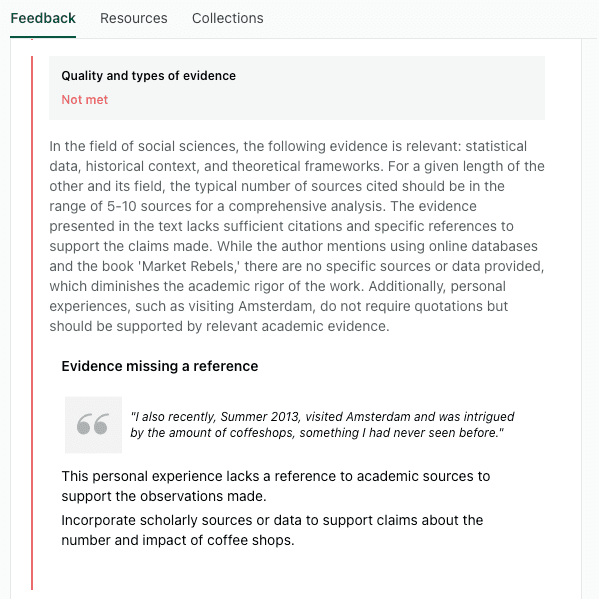
In thesify’s pre-submission review, the evidence panel explains why a claim is not sufficiently supported and highlights specific passages that need academic references.
To arrange a pre‑submission review, identify suitable reviewers who are not co‑authors, provide them with a clear deadline, and specify the type of feedback you need. Early‑career researchers may hesitate to ask busy colleagues for help, but doing so can improve the manuscript’s quality and reduce the burden on journal reviewers.
How the Journal Peer Review Process Works for Your Article
Once you submit your manuscript to a journal, it enters the formal peer review process. The International Committee of Medical Journal Editors defines peer review as the critical assessment of manuscripts by experts who are not part of the editorial staff, describing it as an extension of the scientific process.
Peer review facilitates a fair hearing for your work and helps editors decide which manuscripts are suitable for publication. The process also helps authors improve the quality of reporting by providing constructive feedback.
Peer review typically follows these steps:
Editorial screening: An editor checks whether the manuscript fits the journal’s scope and meets basic quality requirements. At this stage, the editor may reject the submission without external review.
Reviewer selection: Editors select independent experts based on subject matter and methodological expertise. Reviewers must keep manuscripts confidential and disclose any conflicts of interest.
Review and reports: Reviewers evaluate the study’s design, methodology, analysis, originality, ethical compliance, and relevance. They provide reports recommending acceptance, revision, or rejection.
Editorial decision: The editor considers reviewers’ reports along with journal priorities and may request revisions or reject the manuscript outright. Even favourable reviews do not guarantee acceptance.
Types of Journal Peer Review Models
There are several peer review models. Taylor & Francis describes peer review as an independent assessment of a paper’s quality and suitability for publication and notes that at its best it is a collaborative process where authors engage in dialogue with peers to refine their work.
The most common peer review models include:
Single‑anonymized (single‑blind): Reviewers know the author’s identity, but authors do not know who reviews their work. This model is typical in science and medicine.
Double‑anonymized (double‑blind): Neither authors nor reviewers know each other’s identities, which helps reduce bias.
Open peer review: Reviewer and author identities are known to each other; comments may be published alongside the article.
Post‑publication and transparent peer review: Additional comments and revisions can occur after the article is published or reviewer reports are published with the final article.
While peer review upholds scholarly standards and offers valuable feedback, it is subject to delays, workload pressures and variability. Journals may differ in the number and type of reviewers they engage and the transparency of their processes. Authors should always check the peer‑review policy of their chosen journal and be prepared for revision cycles.
Pre-Submission Review vs Peer Review: Key Differences
The following table summarizes the main differences between pre‑submission review and journal peer review. It uses short phrases to allow quick comparison.
Aspect | Pre‑Submission Review | Peer Review (Journal) |
Purpose/Goal | Improve clarity, structure, narrative flow, and overall presentation; identify flaws; prepare for submission and funding success. | Evaluate scientific rigor, originality, validity and suitability for publication. |
Timing | Before submitting to a journal or funder; can include concept reviews months ahead and full reviews weeks before submission. | After submission, during the journal’s editorial process. |
Who performs the review | Chosen by the author: supervisors, colleagues, internal review committees, professional editors, or AI‑supported tools. | Selected by journal editors: independent experts with relevant subject and methodological expertise. |
Criteria/Focus | Readability, logical flow, consistency, ethical statements, completeness and journal fit; may also assess study design and methodology when simulated by subject matter experts. | Study design, methodology, statistical soundness, originality, significance, ethics and adherence to journal standards. |
Depth of evaluation | Can range from high‑level stylistic feedback to simulated peer review; feedback is advisory and non‑binding. | Rigorous assessment of scientific merit; outcomes influence acceptance or rejection; comments must be addressed to progress. |
Use of feedback | Authors decide which suggestions to implement; feedback intended to strengthen the manuscript before submission. | Authors must respond to reviewer comments; failure to satisfy concerns can lead to rejection or further rounds of review. |
Power dynamics | Reviewers have no authority to accept or reject; authors retain full control. | Reviewers and editors influence publication decisions; editorial power rests with journal. |
Outcome | Improved manuscript quality, potentially higher acceptance or funding success, shorter formal review times. | Decision to accept, revise or reject; publication in a peer‑reviewed journal. |
When to Use Pre-Submission Review vs Peer Review
Key takeaways:
Pre‑submission review is an author‑driven process aimed at improving a manuscript before it enters the formal publication pipeline.
Peer review is an editor‑driven process that determines whether a manuscript meets the standards for publication.
Combining both reviews strategically can reduce delays and increase the likelihood of acceptance.
AI Tools for Manuscript Review: Pre-Submission vs Peer Review
AI tools are increasingly marketed as “AI peer review” or “AI reviewer” for manuscripts. In practice, most of these systems operate at the pre-submission stage and carry out a different kind of work than journal peer review. If you want a clear “pre-submission review vs peer review” boundary, it helps to place AI in the right part of your workflow.
For more information on how to distinguish what makes an AI tool “actually academic” vs what is just marketed as one, check out AI Tools for Academic Research: Criteria to Identify Academic-Grade Tools.
Many author-facing tools now offer structured reviews of drafts before submission. They highlight missing sections, unclear arguments, potential reporting issues, or weak presentation of results. Some services price each “AI peer review” as a standalone product and provide several hundred words of comments that look similar to human reviewer reports.
Although the branding suggests peer review, these systems are best understood as pre-submission review tools. They are author-controlled, advisory, and focused on helping you revise before your work reaches a journal decision stage.
Publishers are also experimenting with AI on their side of the process. Large journal groups use algorithms to suggest potential reviewers or flag manuscripts that may fall outside a journal’s scope or raise integrity concerns. These tools support editors but do not replace the role of human reviewers. The final assessment of scientific merit, originality, and suitability for publication remains the responsibility of human editors and peer reviewers.
Policy bodies and editorial organizations have started to draw lines around AI use. They emphasize that tools cannot be credited as authors, that authors and reviewers should disclose their use of AI, and that reviewers should not use generative AI systems to write confidential reports. The shared message is that AI can support parts of the workflow, but the core judgment in peer review is still human.
Differences Between AI Tools for Pre‑Submission and Peer Review
This distinction becomes clearer if you separate AI tools into three groups:
Author-Facing AI Tools for Pre-Submission Review
These tools read your draft before submission, highlight structural and reporting issues, and sometimes organize feedback into sections such as “major” and “minor” comments. They help you revise but do not make any publication decisions.
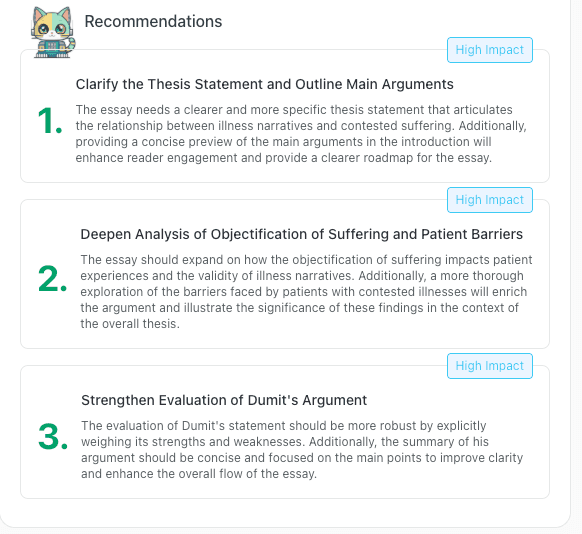
thesify’s recommendations view groups high-impact pre-submission suggestions into clear action points so you can revise your thesis, analysis, and evaluation before journal peer review.
This is the space where thesify sits: as an AI-supported pre-submission review that helps you improve structure, clarity, and alignment with common expectations while you retain full responsibility for the content.
Editor-Facing AI Tools in Peer Review Workflows
These systems sit on the publisher side. They suggest possible reviewers, screen for scope or basic quality issues, or flag potential problems to editors. They may speed up parts of the editorial process, but the journal still relies on human reviewers and editors to decide whether a manuscript is accepted.
It’s important to note cases such as the DOAJ’s rejection of an application that used a proprietary AI algorithm to select peer reviewers because it lacked transparency and human oversight, underscoring the need for clear AI policies and human judgement.
What Peer Reviewers Evaluate in Your Article
Peer review itself is the independent assessment carried out by human experts selected by the journal. Reviewers evaluate originality, methodological rigor, ethics, and contribution to the field and provide reports that inform editorial decisions. Even when reviewers consult AI tools, they are accountable for the content of their reports and for maintaining confidentiality.
What does this mean for pre‑submission tools?
From an author’s perspective, the key point is that AI-supported pre-submission tools, including thesify, help you prepare for peer review rather than replace it. A tool that reads your draft, flags missing components, or suggests clearer phrasing is performing a pre-submission review. It does not simulate the independence, responsibility, or authority of journal peer review.
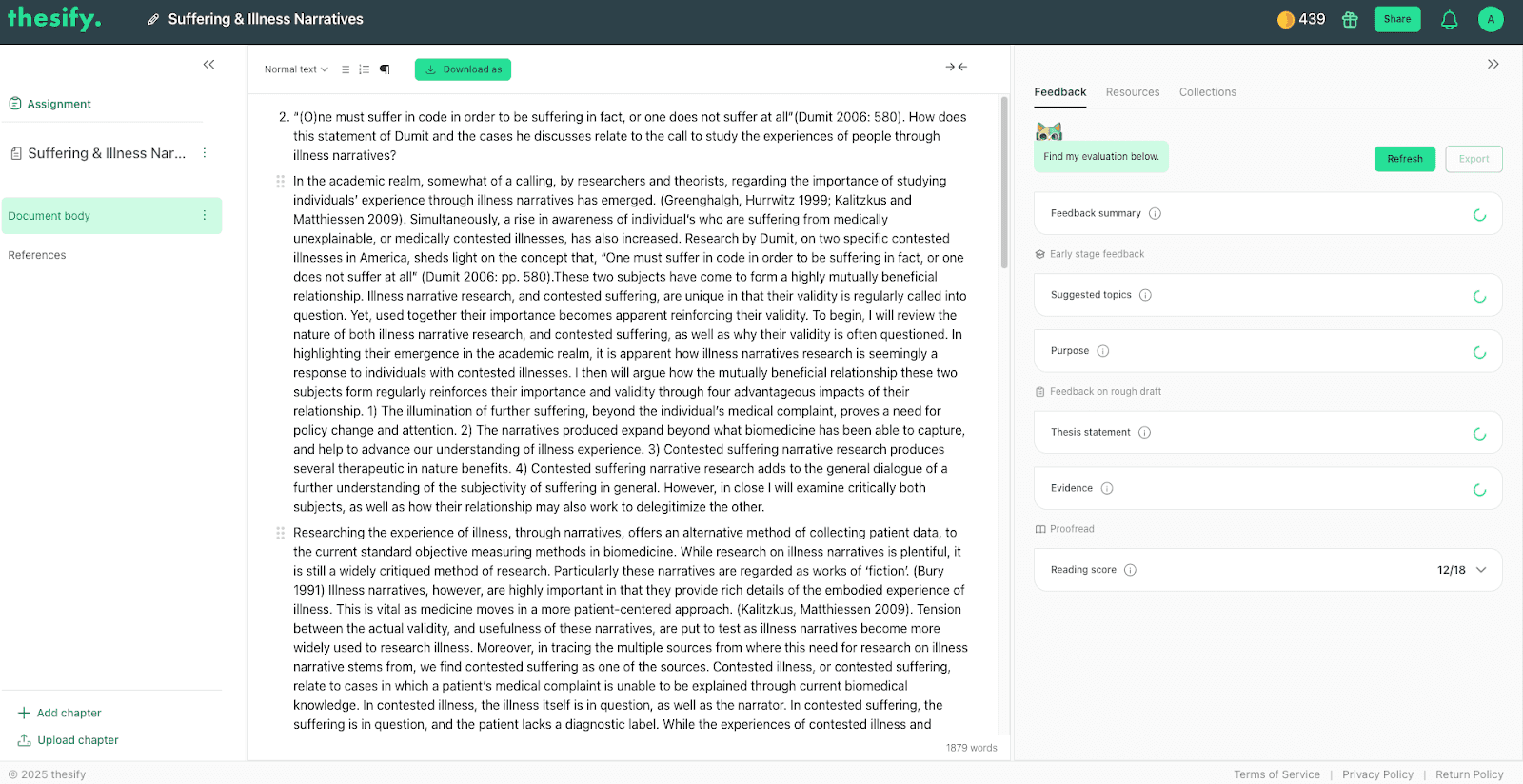
In thesify’s manuscript workspace, you can view your draft alongside structured pre-submission feedback on purpose, thesis statement, evidence, and readability before submitting the work for journal peer review.
When you use AI for pre-submission review, it helps to follow a few ethical AI-use conventions:
Be transparent. If journal guidelines ask about AI use, briefly note that you used an AI tool for structure or language checking and describe its role in one or two sentences.
Keep AI in the right stage. Treat AI feedback as part of your pre-submission review, alongside comments from supervisors, co-authors, or writing groups. Do not present automated checks as evidence that your work has already been peer reviewed.
Verify suggestions. Check every substantive recommendation against your data, methods, and interpretations. If a suggested change affects your analysis or conclusions, make sure it is correct before you adopt it.
Protect confidentiality. Avoid uploading identifiable participant data or unpublished sensitive material to tools that do not offer clear confidentiality guarantees.
Follow journal policies. Many publishers now ask authors and reviewers to disclose AI use and to confirm that AI systems are not listed as authors or credited with responsibility for the work.
For more information check out: AI Policies in Academic Publishing 2025: Guide & Checklist
Used this way, AI-supported pre-submission review tools like thesify sit where they belong: in the early, author-controlled part of the process. They help you arrive at formal peer review with a clearer, more coherent manuscript, while keeping the later, high-stakes evaluation firmly in human hands.
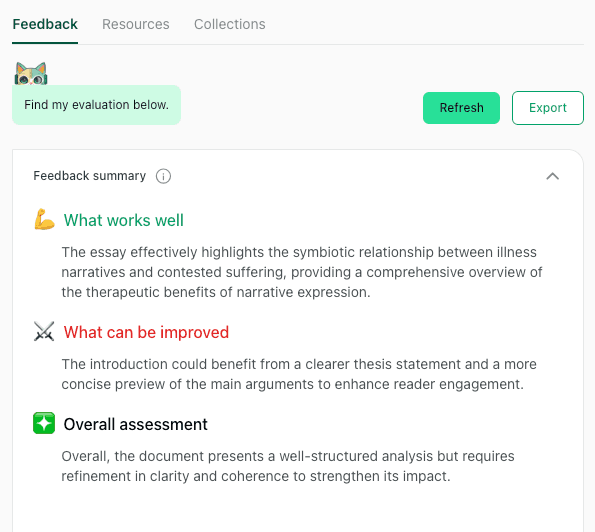
thesify’s feedback summary groups pre-submission comments into what works well, what can be improved, and an overall assessment so you can quickly see the state of your draft before peer review.
Conclusion: Planning Your Pre-Submission and Peer Review Strategy
Pre‑submission review and journal peer review are complementary rather than competing processes. Pre‑submission review gives you a chance to catch structural issues, clarify arguments, and receive constructive feedback before your work enters the formal publication pipeline.
Peer review is the independent, confidential evaluation that determines whether your work is suitable for publication.
The key differences lie in purpose, timing, authority and consequences. Choosing the right type of review at the right time can save you months of revision and increase your chances of success.
As you plan your writing process, seek pre‑submission feedback from mentors, colleagues, internal programmes, or AI‑supported tools such as thesify. These early checks can reduce the burden on journal reviewers and help you submit a polished manuscript.
Once you submit, prepare for peer review by selecting an appropriate journal, responding thoughtfully to reviewer comments, and remaining transparent about any AI tools used. By understanding the distinct roles of pre‑submission review and peer review, you can navigate the publication process more strategically and effectively.
Run a Pre-Submission Review with thesify
If you want to see how a structured pre-submission review works in practice, you can sign up for thesify with a free account and run a review on your next manuscript. Import your draft to thesify, review Theo’s comments section by section, and turn them into a concrete revision plan before you submit.
Related Posts
Mastering the Peer Review Process: This article is your guide to navigating the peer review process as an author from handling reviewer feedback to avoiding rejection. We’ll walk you through a peer review example and peer review process steps. We also cover basic definitions and types of peer review. Learn how as an author you can prepare for and succeed in peer review. Plus, learn more about the role of AI in peer review and how this ties into practical writing advice for authors. Find out more about ethical AI-assisted preparation for peer review.
Chat with Theo: A New Way to Turn Feedback into Revision: Chat with Theo turns feedback into an actionable revision plan. Learn how this academic AI chat feature guides you to improve your draft ethically and effectively. In this post you’ll learn how to go from an AI-generated feedback report to a step-by-step revision plan that emphasizes academic integrity and a feedback-driven workflow. Learn how structured revision (like prioritizing feedback, planning changes), rather than AI writing text for you, is a smarter way to work with AI. We’ll give you examples of Theo in action: analyzing a draft’s weak argument and suggesting improvements and converting feedback into a to-do list. You’ll learn how to ask Theo about your manuscript’s structure and turn these comments into revisions, differentiating Theo from generic “chat with PDF” tools.
Downloadable AI Feedback Reports for Manuscripts: Shareable PDF Guide: Learn how thesify’s downloadable feedback report turns AI writing suggestions into a shareable PDF. Step‑by‑step guide for researchers and students. In this article we’ll walk you through how to get manuscript feedback before submission, how to use thesify’s AI pre-submission check, and how to share AI peer review notes with supervisors. In a research environment where collaboration, transparency and academic integrity matter, a portable PDF of your AI feedback offers practical advantages.