How to Weigh the Strengths and Weaknesses of an Academic Argument

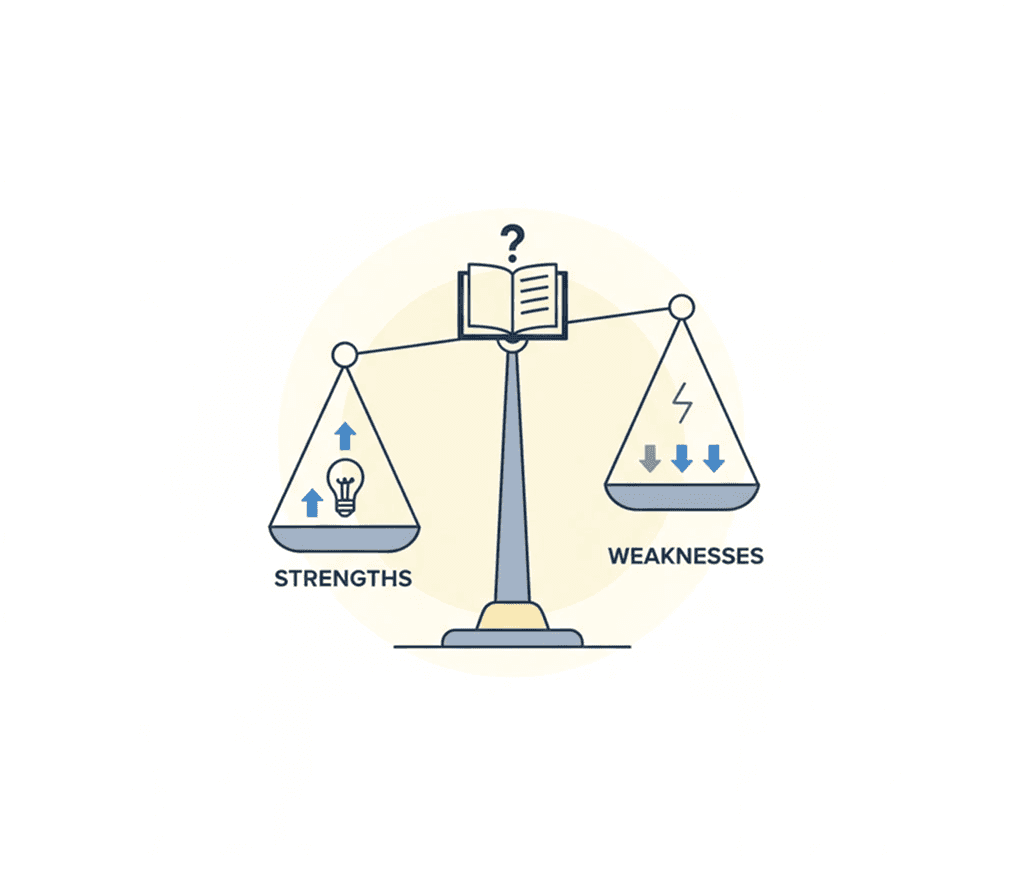
Writers often identify strengths and weaknesses in an academic argument without evaluating what those points mean for the final judgment. A source may present credible evidence and acknowledge limitations, yet leave the core question unresolved: how convincing is the argument overall?
Analytical weighing resolves that ambiguity. It requires a writer to judge which strengths materially support the claim, which limitations narrow it, and whether those flaws qualify the conclusion or weaken it more substantially. This guide offers a structured method for reaching and expressing that judgment in research writing.

What Is Analytical Weighing?
Analytical weighing is the structured evaluation of a single argument, claim, or theoretical position. It determines how much interpretive weight available evidence can bear once strengths and limitations are considered together. Rather than producing a neutral inventory of features, the goal is to reach a justified judgment regarding the claim’s credibility in context.
The key question is significance. Some strengths materially support the argument’s credibility, while others are relevant but limited. Some weaknesses qualify the claim, while others weaken it substantially. Analytical weighing makes those distinctions explicit so that the final judgment follows from the evidence.
Descriptive vs Analytical Writing: Why Listing Strengths and Weaknesses Does Not Count as Evaluation
In academic writing, descriptive balance and analytical judgment are not the same thing. A paragraph can identify strengths and weaknesses in an argument accurately, cite relevant evidence, and still leave the central evaluative question unanswered. The missing step is significance: what do those features mean for the credibility of the claim?
That distinction separates descriptive writing from analytical writing. Description records what is present in the evidence. Evaluation determines the significance of what is present. A strong paragraph explains which strengths materially support the claim, which weaknesses narrow its force, and whether those weaknesses qualify the conclusion or substantially weaken it.
This is why a balanced list rarely satisfies higher-level academic expectations on its own. Supervisors, reviewers, and examiners are looking for a reasoned judgment, not an inventory of points. When evidence is introduced into a paragraph, its analytical value depends on the writer’s explanation of why it matters and how much interpretive weight it can bear. The rest of this guide explains how to make that judgment in a structured way.
Example of Weak Evaluative Weighing in Academic Writing
The example below comes from a thesify feedback report on a section of an academic writing draft about the economic success of coffee shops in the Netherlands. The section identifies the topic clearly, presents the explanation coherently, and makes the basic argument legible. thesify flags it because the writer does not evaluate the argument’s internal strengths and weaknesses, so the section stops short of a clear judgment about how convincing the explanation actually is.
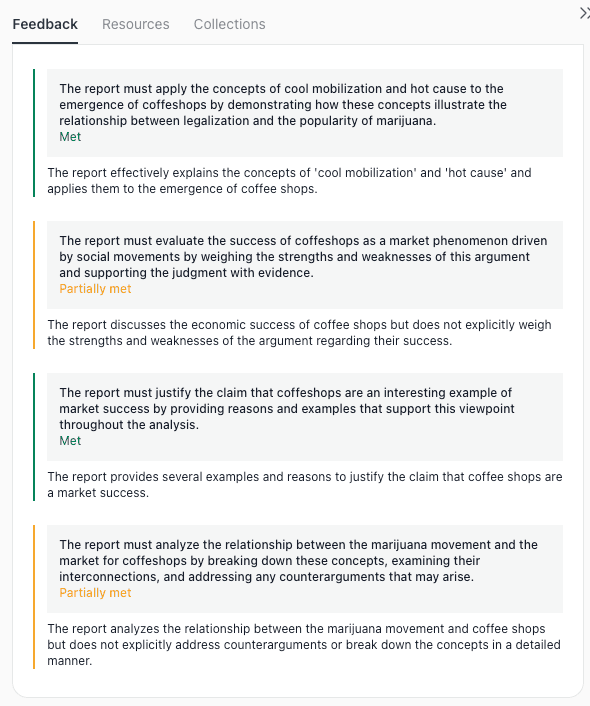
thesify feedback identifying weak evaluative weighing in a section on the economic success of coffee shops.
This feedback identifies a common analytical error. The writer discusses the success of coffee shops, but the paragraph stops at explanation. The section never judges how convincing the argument remains once its evidence and limitations are considered together. The result is descriptive writing without a clear evaluative judgment.
The final feedback block shows the same problem in a second form. The report analyses the relationship between the marijuana movement and the coffee shop market, yet it does not address counterarguments or break the concepts down in a way that sharpens the final conclusion. That is why thesify flags the section as analytically underdeveloped. Although the text contains relevant material, the writer has not adequately weighed it.
A stronger version of the writing would make that weighing explicit. It should identify which evidence most strongly supports the argument, which weaknesses materially affect the claim, and whether those weaknesses merely qualify the conclusion or substantially undermine it. That is the distinction between identifying points and evaluating them.
Criteria for Evaluative Judgment
Clear evaluative judgment depends on criteria. Without them, strengths and weaknesses remain impressions rather than reasons for judgment. The central question is significance:
Which strengths materially support the claim?
Which weaknesses narrow its force?
Which flaws change how convincing the argument remains?
Credibility, relevance, scope, evidential support, conceptual clarity, and engagement with counterarguments all serve as criteria to help determine how far a conclusion can be trusted and defended.
The thesify feedback example from the previous section makes those evaluative criteria visible. In this case, the writer presents a claim about the economic success of coffee shops, offers reasons and examples in support of one part of the argument, and receives a “Met” evaluation there. Elsewhere, however, the draft receives “Partially Met” feedback because the writer discusses the argument without weighing its strengths and weaknesses explicitly and without addressing counterarguments in enough detail. The contrast is useful because it shows that evaluative writing is judged according to specific standards rather than general balance.
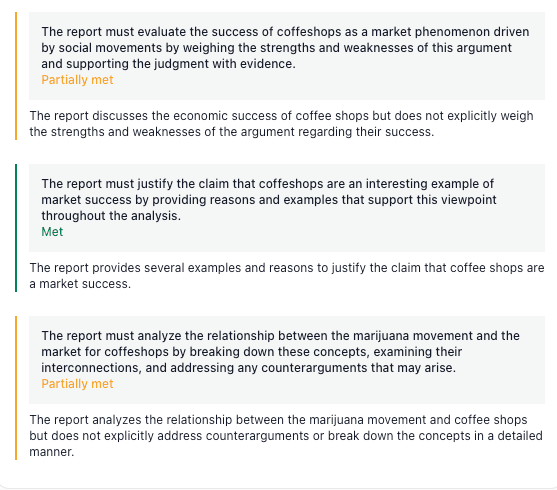
thesify feedback showing how evaluative judgment depends on evidential support, explicit weighing of strengths and weaknesses, and engagement with counterarguments.
The feedback points to the criteria that shape evaluative judgment:
Reasons and examples matter when they support the claim directly.
Weaknesses matter when they affect the argument’s credibility or limit the conclusion’s force.
Counterarguments matter when they test whether the claim can withstand competing explanations.
These are the kinds of questions that turn description into evaluation. The checklist below translates them into a practical framework for judging an academic argument with greater precision.
Weighting Checklist for Strengths and Weaknesses in an Argument
Does this strength directly support the main claim?
A strong point should reinforce the argument’s central reasoning, evidence, or explanatory force. If a strength sits at the margins of the discussion, it should carry less weight in your final judgment.
How relevant is the evidence to the argument being made?
Evidence may be credible without being closely tied to the claim under discussion. Its weight depends on whether it actually supports the argument’s central point rather than a related but less important issue.
Does the scope of the evidence match the scope of the conclusion?
Broad claims require support that is broad enough to justify them. When an argument moves from limited evidence to an expansive conclusion, that gap should weigh against its overall credibility.
How credible is the support the argument relies on?
Consider the quality of the data, the authority of the sources, the recency of the evidence, and the reliability of the reasoning. Strong support increases the argument’s force only when it is both trustworthy and well used.
How serious is the weakness?
Some weaknesses function as caveats. Others alter how convincing the argument remains. The key question is whether the flaw narrows the claim modestly or weakens it in a way that changes your overall judgment.
Does the weakness affect the core reasoning or a secondary point?
A weakness in the argument’s central logic should count more heavily than a weakness in a minor example, side point, or illustrative detail. Not every flaw deserves equal analytical weight.
Does the argument depend on assumptions that remain underexamined?
Some claims appear persuasive until their underlying assumptions are made visible. If the conclusion only holds under narrow conditions, those conditions need to be factored into your evaluation.
Are counterarguments addressed clearly and seriously?
A persuasive argument shows that plausible objections have been considered and judged. When counterarguments are ignored, dismissed too quickly, or left underdeveloped, the final claim becomes less secure.
How much uncertainty remains around the claim?
Uncertainty does not automatically invalidate an argument, but it does affect how strongly the conclusion can be stated. A careful evaluation should reflect whether the evidence supports a firm conclusion or a more qualified one.
Do the strongest points outweigh the most serious weaknesses?
This is where analytical weighing becomes explicit. A single major weakness may matter more than several minor strengths, while a strong evidential base may still support a claim that is presented with appropriate qualifications.
What final judgment follows from this weighing process?
Your conclusion should state what the argument’s strengths and weaknesses amount to overall. It should be clear whether the claim is persuasive, persuasive with important qualifications, limited in scope, or substantially weakened by its flaws.
A useful final step is to label each point as a major strength, minor strength, minor weakness, or major weakness before writing your overall judgment.
How to Signal Evaluative Judgment in Academic Writing
Analytical weighing should be visible in your prose. A reader should be able to see which strength materially supports the claim, which weakness narrows or weakens it, and what final judgment follows from that weighing. This is often where a paragraph loses force. The evidence may be present, the limitation may be mentioned, yet the writing never makes the evaluative logic explicit.
The thesify recommendation below illustrates that problem clearly. The feedback does not suggest that the section lacks material or misunderstands Dumit’s (2006) argument. It identifies the precise writing weakness: the evaluation needs to be strengthened by explicitly weighing the argument’s strengths and weaknesses. In other words, the paragraph discusses the argument, but the prose does not yet show which points carry the most analytical weight or how they shape the final conclusion.
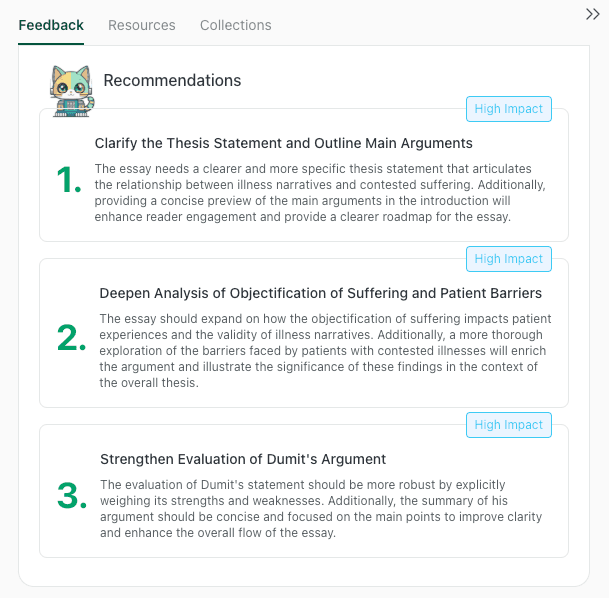
thesify feedback showing that evaluative writing requires explicit weighing of an argument’s strengths and weaknesses.
The judgment has to be visible in the paragraph itself. The wording of the paragraph has to show whether a strength is significant but limited, whether a weakness materially affects the claim, and whether the conclusion remains persuasive once those points are judged together. The templates below help make that logic explicit.
Sentence Templates for Evaluating Strengths and Weaknesses
When a Strength Is Persuasive but Limited
Use these when part of the argument is convincing, but its force is narrowed by a specific limitation.
The argument is persuasive in its account of [X], but its force is limited by [Y].
[Strength] supports the claim effectively, particularly in relation to [X], although [weakness] narrows the conclusion’s scope.
The article offers a credible explanation of [X], yet the absence of [Y] makes the conclusion more qualified than the author suggests.
When a Weakness Changes the Conclusion
Use these when a limitation affects the main claim rather than a secondary point.
Although the argument is supported by [strength], [weakness] materially weakens the claim because [reason].
The central problem lies in [weakness], which limits the argument’s credibility more than [strength] can offset.
[Strength] remains relevant, but it does not resolve the more serious issue of [weakness].
When Counterarguments Affect the Evaluation
Use these when the argument leaves an important objection, alternative explanation, or assumption underdeveloped.
The argument identifies [X] clearly, but its treatment of [counterargument] remains limited.
This weakens the claim because the conclusion depends on [unstated assumption or unresolved objection].
Without a fuller account of [counterargument], the argument remains less convincing than it initially appears.
When Stating the Final Judgment
Use these at the end of a paragraph or section to make the evaluative conclusion explicit.
Taken together, these strengths support a qualified version of the claim rather than the broader conclusion presented.
On balance, the argument remains persuasive, but only within the narrower scope defined by [limitation].
Overall, the argument is weakened by [major flaw], which significantly limits the force of its conclusion.
The claim remains useful as an account of [X], though not as a fully convincing explanation of [Y].
Worked Example: Evaluating an Academic Argument
This method becomes clearer in practice. Consider a researcher evaluating Dumit’s (2006) claim about “suffering in code,” the idea that medical and legal categories shape how illness is interpreted, recorded, and managed.
The thesify feedback below captures the distinction between explanation and evaluation.
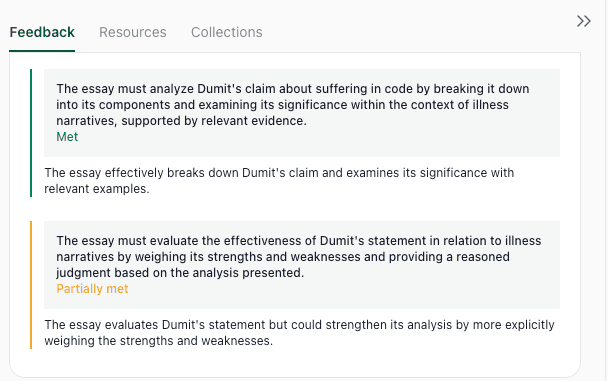
thesify feedback illustrating a common evaluative problem in academic writing: the argument is explained clearly, but its strengths and weaknesses are not weighed explicitly enough.
In this case, the writer successfully breaks down the components of Dumit’s claim and examines its significance. The evaluative task remains less developed because the section does not yet weigh the argument’s strengths and weaknesses clearly enough to support a reasoned judgment.
Applying the Weighting Checklist
Using the checklist from the previous section, the researcher can turn this feedback into a clearer evaluation of Dumit’s (2006) argument.
How directly does the strength support the main claim?
A major strength of Dumit’s argument is conceptual clarity. The framework gives the researcher a precise way to explain how institutions translate subjective suffering into administrative or medical categories. That strength supports the claim directly because it clarifies the argument’s central mechanism.
How serious is the main weakness?
The main weakness is scope. Dumit’s argument foregrounds institutional coding so strongly that patient agency receives less attention. This is not a minor caveat. It matters because it narrows how convincing the framework remains when the analysis shifts from institutional logic to lived experience.
Does the weakness affect the core reasoning or a secondary point?
It affects the core reasoning. If the claim is that suffering is shaped through coding practices, then limited attention to resistance, reinterpretation, or agency changes how complete that explanation appears.
What final judgment follows once the strengths and weaknesses are weighed together?
The framework remains persuasive as an account of institutional objectification, but less persuasive as a full explanation of illness narratives in practice. Its main strength carries substantial weight, but the limitation materially narrows the conclusion.
Rewriting the Evaluation in Prose
A paragraph that reflects this weighing more clearly might read as follows:
Dumit’s account of “suffering in code” offers a credible explanation of how illness becomes institutionally legible, particularly in contexts where medical and legal systems translate subjective experience into formal categories. This conceptual clarity is a major strength of the argument because it helps explain how suffering is organized and managed within institutional settings. At the same time, the framework gives less attention to patient agency and to the ways individuals resist, reinterpret, or exceed those categories in practice. That limitation narrows the argument’s explanatory force. Overall, Dumit’s claim is persuasive as an account of institutional logic, though less convincing as a complete explanation of contested illness experience.
Comparative Analysis vs Evaluation: When to Compare and When to Weigh
Understanding the distinction between comparative analysis and evaluation matters because the two tasks require different forms of reasoning. Although these terms are often used interchangeably in casual academic advice, they do not ask the same question.
Comparative analysis is a cross-case exercise. It places two or more competing theories, policies, or frameworks against a shared set of criteria in order to justify a choice. If your research objective is to determine whether Policy A is more effective than Policy B, then a framework like Comparative Analysis in Research: Matrix Framework is the appropriate method.
Analytical weighing, by contrast, focuses on one position at a time. It judges the credibility of a single argument by weighing its evidence against its limitations. As the thesify recommendations below show, a research task may focus entirely on how robust and relevant one theoretical framework is for a specific case.
Evaluating One Framework: The Rao Example
The thesify feedback below illustrates an evaluative task. Here, the writer is asked to provide a more thorough analysis of the factors contributing to the thriving black market and to evaluate the relevance of Hayagreeva Rao’s (2009) concepts. The task is to judge how well one theoretical position explains a specific phenomenon, where its explanatory strength lies, and where its limitations begin to narrow the conclusion.
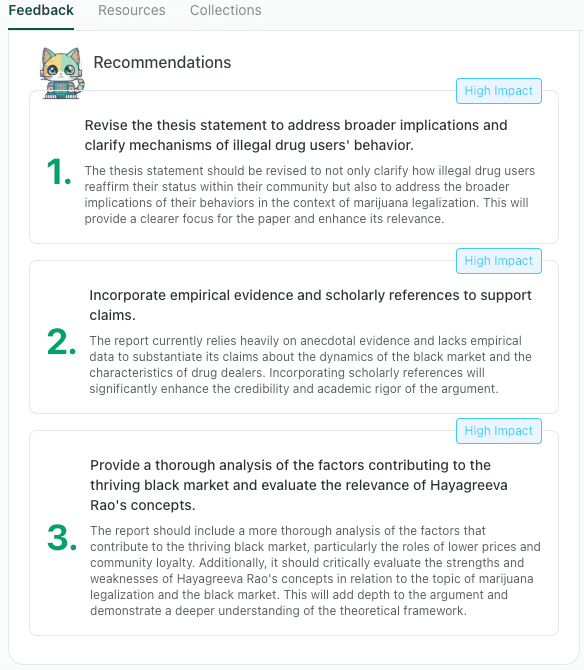
thesify feedback illustrating an evaluative task: the writer must judge how well one theoretical framework explains a specific phenomenon.
In this case, analytical weighing would ask questions such as these:
Does Rao’s framework explain the role of community loyalty in sustaining the black market, and how much explanatory weight should that strength carry?
Do lower prices and other market dynamics expose a limitation in the framework by pointing to factors Rao’s concepts do not adequately capture?
Those are evaluative questions because they test how far one theory can explain the case before its limitations begin to narrow the conclusion.
When the Task Becomes Comparative Analysis
The next piece of feedback, taken from a separate academic paper, demonstrates a comparative task. In the same thesify feedback set, the writer is asked to compare the outcomes of different randomized controlled trials by showing similarities and differences in their results and methodologies. That is a comparative analysis task because multiple studies are being assessed against shared dimensions. In the final feedback block, however, the writer is asked to evaluate the effectiveness of governmental and non-governmental interventions by weighing their pros and cons and supporting the judgment with evidence from the literature. That is an evaluative task.
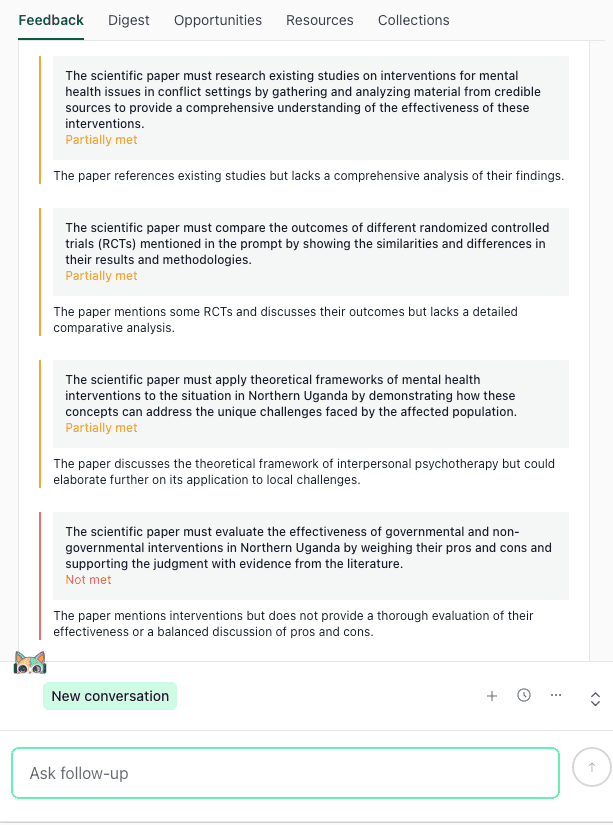
thesify feedback showing the difference between comparative analysis and evaluation in academic writing.
This contrast makes the distinction easier to see. Comparative analysis is required if your research question entails assessing several options against the same criteria. Evaluation is required when your task is to judge the strength, relevance, or limitations of one position. If your writing involves comparing competing studies, theories, or frameworks systematically, use a comparative analysis matrix. If it asks you to judge how much weight a single argument can bear, analytical weighing is the more appropriate approach.
FAQs About Evaluating Strengths and Weaknesses in Academic Arguments
How do you evaluate strengths and weaknesses in an academic argument?
Start by identifying which strengths directly support the main claim and which weaknesses materially affect it. Then judge the significance of each point. A strong evaluation explains whether a limitation qualifies the conclusion, narrows its scope, or weakens it more substantially.
What is analytical weighing in academic writing?
Analytical weighing is the process of judging how much evidential and explanatory weight an argument can bear once its strengths and weaknesses are considered together. It produces a reasoned judgment about how convincing the claim is, rather than a neutral list of positive and negative features.
Why is listing strengths and weaknesses not enough?
A list of strengths and weaknesses describes what is present in the argument, but it does not explain what those points mean for the final judgment. Evaluation requires you to determine which points matter most, how they affect the claim, and what conclusion follows from that weighing process.
What makes a weakness major rather than minor?
A weakness becomes major when it affects the core reasoning, credibility, scope, or explanatory force of the argument. Minor weaknesses may qualify the conclusion or limit one aspect of it, while major weaknesses can change how convincing the argument remains overall.
How do you write a final evaluative judgment?
A final evaluative judgment should state what the strengths and weaknesses amount to overall. It should make clear whether the argument is persuasive, persuasive with qualifications, limited in scope, or substantially weakened by its flaws.
What is the difference between evaluation and comparative analysis?
Evaluation judges the strength, relevance, and limitations of one position. Comparative analysis assesses two or more theories, studies, or frameworks against shared criteria in order to justify a choice. If your task is to weigh one argument, evaluation is the better fit. If your task is to compare several options systematically, use a comparative analysis matrix.
How can I make my evaluation sound more analytical?
Use language that makes the weighing explicit. Show which strength materially supports the claim, which weakness narrows its force, and how those points shape the final conclusion. Analytical writing makes the logic of the judgment visible in the prose.
Get Feedback on Your Evaluative Writing
Ready to test your own draft? Try thesify for free and review where your writing identifies strengths and weaknesses without fully weighing them. The feedback can help you strengthen evaluation, sharpen counterarguments, and clarify the judgment your paragraph is actually making.
Related Posts
How to Fix Weak Analysis Patterns in Academic Writing (And Move Beyond Description): Most writing guides do a great job explaining the theory of analysis but fail to provide academic writers with a reliable way to objectively spot their own weaknesses. Improve analytical writing with our revision guide that helps you diagnose and fix weak analysis patterns using concrete examples and revision steps. Identify weak analysis, compare strong vs weak examples and use thesify’s feedback tips to sharpen your essays.
Comparative Analysis in Research: A Framework for Methodologies & Approaches: Comparative analysis in research is a criteria-based evaluation of two or more methods, approaches, theories, or technologies. Instead of summarising sources in parallel, you assess each option against shared standards, make assumptions and boundary conditions explicit, and produce a context-scoped judgement about methodological fit. Build a comparative matrix to evaluate research methods, technologies, and theories, then write a context-based verdict that fits your research constraints.
How to Fix Weak Evidence in Essays: A Guide for Academic Writers: Struggling with how to use evidence in your essays? This guide shows how to fix weak arguments, cite sources correctly, and align evidence with your thesis — using tips based on writing AI feedback. Learn common signs your evidence isn’t working, what strong evidence looks like in academic writing (with examples), and how to use essay improver feedback tools to spot missing citations or gaps.