Academic Writing in the Age of AI: How to Rise Above the slop

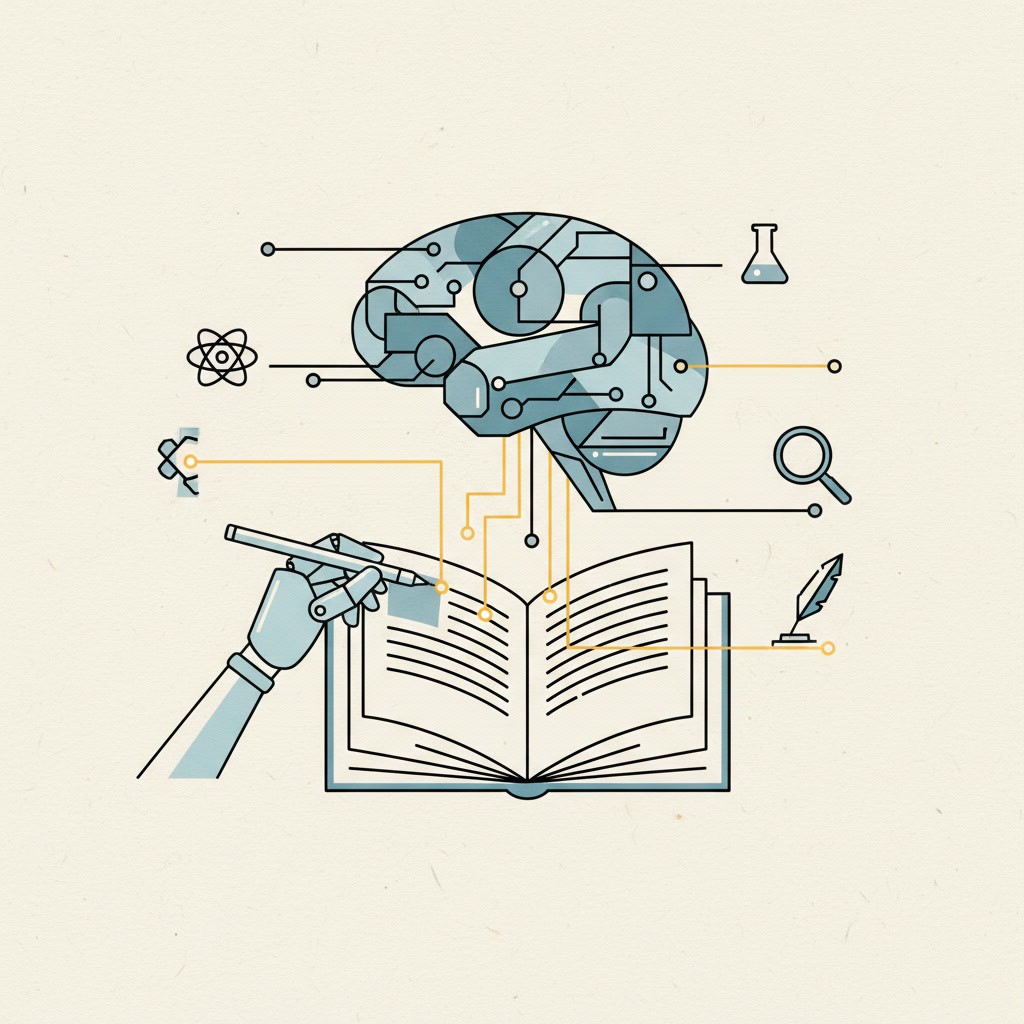
This article is the second instalment in thesify’s series on scientific writing in the age of AI. If you have not read Part One yet, start here: How to Write a Scientific Paper in 2025: Ideas First.
Part One focuses on getting to strong ideas first. This post focuses on what happens next in an AI-saturated writing environment: how to avoid AI slop and still write in a way that gets read, understood, and supported.
What You’ll Learn About Academic Writing With AI
In an AI-saturated literature landscape, polished AI prose often reads as generic, so you need a stronger human narrative to stand out.
Use generative AI as a drafting partner for structure, counterarguments, and clarity, then rewrite in your own voice until you fully own the text.
The parts readers see first, your title, abstract, and introduction, deserve extra iterations because they determine whether your work gets read and recommended.
Why AI Slop Hurts Academic Writing Quality
This section explains why generic AI-generated prose is easier to spot now, and why that matters for publishing and evaluation.

Why AI-Generated Prose Now Reads as Generic
AI is no excuse to be lazy, everybody has it now. After ChatGPT launched in November 2022, there was a short period when AI could save you a lot of time. You could generate a draft, clean it up superficially and get away with it. It was the superpower of a few.
But these days are over. The internet, and even scientific journals, are full of AI slop, and most people have learned to recognize AI-generated texts. So even if the AI-generated text is correct and well written, it still reads like AI. According to a 2025 study, this can signal that you did not put in the work.
But should you be bothered at all? If AI can write, review and read papers, why should you not hand your writing chores over to an AI bot?
Why This Affects Publishing, Hiring, and Funding
The reality is that even in the age of AI your PhD, your faculty position, and your funding depend on the right people reading, understanding, and supporting your ideas. Your publication record isn’t just a trophy list; it is your academic identity.
When you apply for a position, the committee members will check out your papers to judge whether you are a scientist worth having in the faculty. And if you are applying for funding, your publication record will be compared to that of your competition to decide if your research and ideas are worth investing in.
None of this has changed with the advent of AI. What has changed is the volume of papers published and their general language quality. Both have increased noticeably. However, AI has at the same time lowered the quality of the content. With AI everyone can crank out lots of manuscripts in a short time, and too many are yielding to the temptation.
In this cacophony of AI-generated slop it becomes increasingly hard to get noticed. The polished writing of AI becomes the new mediocrity. So, the question is not whether to publish. The question is how to publish something that stands out from the noise and gets noticed. How to craft papers that inspire and draw the reader in?
How Careful AI Use Helps You Stand Out
When everyone uses the same tools carelessly, careful use will allow you to craft manuscripts with your genuine thoughts, ideas, and voice that stand out.
This does not mean that you cannot use AI to speed up writing. It just means that you must be more strategic about what you use AI for, and that you must continue working on your text when others would stop.
For a practical paper structure refresher, see How to Structure a Scientific Research Paper: IMRaD Format Guide.
Co-Writing With Generative AI Without Losing Your Voice
This section shows how to use generative AI for drafting and revision while keeping ownership of your argument and voice.
What to Use Generative AI For (and What Not to Outsource)
If you want to succeed as an academic in the era of AI you must learn to use AI as a tool to do more, not as a shortcut to do less. If AI lets you generate text quickly, do not stop at version one. Use the extra time to revise or even rewrite your paper over and over until it is perfect. Use it to review each version and revise with the feedback that it gives you.
thesify offers an excellent pre-submission review that delivers extensive feedback on all aspects of your manuscript, including figures and tables.
Use AI to extend your capabilities, to explore interpretations of your research you might not have considered, to find clearer explanations for complex ideas, or to explore different ways to structure an argument. The writing itself remains yours because you control every step of it.
A Practical Workflow for Drafting and Revision
A practical workflow:
Prepare your context carefully. Before asking AI to help with any section, you prepare the relevant background: notes, data, your tentative argument, the specific challenges you are facing, and the instructions for the type of manuscript you need to prepare (paper, conference proceedings, etc.).
Let AI generate an outline for your manuscript, including a few bullet points that summarize the content of each section. Then revise the outline until you are happy.
Now it is time to work on each section. For example, search for the best framing for your research and for your target journal or conference. You might ask AI for multiple ways to open a section, or for counterarguments to your thesis statement, or for simpler explanations of a technical concept. You treat the output as input to your thinking.
Revise and rewrite. Whatever AI produces, rewrite it in your own voice. Choose what to keep, what to discard, and what to rephrase. Read every sentence and ask whether it says what you mean.
Iterate until you own it. Though the final text might include formulations that originated with AI, you have reviewed every word and every sentence. The argument is yours. The narrative is yours. The responsibility is yours.
For additional guidance on responsible AI use while writing, see 9 Tips for Using AI for Academic Writing (without cheating).
How to Use AI to Avoid Generic Introductions
This section explains how AI can help you identify generic framing, so you can write a more distinctive title, abstract, and introduction.
Use AI to Surface the Obvious First
People remember what is new and original. If you want your paper to be remembered, it must be new and original, too, particularly the parts that readers will encounter first. These are title, abstract and introduction.
Pixar, the animation studio, has a creative process worth borrowing: in early development, they deliberately generate obvious ideas first, the clichés, the expected beats, the paths of least resistance. Not because they will use them, but because by exhausting the obvious you can discover what is original.
And as it happens, AI is exceptionally good at telling you the obvious because that is exactly what it is trained to do, it produces the most statistically likely text. It makes AI tremendously useful for discovering what not to write.
Vary Prompts to Find What Is Distinctive
For example, prepare a bullet list that summarizes the core of your research. Then let the model of your choice write an introduction section. Read it carefully. What you are reading is the most generic way to introduce your research.
Now vary the prompt, for example by providing some more background information or by proposing how the research should be framed (see below), and try again. Again, read it carefully. Notice what they have in common and where they differ.
Repeat this a few times and you will get a good idea about what is original and what is cliché or fluff. That is the time when you can write your version. Mix and match phrases from the different versions. There is no harm in that. Finally, you will have a text that is original and truly yours.
Write Past the Obvious and Claim Your Voice
So, use AI to see the obvious. Then write past it. To learn more about how to maintain your academic voice in the AI era, you can watch thesify’s interview, Inside the Mind of a Professor: How AI Is Changing Academia and What They Want You to Know. We also recommend reading How to Preserve Your Academic Voice While Using AI Writing Tools.
How to Frame Your Research With AI (Title, Abstract, Introduction)
This section focuses on using AI to test framing, audience, and narrative, especially in the parts that determine whether your paper gets read.
Questions to Ask AI About Framing and Audience
In 1914, Francis Darwin, the son of Charles Darwin, observed that “in science the credit goes to the man who convinces the world, not to whom the idea first occurred”. This is the ultimate goal of scientific writing: to convince the world, and to do this, your research needs a narrative that lets the reader see the importance of your research and the impact it will have beyond its field.
AI can help you find that narrative. Not by writing it for you, but by helping you discover it. Show the AI your draft and then ask:
What are the three best ways to frame your research? What would a skeptic say, and how would you respond?
Beyond your immediate field, who else might care about this work? What analogies from other domains might illuminate your findings?
What is the most vivid way to explain your key result to someone outside your specialty?
Where to Apply Framing in Your Paper
Use this information in your introduction and your discussion sections. In the introduction, proper framing will spark interest in reading further because it helps experts outside your niche understand and appreciate why your work is important. In the discussion, it will show readers the significance of your results and its relevance to the advancement of your field.
Why Title and Abstract Deserve Extra Iterations
Note that most people, including editors and reviewers, decide whether to read a paper after scanning the title and abstract. Also, academic search engines use title and abstract to determine whether an article is worth recommending.
So, while many writers blindly trust AI to write these parts because they falsely believe that they are “boilerplate text,” you can excel by giving these parts extra attention.
The New Standard for Academic Writing in the Age of AI
This section clarifies what AI is good at, what you must still do yourself, and why your writing remains part of your academic identity.
What AI Can Do Well
The academics who will thrive in the age of AI are not the ones who resist these tools, nor the ones who surrender their writing to them. They are the ones who understand what AI can do for them and what they better do themselves.
AI can handle the mechanical. It can suggest, brainstorm, and draft. It can show you the obvious so you can move past it.
What Only You Can Do
AI cannot know what makes your research significant. It cannot know what intuition led you to your hypothesis. Nor can it make the judgment calls about what to emphasize and what to leave out. Finally, it cannot take responsibility for the claims you make.
Why Academic Visibility Still Depends on Human Judgment
Publishing still matters because visibility still matters. And visibility in an AI-saturated world requires writing that is distinctively, unmistakably human even when AI helped you get there. The tools may have changed. Standards may have changed. But the goal remains what it always was: contribute something to your field that only you could have contributed.
If you are curious how AI-generated text is commonly identified, see the guide How Professors Detect AI in Academic Writing.
Disclosure
This post was written using the method described above, using Claude Sonnet 4.5 and thesify for feedback.
thesify is an AI writing tool designed around feedback, not generation.
Our approach helps academics improve their work while maintaining their voice, their skills, and their academic integrity. Learn more about how Theo can support your writing.
Related Posts
How to Write a Scientific Paper in 2025: Ideas First: In this first part of our series on writing scientific papers in the AI age, we argue that your idea and interpretation are the irreplaceable core of your paper. AI tools can assist with editing, outlining and exploring alternative storylines, but they cannot supply your thesis. Learn how respecting the IMRaD structure, starting with a clear title, outlining in spirals, framing your narrative through the introduction and discussion and being selective in your methods and results, leads you to produce a manuscript that communicates your contribution effectively.
Structure of a Scientific Research Paper: IMRaD Format Guide: In short, the IMRaD format makes scientific article writing more accessible, transparent, and impactful—qualities that are essential for advancing knowledge and earning reader trust. By understanding the purpose of each section in a scientific research paper, you can approach writing with greater clarity, precision, and confidence. Whether you're outlining your Introduction or refining your Discussion, recognizing what belongs where helps you communicate your research more effectively—and ensures readers can follow your work with ease.
How University Students Use Generative AI in Education (2025 Findings): A 2025 survey reveals 92% of students use AI tools for studying, finding they save time and enhance learning quality. The survey also reveals how 25% of UK students are comfortable using AI-edited text directly in the assignments. Explore how AI is reshaping student work, the benefits, concerns, and what it means for digital literacy in higher education. This post covers avoiding AI plagiarism and academic integrity with AI. Plus, we distill the survey’s critical findings on student AI skills development. Learn more about ethical AI use in your assessments and get clarifications on acceptable practices.