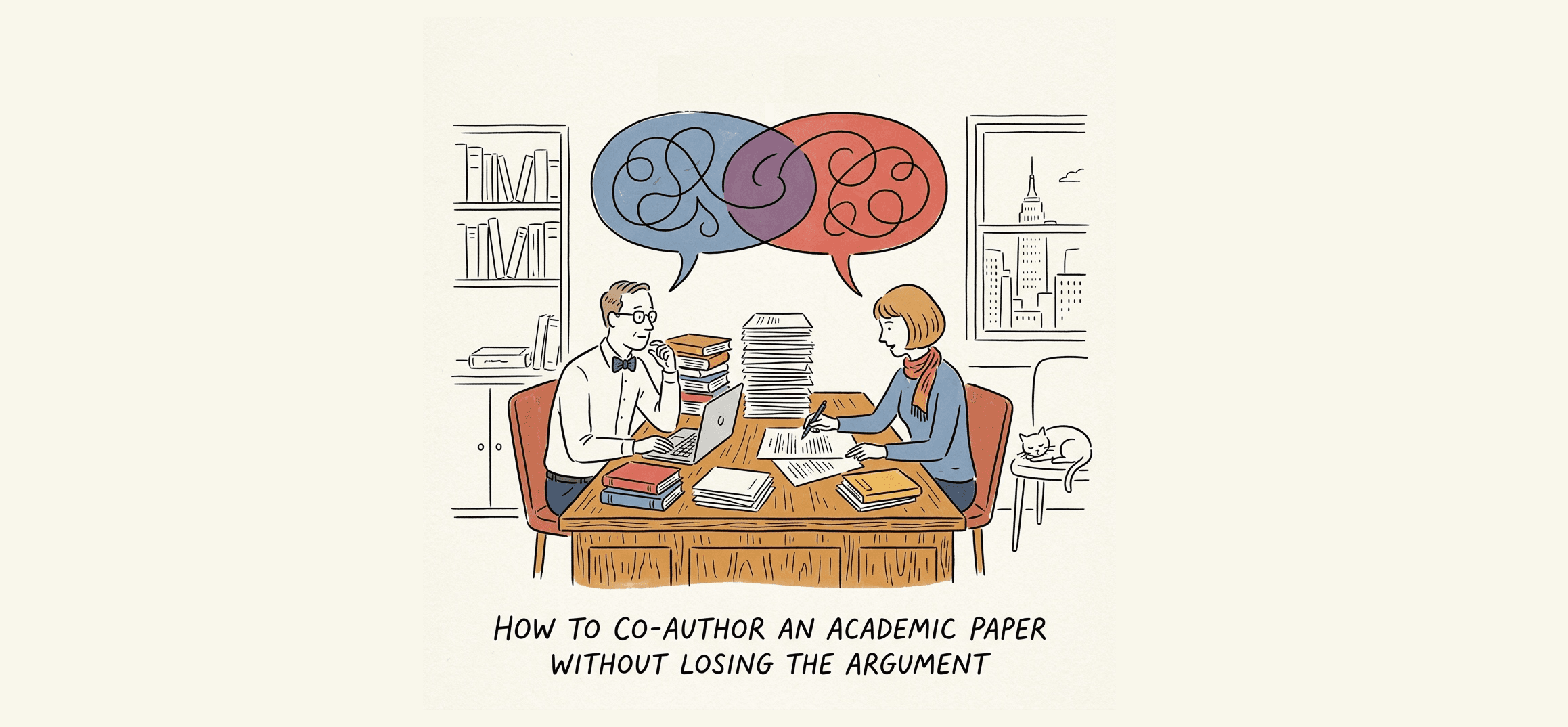
How to Co-Author an Academic Paper Without Losing the Argument

Co-authoring an academic paper begins with decisions about structure, evidence, and authority. Before the first full draft takes shape, the research team needs to clarify who owns the central argument, which discipline sets the standard for evidence, how the target journal shapes the manuscript, and how different kinds of contribution will be recognized.
These decisions matter because co-authored papers often bring together uneven forms of labor. One researcher may design the study, another may analyze the data, another may draft the manuscript, and another may reshape the argument during revision. An explicit agreement gives the team a fair basis for evaluating contributions, especially when authors come from different disciplines or career stag
Early-career researchers often have to navigate two systems at once: formal authorship criteria set by journals or institutions, and tacit expectations around author order, disciplinary framing, revision authority, and communication. Those tacit expectations usually become visible only when the draft begins to stall or a contribution dispute emerges.
This article explains how to co-author academic papers through clear authorship roles, fair authorship order, written co-author agreements, and stronger journal alignment. It also shows how AI-assisted feedback can support revision while keeping responsibility for the paper’s claims, evidence, and final argument with the human authors.
Why Co-Authoring Fails Without Clear Expectations
Co-authored papers often run into difficulty when teams begin drafting before they have agreed on roles, timelines, authorship expectations, and decision-making authority. Each researcher brings a working style, disciplinary background, and understanding of contribution that may differ from the rest of the team. When those assumptions remain implicit, routine writing decisions can turn into authorship disputes, stalled revisions, or fragmented manuscripts.
Assumptions About Labor, Credit, and Revision Authority
Co-author conflict often begins when different forms of labor carry unclear authorship value. One researcher may expect recognition for designing the study, another for analyzing the data, another for drafting the manuscript, and another for reshaping the argument during revision. A written agreement helps the team decide how these contributions translate into authorship roles, authorship order, and revision authority.
Disputes commonly emerge around tasks such as:
Designing the study methodology
Collecting, cleaning, or preparing data
Analyzing results
Drafting the primary manuscript
Revising the core argument
Supervising the project
Managing journal submission
Responding to reviewer feedback
Different tasks carry different kinds of intellectual, practical, and administrative weight. A written co-author agreement helps make those assumptions visible before they affect the writing process.
The Hidden Risk of Disciplinary Drift
Disciplinary drift occurs when different sections of a co-authored paper begin to follow different assumptions about evidence, terminology, structure, or audience. In interdisciplinary projects, this often appears when co-authors use different standards for what counts as persuasive evidence or a meaningful contribution. The issue becomes manageable when the team agrees how each section supports the same manuscript argument.
When these differences remain unresolved, the paper can begin to read as a collection of disciplinary fragments rather than a coherent contribution. The introduction may promise one kind of argument, the methods may support another, and the discussion may speak to a different audience entirely.
Before drafting begins, co-authors should agree on the evidence standards, terminology, structure, and target audience that will guide the final manuscript. For interdisciplinary teams, this conversation often starts with understanding how academic writing across disciplines differs in its treatment of evidence, structure, voice, and audience.
What Counts as a Co-Author? Setting the Agreement
Before drafting begins, research teams need to define who qualifies for the byline. This conversation clarifies co-author responsibilities, makes contribution expectations visible, and reduces the risk of late-stage disputes over credit. Recognized authorship criteria, including the ICMJE criteria, give teams a practical starting point for turning informal expectations into a written co-author agreement.
Standard Criteria for Authorship
A co-author is someone who makes a substantial intellectual contribution to the research, participates in drafting or critically revising the manuscript, approves the final version, and accepts accountability for the published work.
Under the ICMJE recommendations on authors and contributors, research paper authorship requires four forms of participation:
Substantial contribution to the work: This may include the conception or design of the study, data acquisition, data analysis, or interpretation of findings.
Drafting or critical revision: The contributor participates in writing the manuscript or revising it for important intellectual content.
Final approval: The contributor reviews and approves the version submitted for publication.
Accountability: The contributor accepts responsibility for the accuracy and integrity of the published work.
These authorship criteria help teams distinguish between contribution, acknowledgement, and full co-author responsibility. They also create a shared standard for discussing author order, revision authority, and final approval before the manuscript enters submission.
Drafting a Written Co-Author Agreement
After identifying who qualifies for the byline, the team should formalize expectations in writing. COPE guidance on authorship disputes emphasizes early discussion, written agreement, and revision of authorship decisions as contributions change. A written co-author agreement gives the collaboration a shared reference point during drafting, revision, and peer review.
A strong co-author agreement should document:
Project aim: The central research question, purpose, and intended contribution.
Target journal or journal shortlist: The publication venues the team is writing toward.
Authorship criteria: The standards used to determine who qualifies for authorship.
Proposed author order: The agreed sequence of names, including the rationale behind it.
Section ownership: The manuscript sections or tasks assigned to each contributor.
Revision responsibilities: The person or people responsible for integrating sections, resolving inconsistencies, and managing major revisions.
Timeline: Deadlines for drafting, internal review, revision, and submission.
Meeting cadence: The schedule for alignment checks, writing meetings, or talk-write sessions.
Decision-making process: The process for resolving disagreements about evidence, structure, framing, or interpretation.
AI use and disclosure: The team’s policy on AI-assisted feedback, editing, summarization, or structure review, including how any use will be disclosed under current AI policies in academic publishing.
Conflict-resolution process: The agreed escalation path if authorship, contribution, or revision disputes arise before submission.
A useful agreement is clear, specific, and revisable. It should give the team a shared place to update roles, timelines, author order, revision responsibilities, and AI use as the project develops. When co-authors use AI-assisted feedback or structured review tools, the agreement should specify how the team will record prompts, edits, comments, and decisions. An audit-trail approach keeps AI-assisted writing support visible within the revision process. For a practical workflow, see Simple Audit Trail for AI Use.
When Contributors Should Be Acknowledged Instead
Some contributions deserve formal recognition through acknowledgement rather than authorship. Funding acquisition, administrative support, general supervision, technical assistance, language editing, or isolated data collection may belong in the acknowledgements section when the agreed authorship criteria assign them a supporting role.
The acknowledgements section allows teams to credit meaningful support while preserving the integrity of the byline. Contribution statements can also make the division of labor clearer, especially in large or interdisciplinary projects.
The CRediT taxonomy gives teams a standardized vocabulary for describing contributions such as conceptualization, methodology, data curation, formal analysis, writing, review, supervision, and project administration. Using this taxonomy can make recognition more precise while keeping authorship tied to accountable intellectual contribution.
This distinction also matters when teams use AI-assisted feedback. Writing support, editorial suggestions, and structural review can shape a draft while authorship responsibility remains with the researchers named on the paper. For a broader discussion of quiet forms of writing assistance, see Writing Support or Co-Author?.
Navigating Authorship Order Across Disciplines
Authorship order carries different meanings across academic fields. In some disciplines, the first author receives primary credit for the research and writing. In others, author order may reflect seniority, alphabetical convention, or a combination of intellectual contribution and supervisory role. Because these conventions affect hiring, promotion, funding, and scholarly recognition, author order should be discussed early in the co-author agreement process.
Why Authorship Order Should Be Discussed Early
Authorship order should be agreed before drafting begins, then revisited if contributions change during the project. This is especially important for early-career researchers, since first-author publications often carry significant weight in job applications, fellowship reviews, grant evaluations, and tenure-track assessments.
Early discussion also reduces co-author conflict. If one researcher expects first authorship because they designed the study, while another expects it because they wrote the manuscript, the disagreement becomes harder to resolve after months of drafting. A written co-author agreement gives the team a shared record of how author order was decided and when it should be reconsidered.
You should also clarify whether the agreed author order reflects:
Conceptual leadership
Data collection or analysis
Primary drafting responsibility
Revision and integration work
Senior supervision
Alphabetical convention
Journal or disciplinary norms
When these criteria are explicit, co-authors can discuss contribution changes without treating every revision as a personal dispute.
Common Author-Order Conventions
Authorship order across disciplines follows different field-specific traditions. A byline that signals primary contribution in one field may signal alphabetical order, senior authorship, or equal contribution in another. If you are working on an interdisciplinary paper, the team should decide which academic authorship order convention applies before the manuscript is drafted.
Discipline or Field | Common Authorship Order Practice | What Co-Authors Should Clarify |
Medicine and Life Sciences | Often contribution-based, with the senior author last | Who made the main intellectual and practical contribution, and whether the final position signals senior supervision |
Social Sciences | Often contribution-based | Whether author order reflects writing, analysis, conceptual framing, project leadership, or a combination of these |
Single-author work remains common in many fields | Whether co-authorship needs explanation within the field, journal, or contribution statement | |
Mathematics and Some Technical Fields | Often alphabetical | Whether alphabetical order signals equal contribution or follows disciplinary convention |
Interdisciplinary Research | Varies by journal and field | Which discipline’s convention governs the paper and how that decision aligns with the target journal |
Use this table to guide the authorship-order discussion before the manuscript is drafted. In interdisciplinary projects, the team should decide which field’s authorship convention applies, how that choice aligns with the target journal, and how contribution will be represented in the final byline.
First Author vs. Corresponding Author Responsibilities
Clear role definitions help the manuscript move from draft to submission without confusion. A single researcher may hold more than one role, but the first author, corresponding author, and last author usually carry different responsibilities.
First author: The first author usually leads the manuscript’s central argument, primary drafting process, main analysis, or core research contribution. First author responsibilities often include shaping the article’s structure, integrating co-author input, and ensuring that the manuscript speaks to the target journal’s audience.
Corresponding author: The corresponding author manages formal communication with the journal, including academic journal submission requirements, required documentation, editorial queries, revision coordination, and post-submission correspondence with editors and reviewers.
Last author: The last author position often signals senior supervision, mentorship, principal investigator status, or project leadership, especially in medicine, life sciences, and lab-based fields. In other disciplines, the last position may simply reflect lower contribution or alphabetical order, so the team should clarify the meaning before submission.
For co-authored papers, these roles should be named in the agreement rather than assumed. If you are the first author, you should know whether you also manage submission. If you are the corresponding author, you should know whether your role is administrative, intellectual, or both. If a senior researcher expects last authorship, the team should clarify what supervisory, conceptual, or revision responsibility that position represents.
The First Author Anchor Strategy
Co-authored papers need a clear disciplinary center. When several researchers contribute different sections, the manuscript can begin speaking to multiple audiences at once. One section may frame the study for one journal community, while another uses terminology, evidence, or structure that belongs to a different field.
The First Author Anchor Strategy turns that problem into an explicit decision about disciplinary center, journal audience, and evidence standards before separate sections are drafted.
What the First Author Anchor Strategy Means
The First Author Anchor Strategy means that the first author’s disciplinary background should usually guide the manuscript’s target journal, evidence standards, argument structure, and primary audience.
The strategy gives the collaboration a clear center of gravity. In most co-authored papers, the first author carries primary responsibility for shaping the argument, coordinating the draft, integrating feedback, and making the paper legible to its intended reviewers. Those first author responsibilities become especially important when co-authors come from different fields.
A strong first author anchor helps the manuscript maintain a consistent scholarly identity. Multiple kinds of expertise can strengthen the paper when the argument, structure, terminology, and contribution point toward a recognizable journal audience.
Aligning the Target Journal and Audience
Journal alignment begins with the question: which field is this paper primarily trying to persuade?
For example, consider a project led by a sociologist working with public health researchers. If the team selects a sociology target journal, the paper needs sociological framing. The introduction should engage sociological literature, the research gap should be legible to sociologists, and the discussion should show what the findings contribute to sociological knowledge.
If the same project targets a public health journal, the argument shifts toward intervention relevance, population-level implications, measurable outcomes, or policy application. The evidence standards, terminology, and structure should match that journal audience, and the submission strategy should reflect the practical steps involved in submitting a paper to an academic journal.
This is where first author responsibilities become strategic. The first author should help the team connect the manuscript’s contribution to the target journal’s expectations. If the team is still debating the contribution, pause to identify the research gap before committing to a journal shortlist. A shared research gap gives co-authors a clearer basis for deciding which audience the paper should address.
Reconciling Evidence Standards Before Drafting
Interdisciplinary co-authoring often brings together different standards for persuasive evidence. Some co-authors may prioritize measurement, others interpretation, theoretical contribution, policy relevance, or methodological transparency. Each standard can strengthen the paper when the team decides how those standards will work together.
This conversation should happen before co-authors divide the manuscript into sections. If each researcher writes from their own disciplinary assumptions, the final draft may contain conflicting signals across the methods, results, and discussion. The team should agree early on how each section supports the paper’s central claim.
Before drafting, co-authors should agree on:
The main claim the manuscript will defend
The kind of evidence needed to support that claim
The discipline or journal audience that will evaluate the claim
The terms that need shared definitions
The role each method, dataset, or interpretation plays in the final argument
This keeps the section grounded in co-author workflow. Each section should contribute to the same research argument, even when different authors bring different methods, datasets, or disciplinary assumptions.
Questions Co-Authors Should Ask Before Choosing a Journal
Before selecting a target journal, co-authors should use the First Author Anchor Strategy as a structured discussion tool. These questions can also be added to the co-author agreement so the team has a written record of the journal alignment decision.
Which discipline does the first author write from?
Which field does the paper make its main contribution to?
What kind of evidence will the target journal expect?
Does the introduction frame the problem for that journal audience?
Will reviewers see the methods as appropriate for the claim?
Does the title and abstract signal the right disciplinary contribution?
Which co-author has final responsibility for resolving conflicts in framing, terminology, or structure?
At what point will the team revisit the target journal if the manuscript’s argument changes?
These questions help co-authors choose a target journal with greater precision. They also keep the manuscript’s contribution, evidence, and audience aligned as the paper develops.
How to Keep Co-Authors Aligned During Drafting and Revision
Co-author communication needs a workflow once the paper moves from planning to drafting. Multi-author writing involves varied levels of engagement, different work styles, questions of fair credit, and clear communication. These challenges are well documented in the PLOS Computational Biology article “Ten Simple Rules for Collaboratively Writing a Multi-Authored Paper”.
For co-authored academic papers, the workflow should make three things visible: what changed, who made the decision, and how the revision affects the manuscript’s central argument. That record helps co-authors avoid reopening settled decisions, duplicating work, or introducing inconsistencies across sections.
Establishing Version Control and Decision Logs
Version control gives the team a stable record of the manuscript’s development. A decision log adds the reasoning behind major changes. Together, they support clearer co-author communication because the team can see not only which paragraph changed, but also why the change was made.
In collaborative academic writing, a decision log should record agreements about:
Target journal decisions
Author order changes
Major structural revisions
Terminology decisions
Evidence or methods decisions
AI tool use
Reviewer-style feedback decisions
Responsibility for final integration
This log can be simple: date, decision, rationale, person responsible, and follow-up action. The value comes from creating a shared memory for the project. A review workflow works best when each stage has a defined purpose, a specific reviewer, and a clear plan for how feedback will be used. For more guidance, see Build a Review Pipeline For Your Work.
Assigning Revision Ownership Across the Full Draft
When writing with co-authors, section ownership gives each contributor a clear task. Revision ownership gives the manuscript a coherent final shape. The revision owner is responsible for integration across the full draft, including transitions, terminology, argument flow, and response to feedback.
The revision owner carries specific co-author responsibilities: integrating disjointed sections, standardizing terminology, checking transitions, preserving the central argument, and coordinating responses to feedback. For example, if a data scientist drafts the methods section and a sociologist drafts the discussion, the revision owner should check that the discussion section uses the same analytical terms introduced in the methods and keeps its claims within the evidentiary limits of the data.
Revision ownership also matters when feedback begins to conflict. Co-authors may need to weigh supervisor comments, peer feedback, reviewer reports, or structured AI feedback against the manuscript’s core argument. A response process that maps comments, separates major concerns from minor edits, and records revision decisions helps prevent feedback from pulling the paper in multiple directions. This is especially important when co-authors need to respond to journal reviewer comments and conflicting reports.
Conducting Structured Talk-Write Sessions
A talk-write session is a focused meeting where co-authors clarify a claim, section, transition, or revision decision before changing the text. This kind of session is useful when the paper’s logic depends on careful integration across disciplines, methods, or sections.
Schedule talk-write sessions when co-authors need to work through:
Moving from the literature review to the research gap
Explaining methods across disciplines
Interpreting complex results
Revising the discussion section
Deciding whether a suggested revision changes the paper’s main claim
A vague request for “any feedback” often produces scattered comments. Assigning each reader a defined role makes feedback easier to interpret and act on, especially when different co-authors need feedback on different parts of the manuscript. For more guidance on structuring peer feedback, see How to Turn Peers Into Smart Editors.
Scheduling Alignment Checks at Key Draft Stages
Alignment checks protect the paper from accumulating small inconsistencies across multiple rounds of revision. These checks should happen at moments when the manuscript’s direction can still be corrected without reopening every section.
Plan alignment checks:
Before drafting begins
After the first full draft is assembled
Before journal submission
After supervisor or peer feedback
After reviewer comments
A final alignment check should ask whether the paper’s research question, evidence, methods, discussion, and journal audience still fit together. At this stage, pre-submission review can help co-authors examine clarity, fit, and manuscript readiness before formal journal peer review begins. If co-authors need to convert feedback into a revision plan, Chat with Theo can also help translate structured feedback into focused next steps while keeping the author’s reasoning and voice at the center of the revision process.
This workflow keeps co-author communication active throughout drafting and revision. It also gives the team a shared record of how the manuscript changed, who was responsible for each decision, and which issues still need resolution before submission.
How Ethical AI Can Support Co-Authored Manuscripts
AI tools for academic writing can help co-authors review a manuscript more systematically, especially when several people have contributed different sections. Feedback, consistency checks, and revision support are the appropriate uses. Authors still carry responsibility for the paper’s claims, evidence, originality, and final wording.
AI as a Diagnostic Feedback Layer Under Human Authorship
Questions about AI and authorship should be settled before drafting begins. The ICMJE recommendations on authors and contributors assign authorship to contributors who can take responsibility for the accuracy, integrity, and originality of the work. For co-authored manuscripts, AI-assisted tools belong in the revision workflow, while the named authors remain accountable for every claim in the submitted paper.
This point matters for academic integrity because co-authored papers already involve distributed responsibility. Each author should know where AI was used, who checked the output, how citations and interpretations were verified, and how the team will disclose that use at submission.
Where AI-Assisted Feedback Helps Co-Authors
AI-assisted feedback is most useful when it helps co-authors examine the integrated manuscript as a whole. After separate sections have been drafted, AI tools can help the team identify places where the manuscript needs clearer alignment.
For example, AI-assisted feedback can help co-authors:
Flag claims that need stronger evidence
Identify unclear transitions between co-authored sections
Check whether terminology stays consistent across the manuscript
Notice places where the discussion overreaches the results
Review whether the manuscript fits the target journal’s expectations
Turn broad feedback into more concrete revision tasks
This kind of review is especially useful before the paper moves to external readers or formal peer review. If the team mainly needs language-level support, AI Proofreading Tools for Academic Writing: Are They Worth It? explains how proofreading tools differ from deeper academic feedback. If the team needs a broader manuscript-readiness check, AI Tools for Academic Peer Review: What They Actually Check in 2026 explains how AI review tools can assess areas such as methodology, reporting gaps, pre-submission feedback, ethics, and journal readiness.
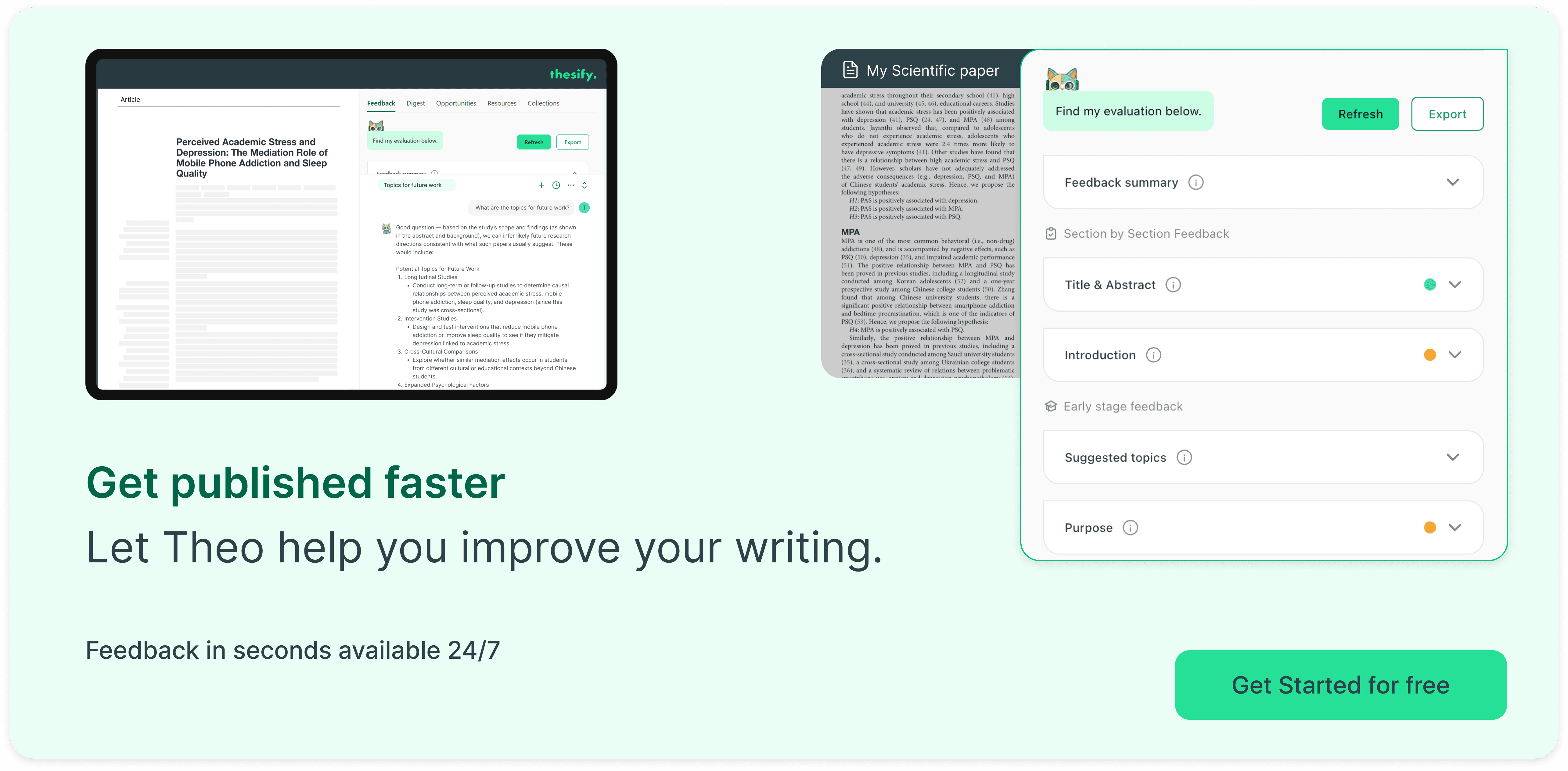
In thesify, co-authors can review structured feedback on argument, evidence, and manuscript readiness in a shared revision process. The authors decide which feedback to accept, how to revise, and how to defend the final argument.
Add AI Use to the Co-Author Agreement
AI disclosure belongs in the co-author agreement because it affects authorship responsibility, journal compliance, and trust within the team. Co-authors should agree on AI use before the manuscript moves into drafting or revision.
The agreement should define:
Which AI tools may be used
Whether AI may be used for feedback, proofreading, summarization, literature support, or structure review
Which parts of the manuscript may be reviewed with AI
Who will check AI-assisted output
How prompts, edits, and decisions will be documented
How AI use will be disclosed to the journal
Which journal or publisher policy will guide the final disclosure
Publisher policies vary, so the team should check the target journal’s requirements before submission. For a broader overview of disclosure rules, authorship limits, image restrictions, and peer review boundaries, see AI Policies in Academic Publishing 2025: Guide & Checklist.
A clear AI clause protects the team from confusion later. It also keeps AI-assisted feedback visible as part of the revision process, while preserving human accountability for the final manuscript.
Co-Authoring Checklist for Academic Papers
Co-authoring academic papers works best when the team has a shared process for authorship, drafting, revision, and submission. Use this checklist to clarify co-author responsibilities before disagreements arise and to keep the manuscript aligned as the project develops.
Before You Start Writing
Use the planning stage to define authorship roles, contribution expectations, and the journal audience. These decisions should be recorded in the co-author agreement.
Confirm who qualifies as a co-author based on recognized authorship criteria.
Draft a written co-author agreement.
Clarify expected contributions for each team member.
Discuss the proposed authorship order.
Identify the first author and corresponding author.
Agree on the target journal or journal shortlist.
Discuss evidence standards and the journal audience.
During Drafting and Revision
During drafting, co-author communication should focus on integration, consistency, and revision decisions. Track decisions that affect the manuscript’s structure, argument, evidence, and target journal fit.
Assign section ownership.
Assign revision and integration ownership.
Maintain a centralized decision log.
Track major changes to structure and argument.
Revisit the agreement if contributions change.
Schedule formal alignment checks.
Discuss feedback before making major revisions.
Before Submission
Before submission, confirm that authorship order, final approval, acknowledgements, contribution statements, and AI disclosure have been reviewed by the full team. This final check supports academic integrity and reduces preventable submission problems.
Confirm the final authorship order.
Verify that all authors approved the final manuscript.
Review acknowledgements and formal contribution statements.
Check AI disclosure requirements against current AI policies in academic publishing.
Confirm that the target journal still fits the manuscript.
Ensure the argument, evidence, and audience align.
Frequently Asked Questions About Co-Authoring Academic Papers
How Do You Co-Author an Academic Paper?
To co-author an academic paper, start by agreeing on roles, authorship criteria, author order, target journal, communication norms, and revision responsibilities. You should also decide how the team will document decisions, handle feedback, and disclose any AI-assisted writing or review tools used during the project.
How Do You Decide Authorship Order?
Authorship order should reflect disciplinary norms, contribution level, and the team’s written agreement. Discuss author order before drafting begins, then revisit it if contributions change. In interdisciplinary projects, clarify which field’s authorship convention applies and how the target journal expects contributions to be represented.
What Is a Co-Author Agreement?
A co-author agreement is a written document that defines how the team will work together. It usually covers roles, expected contributions, author order, timelines, communication, revision responsibilities, AI use, and conflict resolution. A strong agreement gives co-authors a shared reference point as the project develops.
What Does the First Author Do?
The first author usually leads the manuscript’s central argument, drafting process, and journal alignment. First author responsibilities may also include integrating co-author feedback, coordinating major revisions, and ensuring the paper speaks clearly to the target journal’s audience.
What Is the Difference Between First Author and Corresponding Author?
The first author usually leads the intellectual and writing contribution. The corresponding author manages communication with the journal, including submission materials, editorial queries, reviewer correspondence, and administrative requirements. One person can hold both roles, but the responsibilities should be clarified early.
How Do You Avoid Conflict With Co-Authors?
You can reduce co-author conflict by creating a written agreement, discussing authorship order early, tracking contributions, maintaining a decision log, and scheduling regular communication. If disputes continue, seek mediation through a supervisor, department chair, research integrity office, or another appropriate institutional contact before submission.
Can AI Be a Co-Author?
Only accountable human contributors belong in the author byline. AI-assisted tools can support feedback, editing, or review, but researchers must verify all AI-assisted output, document how AI was used, and follow the target journal’s AI disclosure policy before submitting the manuscript.
Use Shared Feedback to Align Your Revision
A co-authored draft is easier to revise when every contributor can evaluate the same feedback, discuss the same structural priorities, and work from a single version of the manuscript. In thesify, you can upload your draft, review diagnostic feedback on argument and evidence, and use the built-in co-author feature to manage revision together.
Sign up to thesify for free today to review your manuscript with your co-authors and keep the final argument coherent, accountable, and ready for the next stage of revision.
Related Posts
Academic Writing Across Disciplines: Styles and Conventions: Learn how academic writing differs across disciplines and get concrete strategies to adapt your structure, evidence, and style when you write in new fields. If you work across multiple fields, you already know that “academic writing” is not one single genre. The expectations for a lab report in biochemistry, a theory chapter in sociology, and a close reading in literature differ in structure, voice, and even what counts as evidence. Understanding differences in academic writing across disciplines helps you write more confidently, supervise more effectively, and interpret feedback with less confusion.
How to Submit a Paper to a Journal: Step‑by‑Step Guide: If you are searching for how to submit a paper to a journal, you are probably looking for two things at once: a clear process, and reassurance that you are not missing something obvious. Learn how to submit a paper to a journal, from selecting the right journal to preparing files, cover letters, and navigating peer review, with confidence. Plus, get more information about what “in review” actually means, including screening outcomes and what to do when you receive a decision.
What Authors Need to Know About Pre-Submission Review vs Peer Review: Pre‑submission review is an author‑driven process aimed at improving a manuscript before it enters the formal publication pipeline, while peer review is an editor‑driven process that determines whether a manuscript meets the standards for publication. Learn how combining both reviews strategically can reduce delays and increase the likelihood of acceptance. Plus, get an overview of how AI tools can support parts of this workflow and where the core judgments in peer review must remain human.