How to Identify Research Gap for Novelty: A Step-by-Step Guide


The "Novelty Fallacy"—the persistent belief that merely addressing an unexplored topic is sufficient to merit scholarly publication—is perhaps the most common pitfall for early-career researchers (ECRs). In practice, "lack of novelty" remains a leading cause for manuscript rejection in high-impact journals.
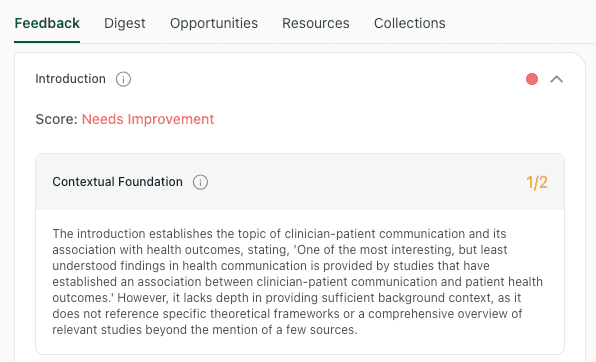
An initial logic audit in thesify. Here, the tool identifies a "thematic summary" that lacks the necessary theoretical depth to establish a scorable research gap.
While an ECR may view a lack of previous coverage as an open door, reviewers in 2026 are often overwhelmed by the sheer volume of submissions and look for more than just 'newness'. They demand proof of Information Gain: a demonstrable shift in the field’s knowledge or a resolution to a specific theoretical tension. If a paper fails to articulate its unique contribution to the collective logic of the discipline, it is frequently dismissed as "incremental".
To navigate this scrutiny, you must move from a descriptive mindset to a diagnostic one. This guide gives you a repeatable logic audit that turns an interesting idea into a contribution a reviewer can evaluate quickly, with clear links between the gap, your aims, and what your methods can legitimately claim. By treating novelty as a structural requirement rather than a creative flourish, you ensure your research signal is not lost in the background noise of contemporary scholarship.
In the following sections, we will break down the gap-novelty cycle, identifying the precise moment where a void in existing literature transforms into an opportunity for innovation. We will detail seven tactical gap-finding methods used to map unexplored academic territory and conclude with a specialized toolkit of lexical bundles. These high-impact signal phrases are the linguistic tools necessary to "flag" your contribution to a fatigued review panel, ensuring your work is both visible and undeniable.
Understanding the Gap-Novelty Cycle: Why "New" Isn’t Enough
To succeed in peer review, you need to move beyond the lay definition of newness and adopt a structural understanding of scholarship. In academic writing, a topic is not inherently valuable simply because it has not been discussed; its value is contingent upon its relationship to a specific deficiency in the collective knowledge base. This relationship is best understood through the gap-novelty Cycle.
The Hole and the Peg: Defining the Distinction
A Research Gap is a functional deficiency in the literature—a "hole" in the current scholarly wall. It represents a point where existing theories fail to explain a phenomenon, where methodologies lack the precision required for modern data, or where empirical evidence remains inconclusive.
In contrast, Research Novelty is your specific contribution—the "peg" designed to fill that hole. Novelty is the original methodology, the fresh theoretical lens, or the unique dataset you introduce. Reviewers do not evaluate a gap in isolation; they evaluate whether your study makes a defensible, well-supported move that resolves it.
Research Novelty vs. Research Gap
Research Gap: The specific question, contradiction, or methodological void identified within existing literature (the problem).
Research Novelty: The original approach, perspective, or evidence introduced to address that void (the solution).
The Relationship: A gap justifies why the study is necessary; novelty defines why the study is significant.
The Complaint vs. The Noise
The danger for early-career researchers lies in failing to bridge these two concepts. A gap without novelty is merely a "complaint"—you have identified a problem but offered no resolution, failing what John Swales (1990) calls "Occupying the Niche." Conversely, novelty without a gap is "noise." It is an original idea that lacks a justification; it is "new," but it does not provide information gain because it isn't solving a recognized tension in the field.
Scientific progress is iterative. Every novel contribution, once published, becomes part of the "Status Quo," which inevitably reveals new boundary conditions and further gaps. Understanding this cycle allows you to position your work as a necessary evolution of the field.
Step 1: Mapping the Status Quo to Find Real Gaps
If you approach literature paper-by-paper without a map, you will likely end up with a subjective 'feeling' that a gap exists, rather than a demonstrable proof of its location. To satisfy a 2026 review panel, your first objective is to map the status quo: the dominant claims, standard methods, and datasets that currently define the field’s boundaries.
Bibliometric mapping is a useful first step because it visualizes patterns in citation and co-occurrence networks, helping you see which conversations are dense and which connections are thin. Those thin connections are often where you can justify a focused gap, for example, a missing link between two clusters that rarely cite each other.
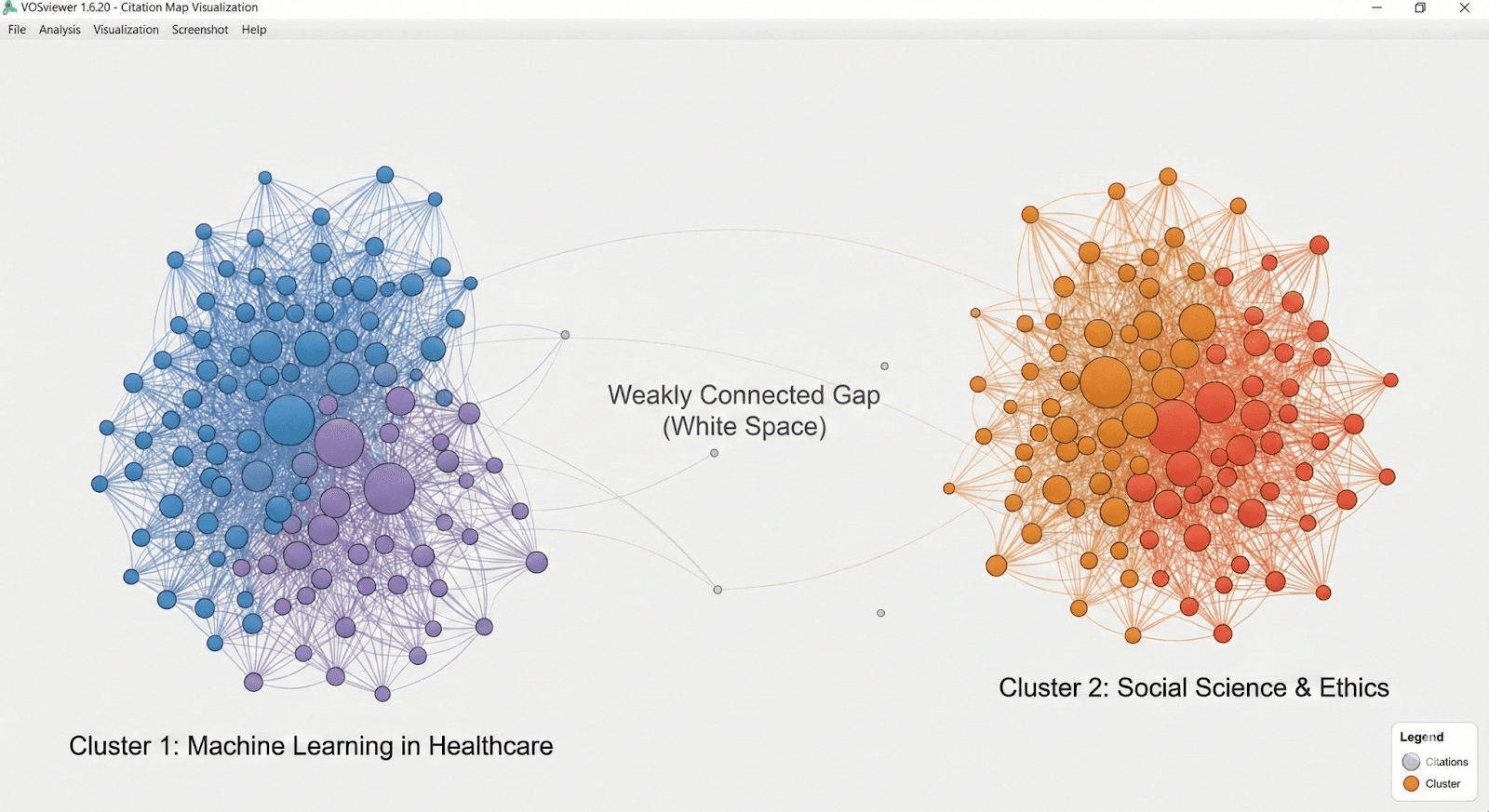
A VOSviewer citation map identifying the "white space" between distinct research clusters. This weakly connected area represents a high-potential research gap where interdisciplinary novelty can be established
A Rigorous Workflow for Status Quo Mapping:
Construct a High-Signal Core Set: Do not begin with a broad keyword search. Start with 2–3 recent systematic reviews or meta-analyses. Extract the "foundational" papers they cite and supplement them with the 10–20 most recent publications (last 24–36 months). This ensures your map is grounded in both tradition and the current frontier.
Visualize the Paper Graph: Utilize algorithmic tools like Connected Papers or ResearchRabbit to produce a graph around a seed article. This allows you to identify nearby literatures—neighboring disciplines that may have already solved your problem using different terminology.
Apply Taxonomic Labels: Your goal is an interpretable heuristic. Label your clusters by their functional role: e.g., "the measurement tradition," "intervention-based studies," or "predictive modeling clusters."
Identifying Outdated Methodologies in 2026
Once the wall of existing literature is visible, you can begin to identify the cracks. Often, a gap exists not because a topic is unstudied, but because the methodological resolution is insufficient for modern inquiries. In 2026, many standard methods remain conventional simply through disciplinary inertia, not because they still fit the data.
To find these methodological voids, perform an audit on the field’s assumptions by examining:
sampling frames
temporal resolutions
causal identification strategies
When the standard toolkit can no longer validly answer the current version of a question—due to shifts in technology or environment—you have identified a defensible, "scorable" gap. As we discuss in thesify’s Signal-to-Noise framework, this is where you move from contributing noise to providing high-fidelity signal.
Avoiding the "Buried-in-Prose" Syndrome
Dense literature reviews often hide logical inconsistencies within a narrative flow. To extract these without losing your critical orientation, force every source into a repeatable Evidence Schema:
The Claim: What is the primary assertion?
The Evidence: Is it experimental, observational, or simulation-based?
The Context: In what specific population or setting does this hold?
The Boundary: Under what conditions does the logic fail?
This turns “background” into an audit trail you can check. If you are using a tool like Zotero, collections and tags make this kind of structured filing workable at scale (for example, tags for “method,” “context,” “assumption,” and “limitation”). This ensures that when you write your introduction section, you aren't just summarizing; you are performing a Critical Synthesis.
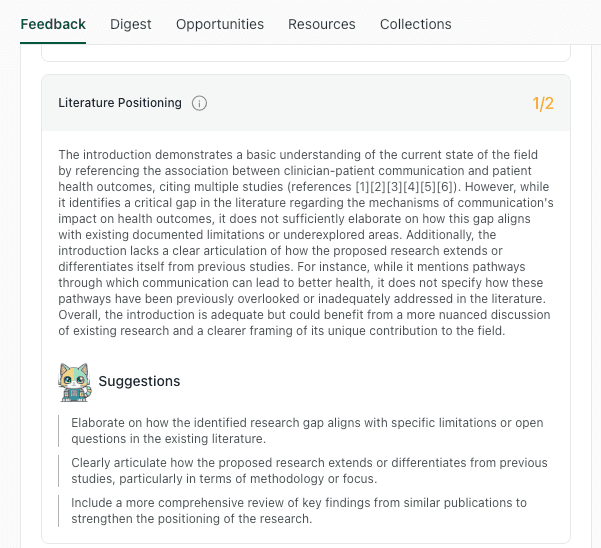
thesify’s Literature Positioning feedback points out when you cite relevant studies but have not yet shown how your gap and contribution clearly extend, refine, or challenge that existing work.
Step 2: How Do I Find a Research Gap Quickly? 7 Expert Tactics
To move from a vague interest to a viable research program, start diagnosing gaps. In an academic context, quickly refers to a high-yield diagnostic scan of the literature to identify where the current scholarly consensus is most fragile.
As we emphasize in thesify’s Signal-to-Noise framework, your objective is to find an entry point that offers the highest information gain for the field.
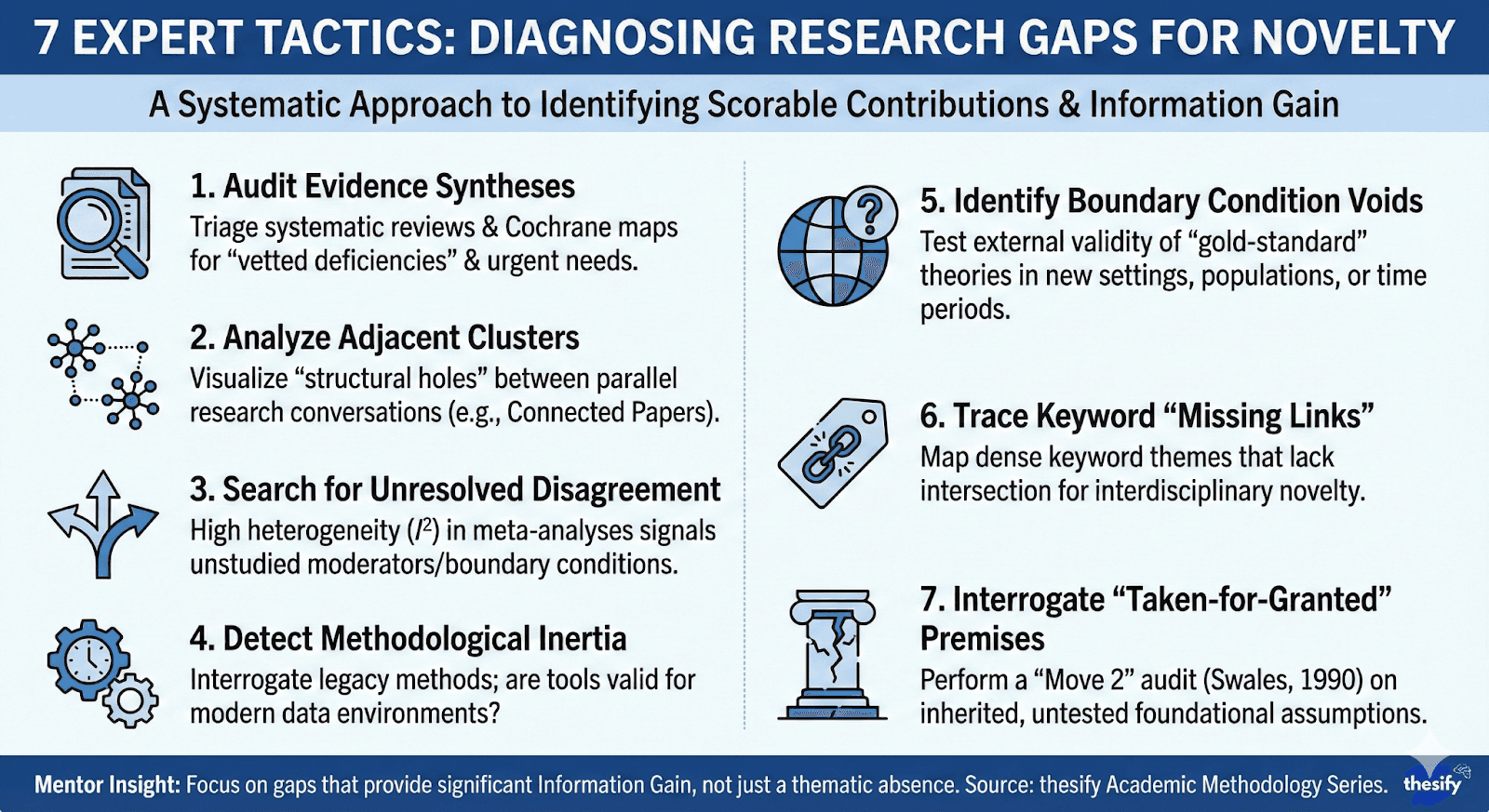
A systematic cheat sheet for diagnosing research gaps. By moving through these seven diagnostic filters, researchers can transform a broad area of interest into a scorable contribution that maximizes Information Gain.
For those looking to optimize their literature triage, these seven tactics offer a systematic way to identify high-potential niches:
Audit Evidence Syntheses: Read the implications for research sections of recent systematic reviews. These are vetted "shopping lists" of the field’s most urgent needs.
Analyze Adjacent Clusters: Use a paper graph tool like Connected Papers to find clusters that rarely cross-cite. The white space between these clusters often hides untested assumptions or missing theoretical links.
Search for Unresolved Disagreement: If effects vary meaningfully across studies, you may be looking at boundary conditions or measurement differences rather than noise, and those are publishable gaps when you can specify what changes and why.
Detect "Default" Methodological Inertia: Identify methods used primarily out of habit. If a conventional approach's assumptions (e.g., sampling frame or causal identification) are violated by modern data environments, you have a methodological gap.
Identify Boundary Condition Voids: Ask where the evidence base is thin. A gap is not just an unstudied population; it is a context where the core mechanism of a theory is plausibly expected to shift.
Trace Keyword Missing Links: Use bibliometric mapping to find dense keyword clusters that do not connect. This structural hole indicates two scholarly conversations happening in parallel that require a bridge.
Interrogate "Taken-for-Granted" Premises: Identify the foundational assumptions everyone inherits but no one tests. This is the classic "Move 2" in Swales’ (1990) CARS model: establishing a niche by indicating a limitation or unexamined premise.
Mining "Future Research" and Seminal Works
When mentors advise reading the "future research" section, they are suggesting you perform a translation. You must convert a suggestion into a structured gap statement: define exactly what is unknown, in what context, and what the plausible implication is if the answer changes.
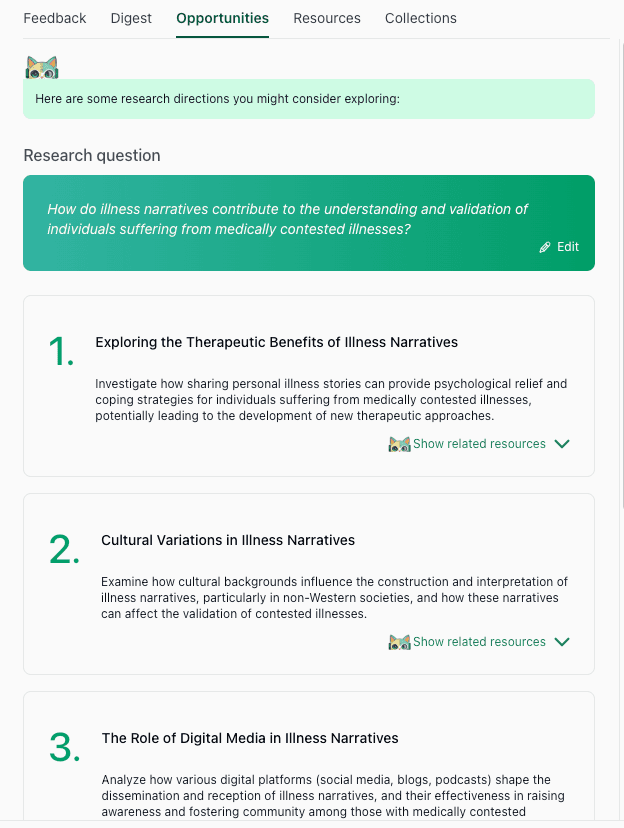
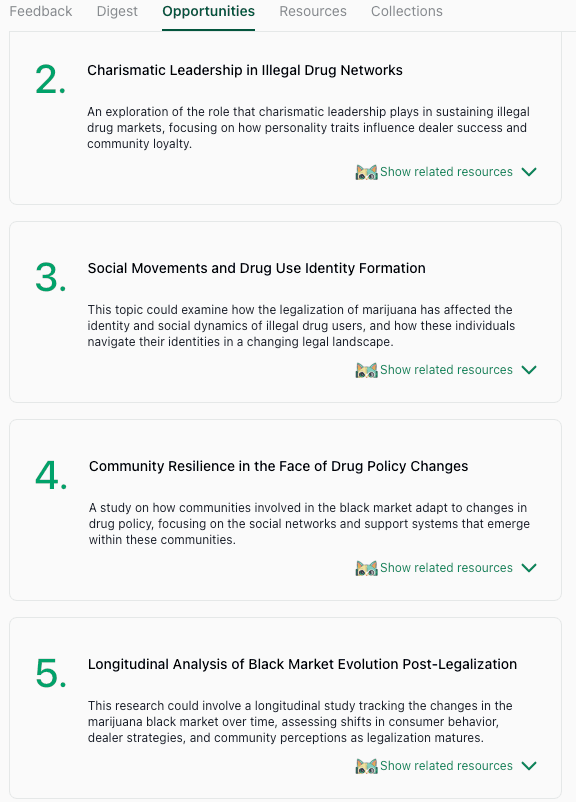
Using thesify to translate broad themes into specific research opportunities. This feature acts as a diagnostic scan, identifying underdeveloped "niche" areas that promise high information gain.
Spotting Methodological and Contextual Voids
Two specific signals differentiate a scorable gap from a superficial one: heterogeneity and generalizability.
As noted in the thesify guide onScientific Paper Introduction Structure: The Gap to Aim Link, a contextual gap is only valid if you can explain why a new setting or population changes the underlying mechanism. You aren't just collecting a new sample; you are testing the external validity of a theory. If results vary, it is a signal that moderators—the "how" and "when"—are currently poorly specified. This shift from thematic description to mechanistic interrogation is what secures a reviewer's advocacy.
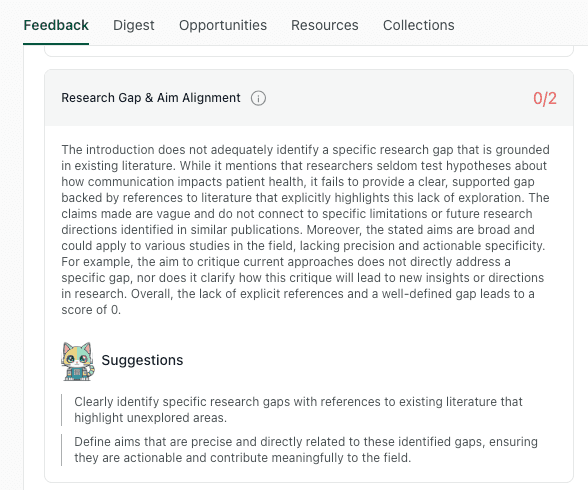
thesify flags when your gap is not anchored to specific literature limits, and when your aims remain broad rather than directly actionable responses to the stated gap.
Step 3: Using Lexical Bundles for Establishing Novelty in Thesis
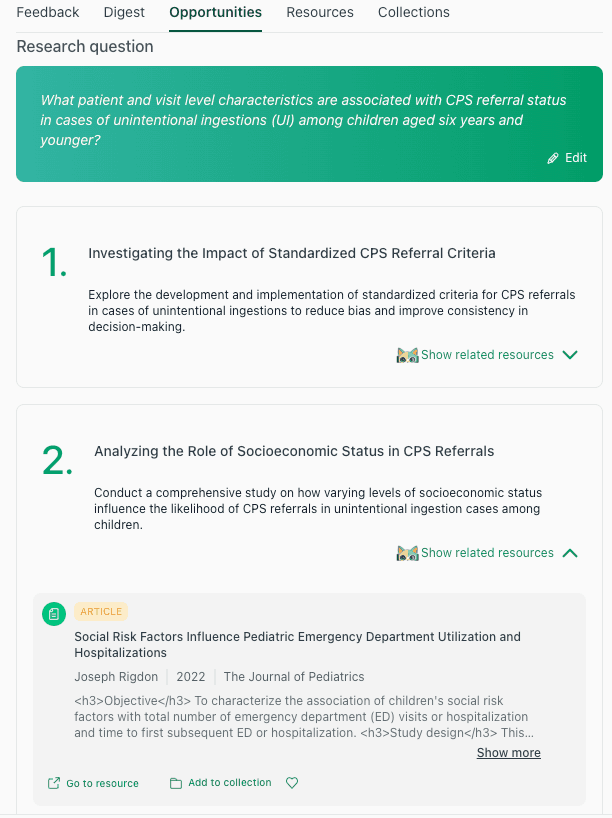
The result of a successful gap diagnosis. thesify helps you transition from a thematic area to a specific, mechanistic interrogation that you can now signal using lexical bundles.
Establishing scholarly novelty is a matter of making your idea legible to your audience. In the 2026 peer-review landscape, reviewers are often triaging manuscripts under significant time pressure. If your contribution is not clearly flagged using the specific linguistic conventions of your discipline, it risks being filtered out as noise before it is even fully understood.
As we emphasize in Scientific Paper Introduction Structure: The Gap to Aim Link, high-impact writing is a linguistic performance that minimizes the reviewer's cognitive load. To achieve this, successful authors employ lexical bundles—fixed, multi-word sequences that act as rhetorical signposts. These bundles signal your "moves" within the literature, transitioning your prose from a descriptive summary to an authoritative argument.
The Gap Move: Signaling Unexplored Territory
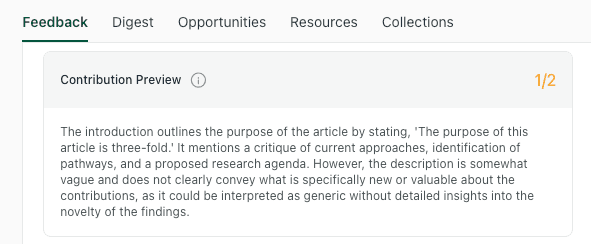
thesify’s Contribution Preview highlights when a draft explains what it covers, but does not yet make the contribution explicit enough for a reviewer to recognise quickly.
Before you can occupy a niche, you must first establish that one exists. This is known as "Move 2" in the Create a Research Space (CARS) model. The goal is to identify a functional deficiency in the "status quo" you mapped in Step 1. Using bundles that signal a gap creates a logical "need" for your research in the mind of the reader.
For a deeper dive into these structures, consult our Identify the Research Gap (Types and Wording) for discipline-specific variations.
Example Bundles:
"While recent research has focused on X, the underlying mechanism of Y remains elusive..."
"Previous studies have tended to prioritize X; however, there has been little quantitative analysis of..."
"Despite the growing body of literature on X, the boundary conditions for Y are poorly specified."
The Novelty Move: Highlighting Your Unique Contribution
Once the gap is identified, you must immediately signal your information gain. This is where you pivot from the problem to your specific solution. Avoid passive language like "This paper discusses..." To be "scorable," your language must be diagnostic and assertive. You are not just "looking at" a topic; you are correcting a deficiency or extending a logic.
Example Bundles:
"This study departs from traditional models by integrating..."
"To address this limitation, we introduce a novel framework that..."
"By applying X to the context of Y, this research provides a higher resolution of..."
Lexical Bundles for Establishing Novelty
The "Move" | Rhetorical Purpose | Example Lexical Bundle |
Establishing a Niche | To identify a functional void or unanswered question. | "However, the relationship between X and Y is still not well understood." |
To challenge a dominant assumption or highlight a conflict. | "This assumption, however, is not supported by recent evidence from..." | |
Indicating a Limitation | To point out a methodological or contextual boundary. | "The generalizability of these findings is constrained by a reliance on..." |
Occupying the Niche | To announce your specific original contribution. | "In this paper, we propose a novel approach for..." |
Signaling Info Gain | To highlight the specific payoff of your novelty. | "Our findings offer a more nuanced understanding of how..." |
Expert Tip: Never say your work is 'new' just for the sake of it. Use these bundles to show that your novelty is corrective—you are fixing a specific flaw or filling a specific void that currently holds the field back.
Step 4: Checklist for Verifying Research Novelty Before Submission
You have mapped the status quo, identified a tactical gap, and signaled your contribution with the correct lexical bundles. Now comes the final, critical step before you hit submit: your logic audit.
In the harsh light of a 2026 peer-review panel, a proposal that feels exciting to write can often look risky to fund or publish. Perform this final sanity check to ensure your novelty holds up to professional scrutiny. This allows you to stress-test the structural integrity of your argument.
A proposal reads as scorable when the novelty is explicit and the path from methods to claims is easy to evaluate. Use the checklist below to confirm that your significance, differentiation, and feasibility are stated plainly and supported by the design.
The Pre-Submission Novelty Audit
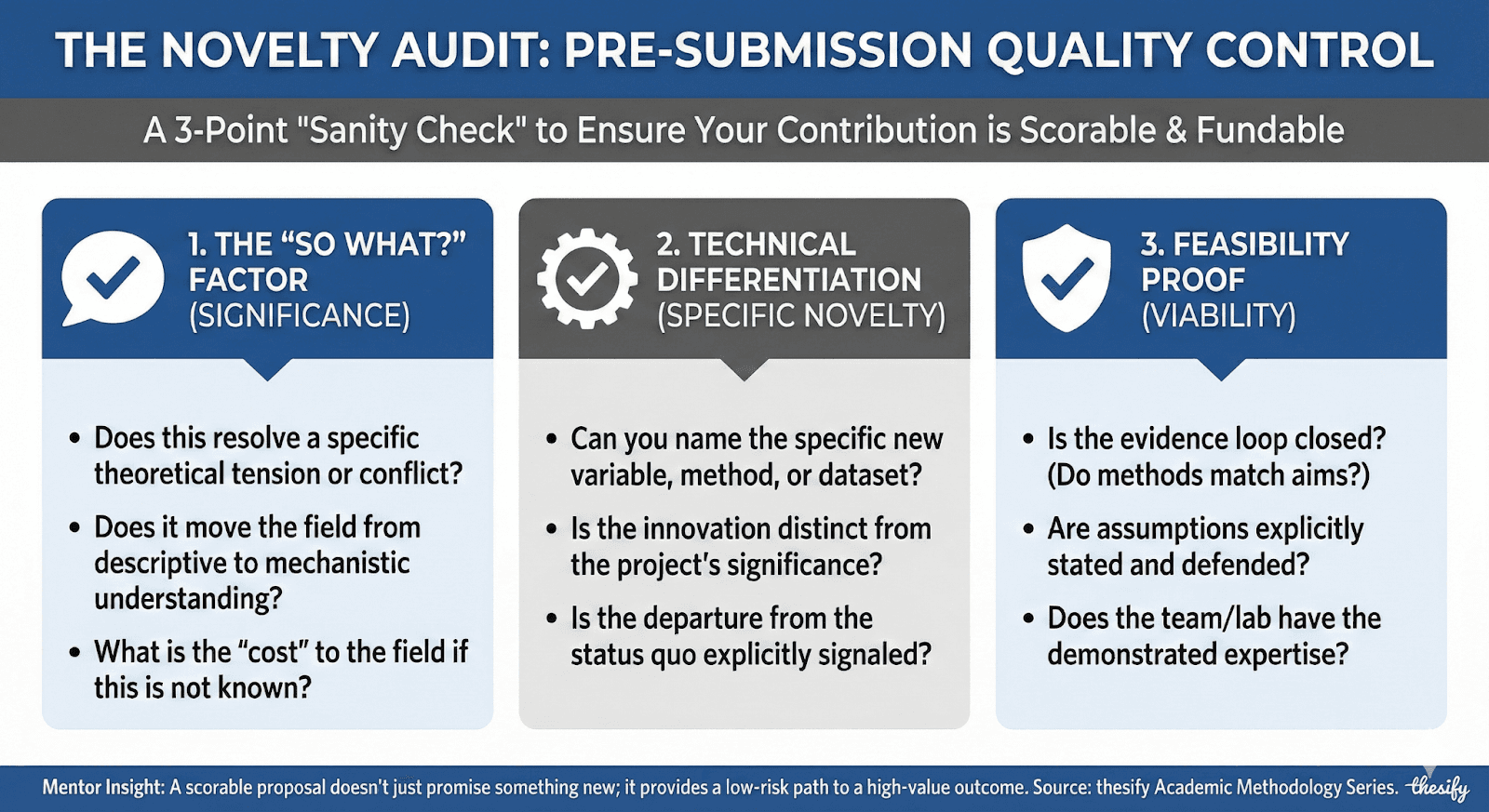
A final quality-control checklist for your research proposal. Before submitting, ensure your novelty passes the "Significance," "Differentiation," and "Feasibility" tests to maximize its scorability with review panels.
The "So What?" Factor (Significance Test)
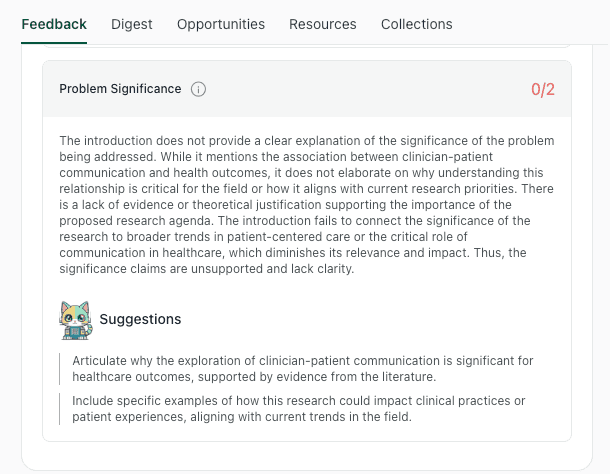
thesify’s Problem Significance feedback helps you check whether you have stated why the problem matters (not just that it exists), and whether the significance is supported rather than implied.
Does your identified gap resolve a specific theoretical tension or conflict in the field, or is it merely a "gap of absence" (i.e., "no one has done this yet")?
Does filling this gap move the field from a descriptive understanding to a mechanistic or predictive one?
If a reviewer asks, "What is the 'cost' to the field if this is not known?", do you have a clear, non-generic answer?
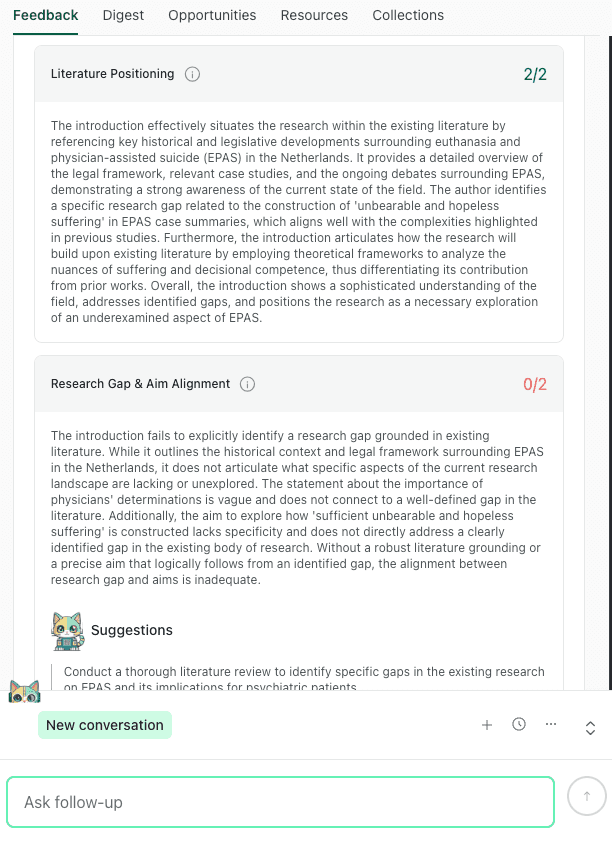
A critical feedback report on research alignment. Even with strong literature positioning, thesify flags a failure to explicitly link the identified gap to the study’s specific aims.
Technical Differentiation (Specificity Test)
Can you name the specific new variable, method, dataset, or theoretical lens that constitutes your novelty?
Avoid vague claims like "a new approach."
Is your "Innovation" distinct from your "Significance"?
Significance is the problem's importance.
Innovation is your solution's uniqueness.
Have you explicitly used counter-claiming or gap-signaling lexical bundles in your introduction section to mark your departure from the status quo?
Feasibility Proof (Viability Test)
Is the evidence loop closed?
Does your proposed methodology logically produce the specific outcome claimed in your aims?
Are your assumptions explicitly stated and defended?
A novel approach often rests on unproven assumptions; ignoring them is a red flag for reviewers.
Does your team or lab have the demonstrated expertise or preliminary data to execute this specific novel approach?
A high-signal proposal is one where the novelty is not just asserted, but structurally engineered into every component of the research design. This audit is your final safeguard against the "Novelty Fallacy."
The "Reviewer-First" Interrogation: Stress-Testing with thesify
A novelty claim fails in review most often because it is not auditable. The logic is there, but it is not easy to check: the gap is vague, the contribution is implied rather than stated, or the Methods cannot actually carry the weight of the claim. thesify is useful here as a structured interrogation tool that helps you locate those breaks in logic before you submit.
Use thesify as a demanding reviewer who cares about alignment and support:
Run a Pre-Submission Review on your current draft.
Do this before you “polish” language. You want to find structural problems while they are still cheap to fix.
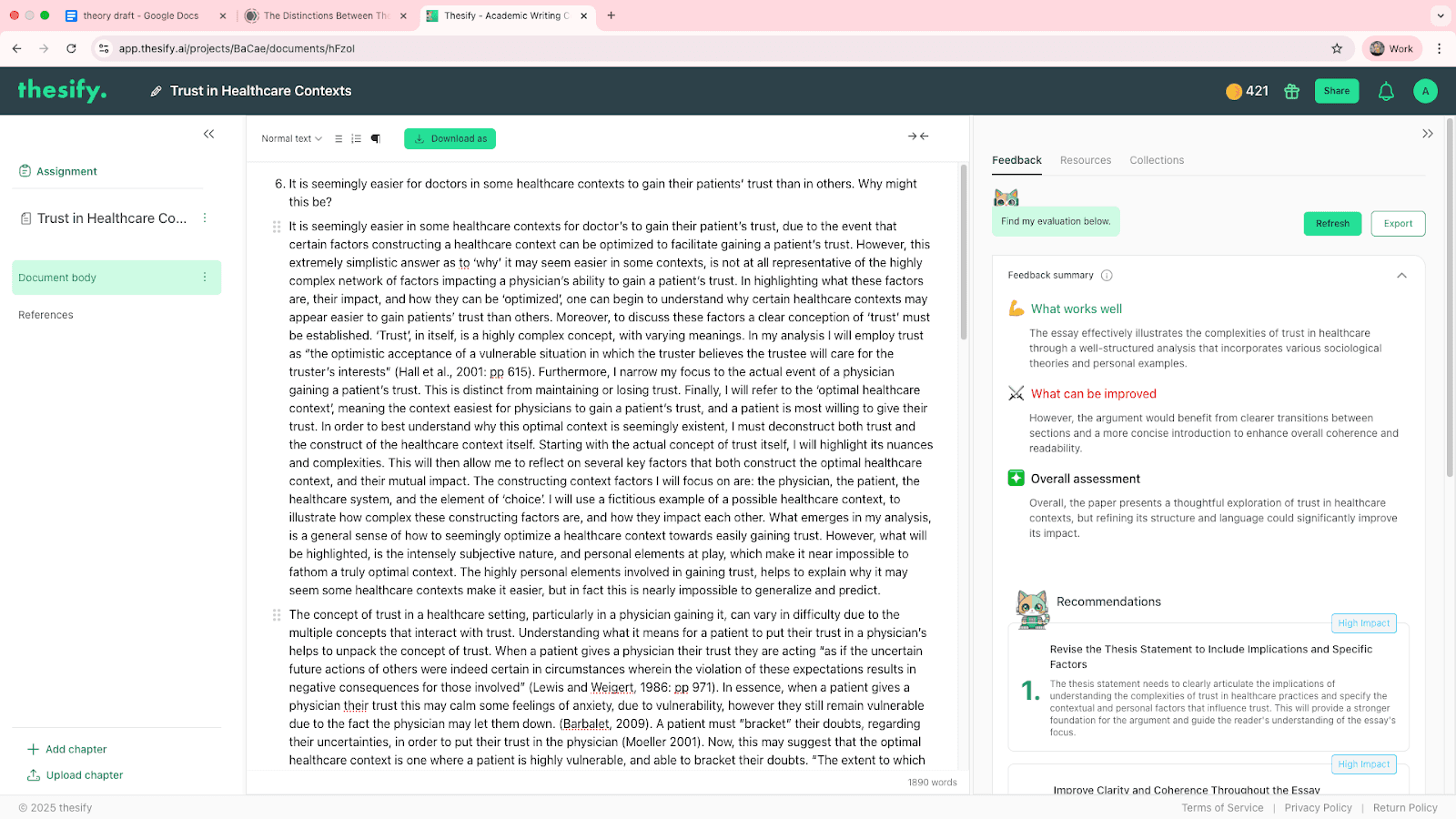
Simulating a professional pre-submission environment. By flagging structural problems before they become "expensive" to fix, thesify ensures your novelty is both visible and defensible.
Locate the exact place where novelty should be visible.
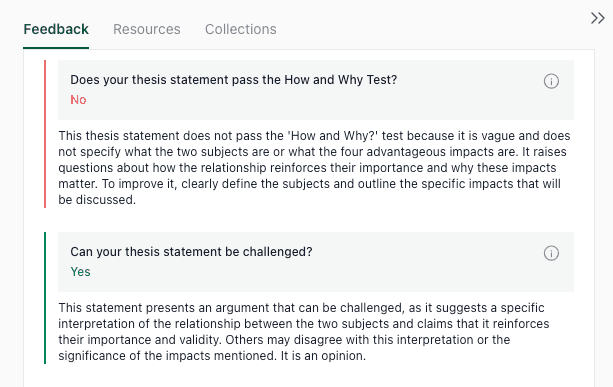
thesify flags when a central claim is too vague to pass a basic “how and why” standard, and whether it reads as an arguable position a reviewer can assess.
In practice, this is usually your Introduction (gap and aim), then the Methods and Results logic that makes the novelty claim defensible. thesify’s section-level feedback is designed to target Methods, Results, and Discussion, which are routinely treated as decisive sections in evaluation.
Use Chat with Theo to red-team your novelty claim in your own words.
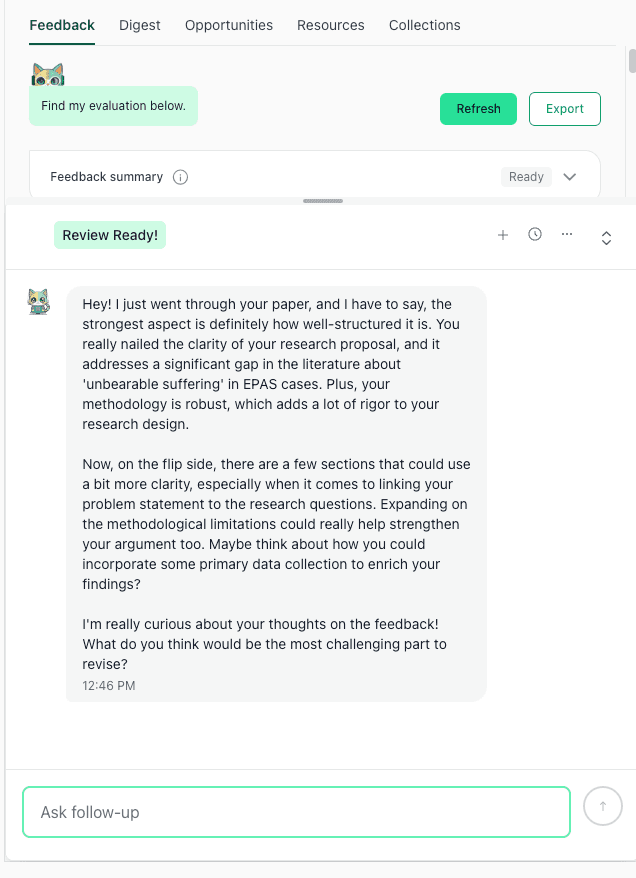
Chat with Theo provides a reviewer-style summary of what is clear, what is underspecified, and which revisions will most improve gap and contribution clarity.
Chat with Theo and ask Theo to:
Restate your novelty claim in one sentence
List the assumptions that must be true for that sentence to hold
Propose the strongest counter-claim a skeptical reviewer could make.
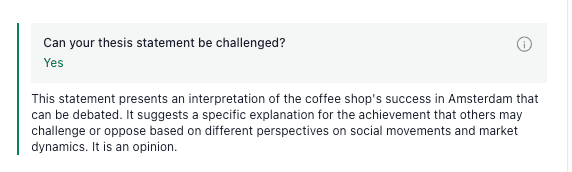
thesify helps you test whether your core claim is genuinely contestable, which is a useful proxy for whether your contribution is framed as an argument rather than a description.
Then ask Theo to point to the specific paragraphs where your draft does or does not answer those challenges. This keeps authorship in your voice while turning feedback into a revision plan.
Convert critique into a revision checklist you can execute.
Export a feedback report, then turn each flagged issue into a concrete edit task (tighten scope, add a boundary condition, clarify the mechanism, align claims with design).
Conclusion: Making Novelty Scorable
If you want reviewers to credit your work as novel, you need to make the novelty claim easy to verify. Editors frequently desk reject manuscripts when originality, novelty, or significance are not clear from the framing, even if the underlying work is solid.
A reliable way to prevent that outcome is to present a short, auditable chain of reasoning:
Map the status quo so you can state what the field currently treats as established.
Name a specific gap (missing mechanism, unresolved contradiction, boundary condition, or method that no longer fits the data).
State your novelty as a direct response to that gap, in concrete terms (new evidence, method, model, dataset, or test).
Signal the move explicitly using conventional introduction structure, where you establish the territory, establish the niche, then occupy the niche with your study’s purpose and contribution.
Bound the claim so it matches what your design can support, which is the difference between a credible contribution and an overreach. (This expectation is explicit in reviewer-facing evaluation criteria that include innovation and significance.)
Ready to stress-test your novelty claim against reviewer logic?
Sign up for thesify for free, upload your draft, and run a pre-submission review to audit your gap and contribution.
Related Posts
Scientific Paper Introduction: Fix Gap-Aim Alignment: Is your introduction just a summary? Scientific paper introduction structure should make your rationale explicit. In a research paper introduction, you justify the study by linking three elements in sequence: what is known, what is missing (the research gap), and an aim that directly addresses that gap. When the gap does not logically require the aim, the opening reads as topic description rather than a defensible argument for why the study was needed. Use thesify to check research gap–aim alignment, problem significance, and positioning for a clearer rationale.
The Logic Audit: How to Survive a 2026 Grant Review Panel: In the current funding landscape, the "Signal-to-Noise" ratio of your research proposal determines its survival. With application volumes at record highs—and success rates for major federal awards like the NIH R01 often falling below 15%—reviewers have transitioned from reading for interest to reading for structural failure. To win, your grant must survive a "Logic Audit": a rigorous self-scrutiny process that prioritizes evidence alignment over persuasive prose.
Scientific Paper Discussion Section Feedback: How to Stress-Test Your Claims: Your Discussion section is where you must bridge the gap between your raw numbers and the broader field, answering the "So What?" question without overstepping your evidence.To help you navigate this balance, thesify offers specializedsection-level feedback designed to stress-test the logic of your Discussion. Unlike a standard grammar check, this feedback evaluates the validity of your claims, the specificity of your limitations, and the feasibility of your future research suggestions.