Fix Weak Analysis Patterns in Academic Writing

If you have been told that your academic writing is too descriptive or that it needs more analysis, the problem is usually not a lack of information. The problem likely lies in that your draft presents evidence without fully interpreting it or showing how it supports your thesis statement. To improve analysis in academic writing, you need to understand what weak analysis looks like on the page.
This guide explains the most common weak analysis patterns and how to revise them.In academic writing, analysis is the component of a paragraph that interprets evidence, explains significance, and connects specific points to the overarching argument. When that step is missing, the writing may be clear and well researched, but the reasoning will still feel underdeveloped.

Understanding Analysis vs Summary vs Evidence
In academic writing, summary, analysis, and evidence do different jobs.
Summary establishes what a source, event, or study says.
Analysis explains what that material means, how it works, why it matters, or what follows from it.
Evidence provides the support that analysis interprets and connects back to the argument.
University of Reading defines analytical writing as writing that moves beyond brief description to answer questions such as why, how, and so what. While summary reports what a text says, analysis examines its internal logic and broader significance. University of Michigan's writing guide makes the same point in practical terms: wherever evidence appears, analysis should connect it back to the main argument.
The distinctions below are useful because weak analysis often begins when summary or evidence is mistaken for analysis. A paragraph may accurately describe a source or present relevant data, yet still remain underdeveloped if it does not interpret significance, explain relationships, or show how the evidence supports the thesis statement.
Element | Main Job | Core Question | What It Looks Like on the Page |
Summary | Establish context or report content accurately | What happened? What does the source say? | Condensed restatement of the main point, event, or finding |
Evidence | Support a claim with quotations, data, examples, or findings | What support is available? | Quoted material, statistics, examples, study results |
Analysis | Interpret and explain significance | Why does this matter? How does this work? So what? | Explanation of implications, relationships, tensions, and argumentative relevance |
This distinction is especially important when revising academic drafts. Summary is often necessary, and evidence is often strong, but neither one can carry the argument on its own. Analysis is the step that explains why the summary matters and what the evidence shows in relation to the thesis.
Why the Distinction Matters in Practice
A sentence can include citations and still remain weak if it only presents information without interpreting it. Even in peer-reviewed scholarship such as Singh (2013), analytical gaps occur when high-quality sources are presented without an explicit explanation of their relevance to the specific argument. This is the critical difference between presenting evidence and analyzing it.
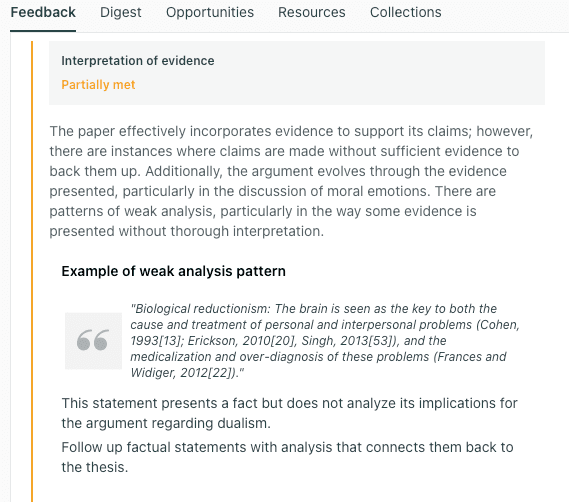
thesify shows that a sentence can include citations and source material but still needs stronger analysis to explain its significance for the argument.
Summary vs Analysis Example
Mostly Summary:
“The cited sources argue that biological reductionism treats the brain as central to the cause and treatment of personal and interpersonal problems, which can contribute to medicalization and over-diagnosis.”
Shift Toward Analysis:
“This matters for the argument about dualism because the cited sources do not simply describe a medical trend. They show how biological reductionism narrows the explanation of human problems to brain-based accounts, which sidelines broader social and interpersonal dimensions. In this context, the evidence supports the claim that dualist thinking is weakened when complex human experience is interpreted through an exclusively biomedical framework.”
The second version works better because it does not stop at restating what the sources say. It explains why that material matters and how it supports the paragraph’s larger point.
A Quick Check Before You Move On
Before treating a sentence as analysis, ask:
Does it explain why the point matters?
Does it explain how the evidence supports the claim?
Does it answer so what for the reader?
Does it connect the point back to the thesis?
If the answer is no, the sentence may still be functioning as summary or evidence rather than analysis.
6 Common Weak Analysis Patterns in Academic Writing
This section identifies six common weak analysis patterns in academic writing. For each one, it explains why the pattern weakens an argument, shows what it looks like on the page, and outlines the kind of revision it requires. The goal is to help you recognize these patterns before moving to diagnosis and detailed revision.
Naming a Consequence Without Explaining Its Significance
A weak analysis pattern appears when a sentence identifies a consequence but does not explain why that consequence matters. The writing points to an outcome, but stops before clarifying its analytical significance for the argument.
Weak Analysis Example: Naming a Consequence
In the example below, the sentence introduces the idea that objectifying suffering in biomedicine can leave uncategorizable patients in a kind of “healthcare system purgatory.” This is a potentially important point, but it remains incomplete as analysis because the consequence is named without being fully interpreted.
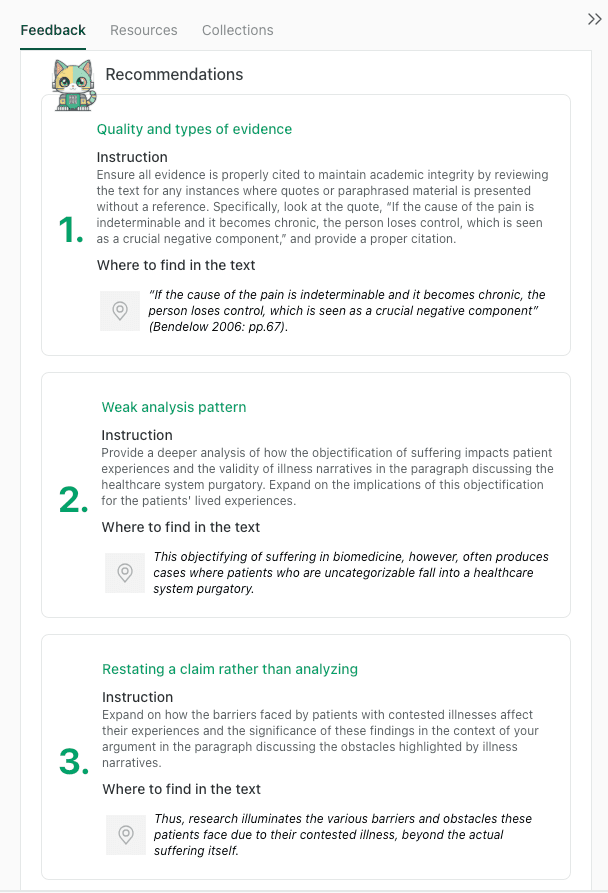
By only identifying a result, the writer fails to clarify the interpretive weight of the finding, stalling the progression of the argument.
How to Fix Analysis That Names a Consequence Without Explaining Its Significance
To strengthen this kind of analysis, you need to explain:
What the consequence reveals
Why it matters for the paragraph’s specific claim
How it affects the broader thesis statement
What the reader should understand from it
By moving beyond simply identifying the consequence, you actively clarify its interpretive weight and drive the argument forward.
Restating a Claim Rather Than Analyzing It
This pattern weakens analysis because it repeats the paragraph’s main point without extending the reasoning. The sentence returns to the claim, but does not clarify its significance, develop its implications, or show what the reader should understand from it analytically.
Weak Analysis Example: Restating a Claim
This example sentence states, “that suffering may be subjective, while both the RTE and physicians attempt to objectify that experience.” That may accurately reflect the paragraph’s central tension, but it remains limited as analysis because it largely repeats the claim rather than developing it.
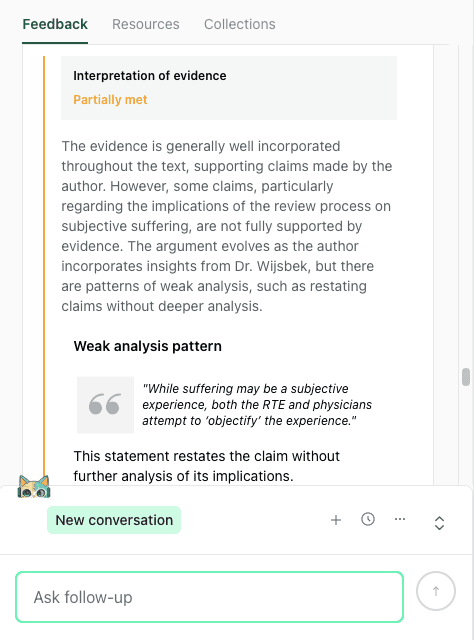
thesify flags a weak analysis pattern where a sentence repeats the paragraph’s core claim without adding deeper interpretation.
How to Fix Analysis That Restates a Claim Rather Than Analyzing It
To push past mere repetition, you need to explain:
What the initial claim actually reveals
Why the tension matters for the paragraph’s specific argument
What follows from the claim analytically
How the claim connects to the broader thesis
A draft becomes stronger when it moves beyond repetition and explains the significance of the claim.
Making an Interpretive Claim Without Demonstrating It
Delivering a decisive judgment without showing your analytical reasoning is a major structural flaw in academic writing. Even if a conclusion is entirely plausible, presenting it without the foundational reasoning or evidence turns the sentence into an assertion rather than a demonstration.
Weak Analysis Example: Making an Interpretive Claim
In the example below, the sentence states that “Norwood’s success is due to her perseverance and passion.” While this may be a reasonable observation, it remains underdeveloped as analysis. The sentence identifies a cause, but it moves straight to interpretation without demonstrating what specific actions, data, or text in the paragraph justify that claim.
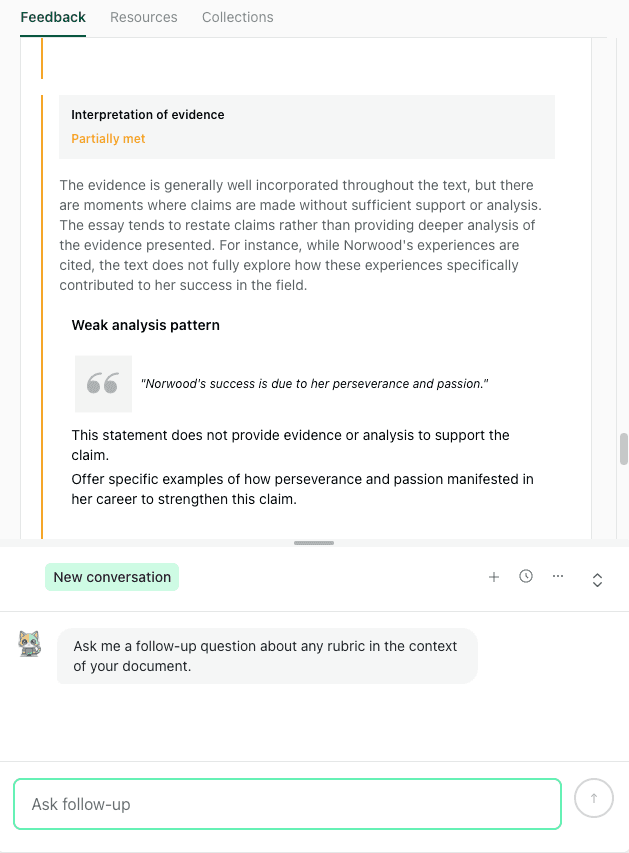
How to Fix an Undemonstrated Interpretive Claim
To make this conclusion persuasive, you need to explain:
What specific evidence or data led directly to this interpretation
How the subject's actions explicitly demonstrate the claim
Why this interpretation is the most logical conclusion to draw from the research
How this judgment connects back to the paper's central thesis
Rather than demanding the reader simply trust your conclusion, strong analysis transparently demonstrates the intellectual steps taken to get there.
Presenting Evidence Without Interpreting It
When a paragraph includes relevant evidence but stops at the level of reporting it, the analysis remains incomplete. The data, quotation, or finding may be credible and clearly presented, yet the analysis remains incomplete because the reader is not told what the evidence means or why it matters for the argument.
Weak Analysis Example: Presenting Evidence Without Interpreting It
Here, the draft successfully reports survey findings about the lack of Spanish-language autopsy consent forms and the negative effect this has on communication. However, the paragraph remains analytically limited because the figures are presented without explaining what they mean for healthcare practice, language access, or patient outcomes.
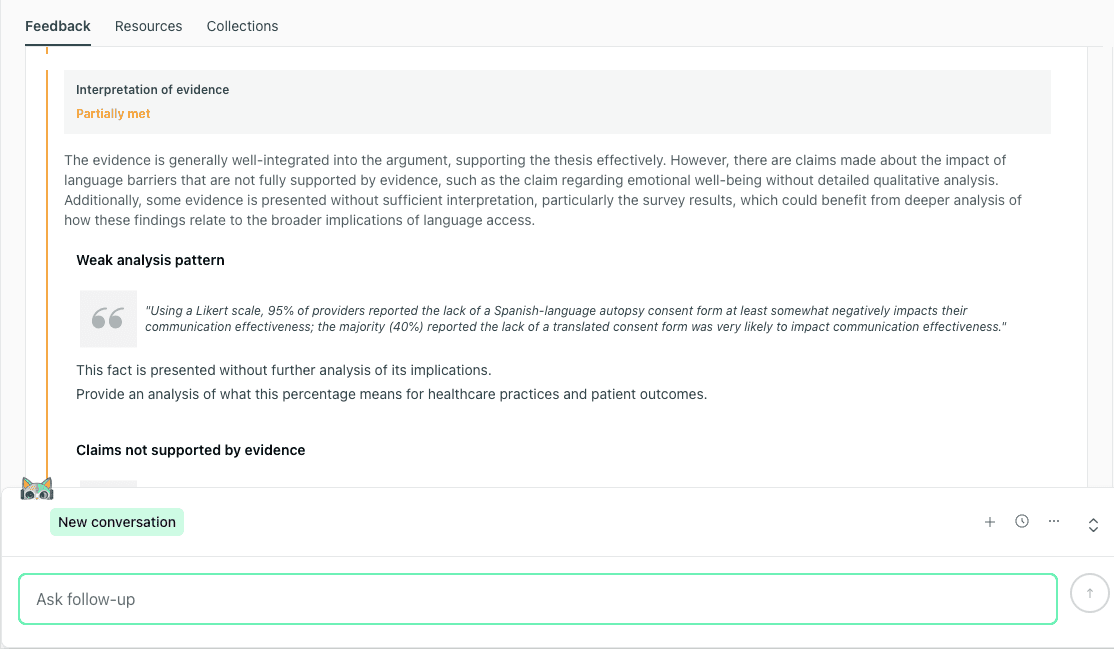
thesify flags a weak analysis pattern where relevant data is reported, but its implications are not yet interpreted for the reader.
How to Fix Analysis That Presents Evidence Without Interpreting It
To extract the meaning from your data, you need to explain:
What the evidence shows
Why the evidence matters for the paragraph’s specific claim
What the reader should conclude from the data
How the evidence connects to the broader thesis statement
Raw data is just your starting point; your job as a researcher is to apply it directly to the problem at hand.
Making a Normative Assertion Without Analytical Support
Normative assertions weaken analysis when a writer moves from interpretation to judgment without establishing the reasoning needed to support that move. A normative claim becomes weak when a writer moves from interpretation to judgment without showing the reasoning that supports that move. If a paragraph states what should be done without grounding that claim in evidence or theory, the argument remains underdeveloped.
Weak Analysis Example: Making a Normative Assertion
In the draft below, the writer forcefully asserts that prospective parents should be required to pass an evaluation before having children. It fails as academic analysis because it leaps directly into a massive evaluative judgment without demonstrating the specific reasoning or ethical frameworks required to justify it.
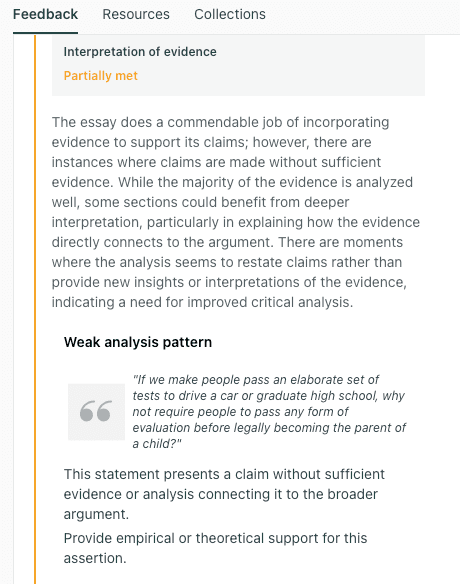
thesify flags a weak analysis pattern where a paragraph shifts into a normative claim without fully developing the analytical basis for that judgment.
How to Fix an Unsupported Normative Assertion
To turn an opinion into a defensible academic argument, you need to explain:
The specific evidence or theoretical framework that justifies this ethical or policy judgment
Why this proposed solution logically follows from the preceding data
How potential counterarguments or complexities factor into this judgment
How this normative claim connects directly to your central thesis
By grounding your advocacy in rigorous, step-by-step reasoning, you transform a fragile opinion into a scholarly conclusion.
Making a Comparative Claim Without Establishing the Basis of Comparison
Claiming that a case study, text, or historical event is ‘unique’ or ‘unlike any other’ requires clear criteria of comparison. However, this becomes a structural weakness if you never actually define the specific criteria or parameters used to measure that difference.
Weak Analysis Example: Making a Comparative Claim
Look at the sentence below claiming that Cho’s attack is distinctive and unlike any other massacre. The statement sounds confident, but the comparison is asserted rather than established. The reader is told the case is different, but not whether that difference is based on scale, motive, media treatment, or historical context.
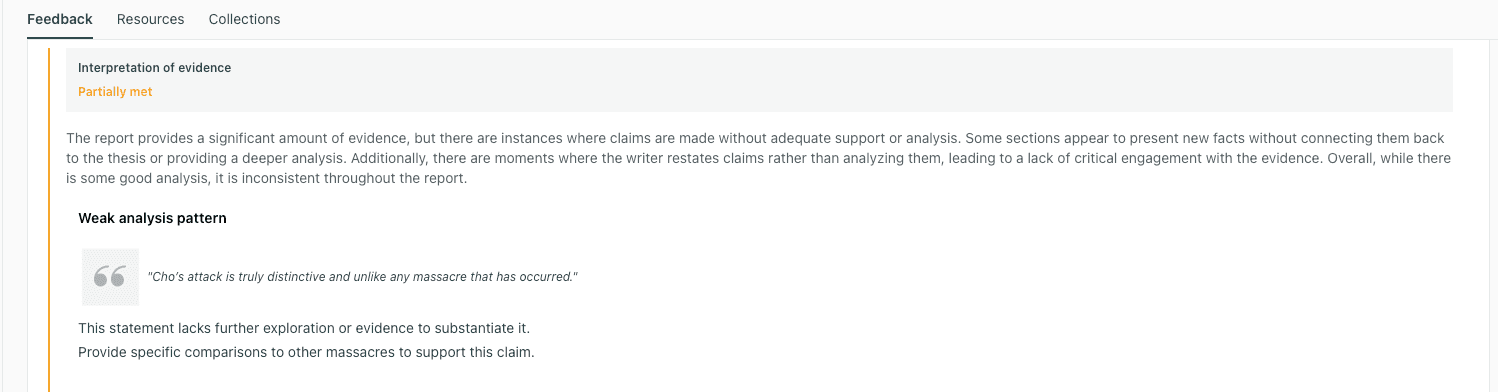
thesify flags a weak analysis pattern where a sentence claims something is unique or distinctive without establishing the grounds for that comparison.
How to Fix a Vague Comparative Claim
To make a comparative analysis valid, you need to explain:
What specifically is being compared
Which criteria define the comparison
Why the difference matters for the paragraph’s specific claim
How the comparison supports the broader thesis
A comparison only works when the parameters are clearly defined, allowing the reader to evaluate the contrast objectively.
Diagnosing Weak Analysis in Your Draft
After spending a long time on a draft, it becomes harder to notice gaps in your own reasoning. Prior knowledge of your own intent often leads you to subconsciously bridge logical gaps that remain unaddressed on the page. Consequently, self-diagnosing analytical gaps requires a deliberate, structured approach to overcome inherent draft blindness.
Underdeveloped analysis does not only weaken individual sentences. It can also leave the paper’s main interpretive questions only partly answered.
Self-Diagnosing Weak Analysis Patterns in Your Draft
One of the clearest signs of underdeveloped analysis is that important questions remain only partly answered. A paragraph may identify an issue, introduce evidence, or gesture toward an implication, but stop before explaining why that point matters, what it shows, or how it advances the argument. When this happens repeatedly, the draft may appear coherent on the surface while still leaving its core analytical work unfinished.
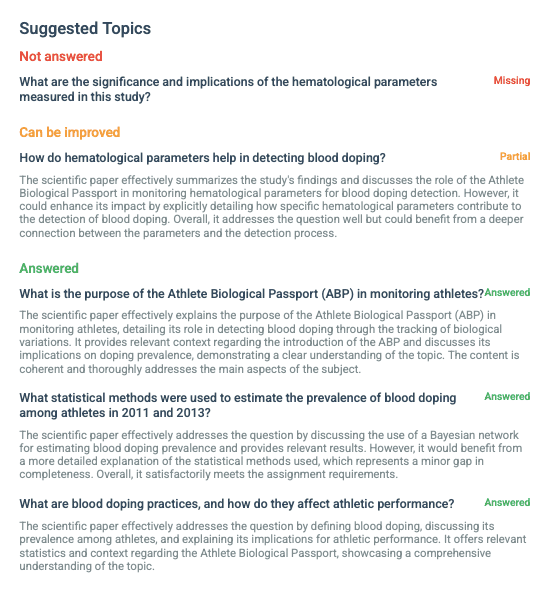
thesify shows how weak analysis often leaves key interpretive questions unanswered or only partially addressed.
Weak Analysis Self-Audit Checklist
Before submitting your manuscript, use the questions below to assess whether a paragraph is analyzing rather than only summarizing, reporting, or asserting:
Does the sentence explain why the point matters?
Does it explain how the evidence supports the claim?
Does it clarify what follows from the point analytically?
Does it interpret the evidence rather than simply present it?
Does it move beyond repeating the claim in different words?
Does it connect the paragraph’s reasoning back to the thesis statement?
Does it leave any major implication, tension, or comparison underexplained?
Does the paragraph fully answer the interpretive question it seems to raise?
Whenever you introduce a quote, statistic, or case study, read through your draft and ask yourself these four diagnostic questions:
Am I interpreting or just restating?
If you remove your sentence, does the evidence stand on its own? If yes, you are merely summarizing. Your analysis must add a layer of meaning that the raw data does not possess.
Have I answered the "So what?" question?
Does the paragraph explicitly state why this specific piece of evidence matters to the field or to your broader argument?
Is the underlying reasoning transparent?
Have you demonstrated the intellectual steps between the data and your conclusion, or are you just expecting the reader to take your word for it?
Does this link directly back to the thesis statement?
Is the connection to your central claim explicitly written on the page, or is it merely implied?
How thesify Helps You Diagnose Weak Analysis
thesify’s feedback report helps diagnose weak analysis by doing more than flagging a paragraph as underdeveloped. It identifies the type of issue involved, such as weak interpretation of evidence, gives a concrete instruction, and points to the exact place in the draft where the problem appears. That makes it easier to see whether a paragraph is presenting evidence without analyzing its implications, restating a claim, or leaving an important point underexplained.
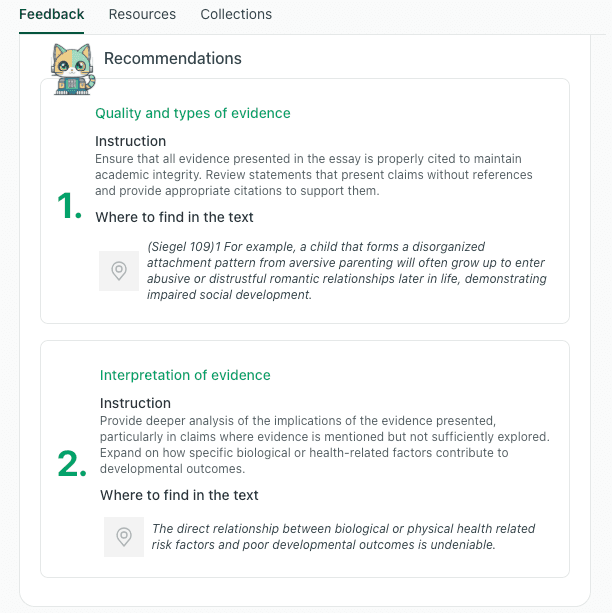
thesify helps diagnose weak analysis by identifying gaps in interpretation of evidence and showing exactly where they appear in the draft.
Revising Weak Analysis: Before and After Examples
This section provides before-and-after examples of weak analysis in academic writing. The examples are drawn from real drafts reviewed in thesify and are used to show how common weak analysis patterns can be revised into clearer, more persuasive analytical writing. The focus is on what changes on the page, and why those changes strengthen the argument.
Revision Example 1: Developing an Unexplained Consequence
The sentence below names a consequence, but does not explain why that consequence matters for the argument. It points to an outcome, but leaves its analytical significance underdeveloped.
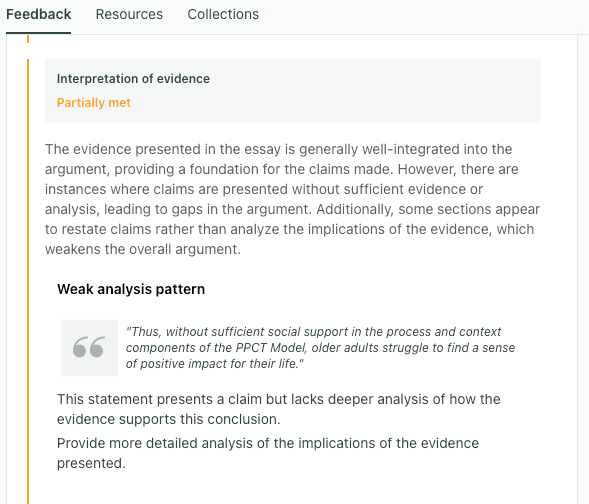
thesify identifies a weak analysis pattern where a sentence names a consequence but does not explain why that consequence matters for the argument.
Before: Stating an Unexplained Consequence
"Thus, without sufficient social support in the process and context components of the PPCT Model, older adults struggle to find a sense of positive impact for their life."
The Analytical Gap
The sentence identifies a consequence, namely that older adults struggle to find a sense of positive impact, but stops there. The problem is not the conclusion itself. The problem is that the paragraph does not explain how the evidence supports that conclusion or why the consequence matters within the PPCT framework. The outcome is named, but its theoretical significance remains undeveloped.
After Revision: Interpreting the Mechanism and Significance
“Thus, without sufficient social support in the process and context components of the PPCT Model, older adults struggle to find a sense of positive impact in their lives. Because the PPCT framework depends on regular, reciprocal interactions through proximal processes, the absence of community integration does not simply reduce well-being. It weakens the developmental conditions through which older adults sustain meaning, connection, and resilience. In this way, the consequence is not only personal but structural, which supports the argument that later-life cognitive decline must be understood in relation to social context rather than biology alone.”
Impact of Interpretation:
It unpacks the mechanism: Rather than just stating the consequence, the revision explains exactly how the lack of support causes the issue by defining the components of the theory.
It establishes significance: It connects the specific struggle of older adults to a much larger, arguable thesis (that cognitive decline is structural and social, rather than solely biological).
Revision Example 2: Developing a Restated Claim into Analysis
The sentence below repeats the paragraph’s main point, but does not extend the reasoning. It returns to the central tension, but stops before explaining what that tension reveals or why it matters for the argument.
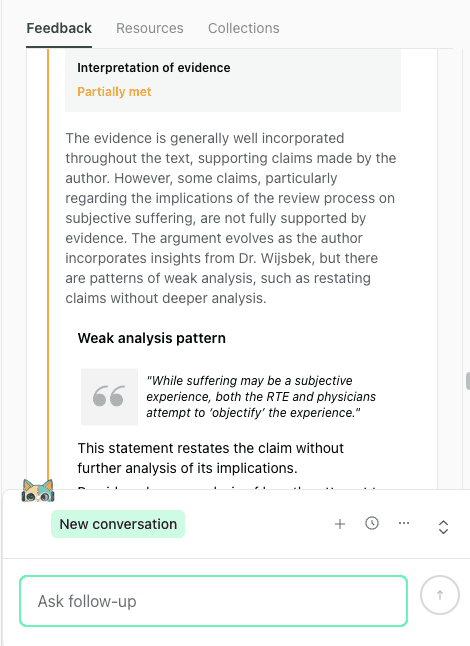
thesify identifies a weak analysis pattern where a sentence repeats the paragraph’s core claim without adding deeper interpretation.
Before: Restating the Claim
“While suffering may be a subjective experience, both the RTE and physicians attempt to ‘objectify’ the experience.”
The Analytical Gap
The sentence successfully identifies a conflict (subjective suffering vs. objective evaluation) but immediately stops. As the thesify feedback points out, it merely restates the premise. The writer observes what the institutions are doing, but fails to analyze how this attempt at objectification actually impacts the patient or why it matters to the paper's broader argument.
After Revision: Explaining the Tension and Its Implications
“While suffering may be experienced subjectively, both the RTE and physicians attempt to objectify it through evaluative procedures that translate personal distress into administratively legible criteria. This matters because the review process does not simply record suffering. It determines which forms of suffering can be recognized as credible within institutional frameworks. The tension, then, is not only between subjectivity and objectification, but between lived experience and the standards through which that experience is judged and authorized.”
Analytical Transformation:
It Moves Beyond Restatement: Rather than repeating the paragraph’s central claim, the revision explains what the tension actually reveals.
It Clarifies the Implications: The revision shows why objectification matters by connecting it to institutional recognition and credibility.
It Develops the Argument: The sentence no longer stops at naming the tension. It explains how that tension supports the broader claim about subjective suffering and institutional judgment.
Revision Example 3: Demonstrating an Interpretive Claim with Evidence
Returning to our earlier example of making an interpretive claim without demonstrating it, the problem here is not that the conclusion is implausible. The problem is that the paragraph states the interpretation without showing how the evidence leads to it.
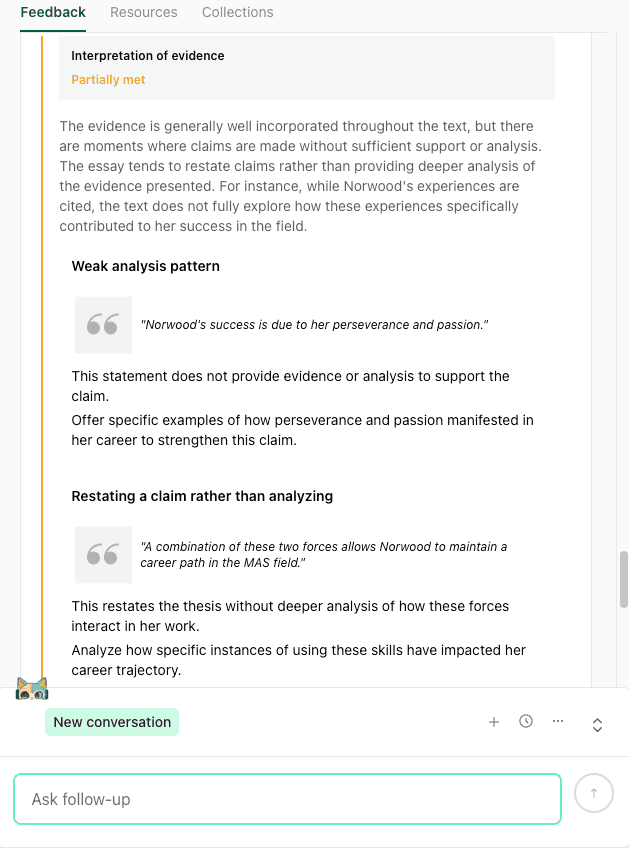
thesify identifies a weak analysis pattern where a sentence makes an interpretive claim without showing how the evidence supports that conclusion.
Before: Stating an Interpretive Claim Without Demonstrating It
“Norwood’s success is due to her perseverance and passion.”
The Analytical Gap
This claim offers an interpretation, but it does not show how the writer arrived at it. The paragraph does not identify which experiences, actions, or patterns in Norwood’s career justify treating perseverance and passion as the main explanation for her success. The conclusion is stated, but the analytical basis for it remains unstated.
After Revision: Demonstrating the Interpretation Through Evidence
"Norwood's success in the MAS field stems directly from her perseverance and passion. By consistently securing grant funding despite three consecutive early-career rejections, she demonstrated a resilience that allowed her to sustain her research agenda when others abandoned the topic. This relentless drive ultimately positioned her to make the breakthrough discovery that defined her career."
How the revision closes the gap:
It provides the evidence: It grounds the abstract traits ("perseverance" and "passion") in concrete, observable actions (securing grant funding despite repeated rejections).
It demonstrates the interpretation: It explicitly connects those specific actions to the outcome (sustaining her research agenda and making a breakthrough), proving why the initial claim is accurate rather than just demanding the reader believe it.
Revision Example 4: Presenting Evidence Without Interpreting It
This example is adapted from a published study on doping prevalence in elite athletics (Ulrich et al., 2017). It demonstrates a common error: dropping quantitative data into the text without explaining what that number means for the broader argument.
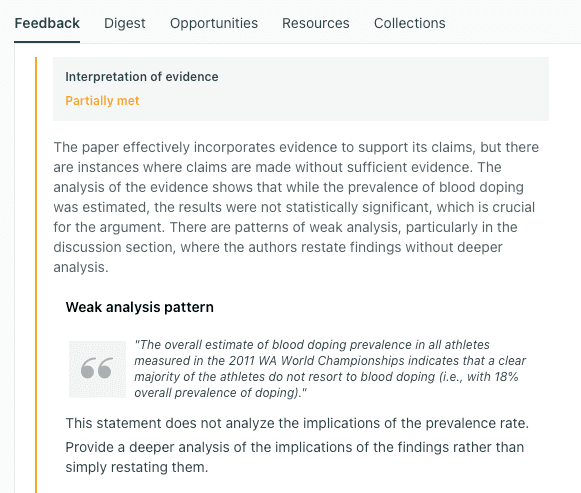
thesify identifies a weak analysis pattern where a sentence reports a prevalence finding but does not explain what that result means for the argument.
Before: Reporting Evidence Without Interpretation
“The overall estimate of blood doping prevalence in all athletes measured in the 2011 WA World Championships indicates that a clear majority of the athletes do not resort to blood doping (i.e., with 18% overall prevalence of doping).” (Ulrich et al., 2017)
The Analytical Gap
The sentence reports the prevalence estimate, but stops at description. It tells the reader what the number is, but not why that number matters. The paragraph therefore presents a result without clarifying its significance for the study’s claims about doping, prevalence, or interpretation of the findings.
After Revision: Interpreting the Significance of the Data
“The overall estimate of blood doping prevalence in athletes measured during the 2011 WA World Championships suggests that most athletes were not engaging in blood doping, with an estimated prevalence of 18%. Analytically, however, this figure still matters because it indicates that doping was not marginal or negligible within the competition. Even if the majority of athletes did not dope, the prevalence remains high enough to support the study’s broader concern with detection, monitoring, and the limits of relying on surface-level assumptions about prevalence in elite sport.”
How the Revision Closes the Gap
It Moves Beyond Reporting the Result: The revision does not stop at stating the prevalence estimate.
It Explains Why the Finding Matters: The revised version shows why 18% is analytically significant in the context of the study.
It Connects the Evidence to the Broader Argument: The sentence now links the result back to the paper’s larger claims about detection and interpretation in elite sport.
Revision Example 5: Grounding a Normative Assertion in Analysis
Returning to our earlier example of making a normative assertion without analytical support, the weakness here is not that the sentence takes a position. The problem is that it moves to a strong policy judgment without establishing the evidence, reasoning, or framework needed to justify it.
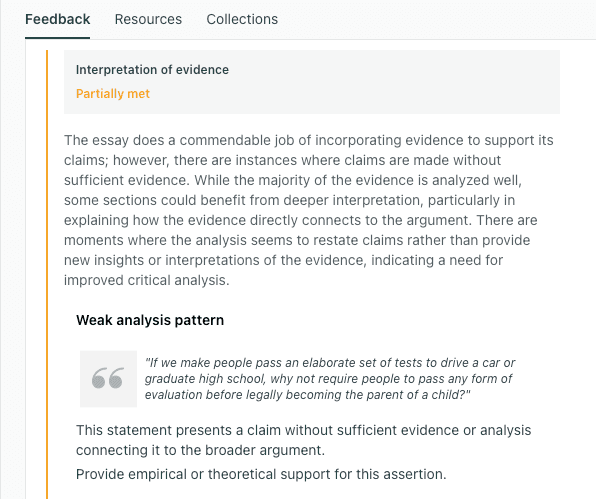
thesify identifies a weak analysis pattern where a sentence shifts into a normative claim without providing enough analytical support.
Before: Asserting a Normative Claim Without Support
"If we make people pass an elaborate set of tests to drive a car or graduate high school, why not require people to pass any form of evaluation before legally becoming the parent of a child?"
The Analytical Gap
The sentence makes a forceful comparison and arrives at a policy-style conclusion, but it does not establish why that conclusion follows from the argument. It assumes that the logic of testing in other domains can simply be extended to parenthood, without addressing the ethical, legal, or social differences involved. As a result, the sentence reads more like advocacy than analysis.
After Revision: Grounding the Assertion in Theoretical Frameworks
“Comparisons to driving tests or graduation requirements suggest that societies sometimes accept formal evaluation when individual actions have broader social consequences. However, extending that logic to parenthood requires far more careful justification, because reproduction raises distinct ethical, legal, and social questions that cannot be treated as equivalent to licensed or credentialed activities. Any argument for parental evaluation therefore needs to explain not only what harms such a system would prevent, but also how it could avoid discriminatory standards and remain ethically defensible.”.
How the Revision Closes the Gap
It Defines the Basis of the Comparison: The revision no longer assumes that testing in other domains automatically justifies evaluation in parenthood. It identifies the comparison and then limits it.
It Introduces Analytical Qualification: Rather than moving straight to a policy conclusion, the revision shows why the comparison is contested and why additional reasoning is needed.
It Grounds the Normative Claim in Argument: The revised version turns a rhetorical question into an analytical claim by identifying the ethical and social conditions that would need to be addressed.
It Shifts from Advocacy to Analysis: Instead of simply asserting what should happen, the revision explains what would need to be demonstrated before that conclusion could be defended.
Revision Example 6: Establishing the Basis of a Comparative Claim
Returning to our earlier example of making a comparative claim without establishing the basis of comparison, the weakness here is not that the sentence draws a comparison. The problem is that it declares one case to be unique without explaining what makes it distinct or why that distinction matters for the argument.
Before: Asserting a Vague Comparison
"Cho’s attack is distinctive and unlike any other massacre."
The Analytical Gap
The sentence confidently declares the event to be unique, but it stops there. It asserts a comparison without establishing what makes it different. Is it distinctive because of the scale, the motive, the media coverage, or the historical context? Without defined criteria for comparison, the claim lacks the necessary parameters for objective evaluation.
After Revision: Defining the Basis of Comparison
“Cho’s attack can be understood as distinctive not because mass violence itself was unprecedented, but because of the way the event combined multiple forms of public visibility, institutional failure, and cultural interpretation. Unlike accounts that treat the attack only as an instance of mass murder, this case drew unusual attention to the relationship between warning signs, mental health discourse, and media narration. Its distinctiveness, then, lies in how the event was framed and interpreted, rather than in the fact of violence alone.”
Establishing Comparative Rigor:
It Specifies What Is Being Compared: The revision no longer makes a vague claim of uniqueness. It clarifies that the comparison concerns framing, interpretation, and institutional context.
It Defines the Criteria of Comparison: The sentence identifies the dimensions that make the case distinctive, rather than leaving the basis of comparison unstated.
It Connects the Comparison to the Argument: The revised version shows why the comparison matters by linking it to the broader analytical discussion, not just to a rhetorical claim of exceptionality.
This revision is stronger because it turns a broad assertion into a defined analytical comparison.
Distinguishing Weak Analysis from Weak Evidence, Summary and Unsupported Claims
In academic writing, a "weak" paragraph usually fails in one of four specific ways. Understanding these distinctions matters because adding more research will not fix a logic gap, and adding more logic will not fix a lack of data.
1. Weak Evidence vs. Weak Analysis
Weak evidence is a sourcing problem. It manifests as vague claims, misaligned sources, or a total lack of citations. Even the most brilliant analysis cannot save a paper if the underlying data is non-existent or unreliable.
The Symptom: Your claims feel "thin" or "unproven."
The Fix: Conduct further research and integrate credible, peer-reviewed sources.
Visualizing the Evidence Gap
Even published research is not immune to these types of errors. In reality, even peer-reviewed papers can fall into descriptive traps. The following example shows thesify feedback generated on a scoping review of patient-provider communication (Kourou et al., 2023). Even in this published context, thesify identifies a clear split between a need for more data (Evidence) and a need for deeper reasoning (Analysis).
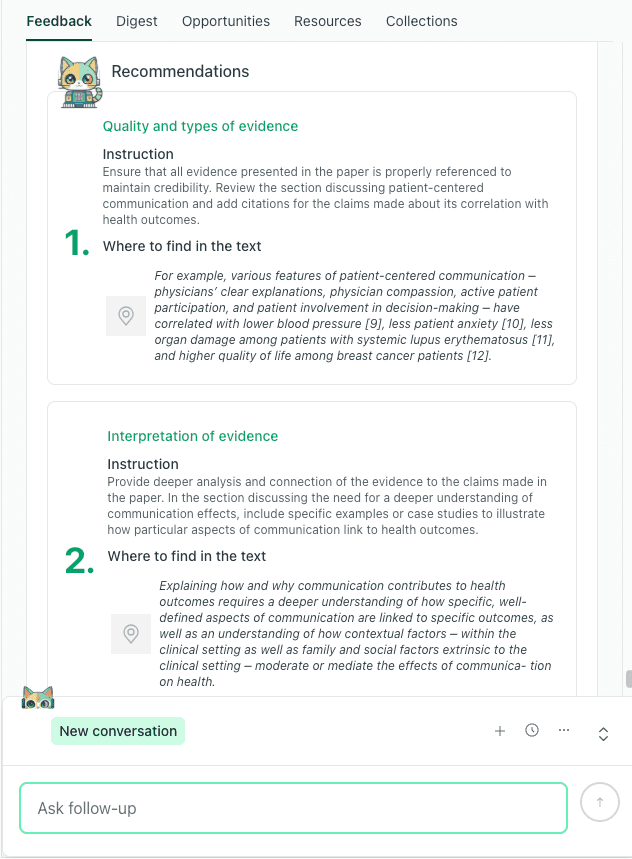
thesify categorizes issues separately so you know if you need more sources (1) or more original thought (2).
2. Summary vs. Analysis
Summary is a descriptive task. Its job is to condense "what happened" or "what the author said" so the reader has context. While some summary is necessary to set the stage, it should remain minimal.
The Symptom: Your paragraph reads like a book report or a play-by-play of an experiment.
The Fix: Apply the "So What?" test. After every descriptive sentence, write a sentence explaining what that description reveals about your thesis statement.
3. Unsupported Claims vs. Weak Analysis
An unsupported claim is an assertion presented without sufficient evidence. It occurs when you make a bold statement but provide no data to back it up. Weak analysis, on the other hand, often has the evidence present but fails to "connect the dots" or interpret its significance.
Diagnosing an Unsupported Claim
As seen in the screenshot below, an unsupported claim can occur when a writer presents a conclusion without the necessary factual bridge.
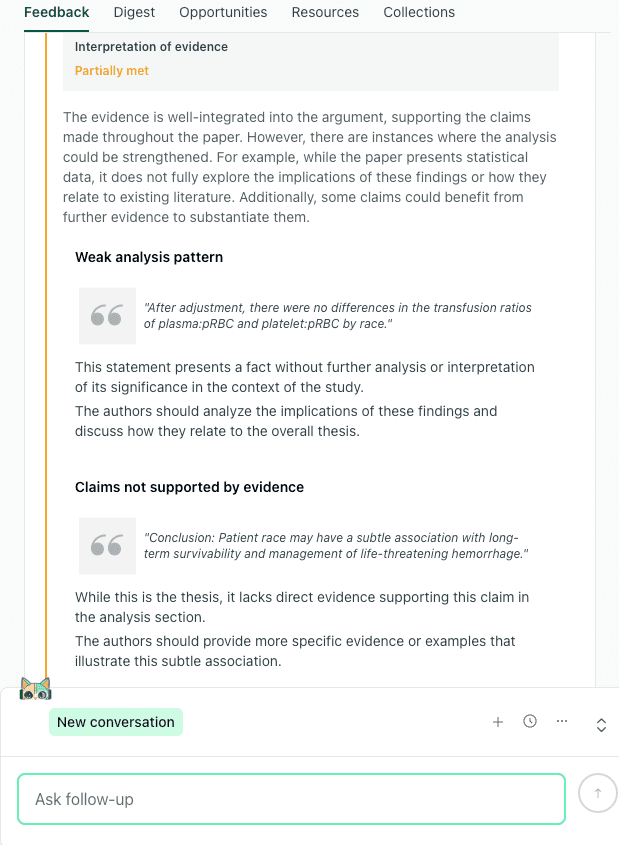
A claim is unsupported when it presents a conclusion (like the 'subtle association' above) without providing the specific data to justify it.
4. Critical Analysis: The Final Layer
Critical analysis is the interpretive work that happens after the evidence and summary are established. It is the process of evaluating the data, considering limitations, and building a reasoned argument.
Problem | Manifested as... | Primary Fix |
Weak Evidence | Vague data or missing citations. | More research/sourcing. |
Too Much Summary | Lengthy descriptions of "what happened." | Cutting description; adding "how/why." |
Unsupported Claims | Assertions without any data "bridge." | Adding specific examples or facts. |
Weak Analysis | Evidence is there, but significance is ignored. | Developing the "So What?" factor. |
Understanding Feedback: When Lecturers Say “Too Descriptive”
Receiving feedback that your work is too descriptive and not analytical is common in academic writing. It essentially means you are reporting facts or summarizing someone else's work without explaining their significance. You have answered "What happened?" but ignored "So what?" and "How does this prove my point?"
Decoding the Critique
When a lecturer flags a section as "too descriptive," they are noting that your voice has disappeared. You are reporting information rather than interpreting it. To move from description to writing critically, you must use your evidence as a platform for an argument, not a final destination.
Example of Descriptive Feedback
This example, adapted from a study on blood doping prevalence (Ulrich et al., 2017), shows how providing a statistic without interpreting its meaning results in writing that feels "too descriptive."
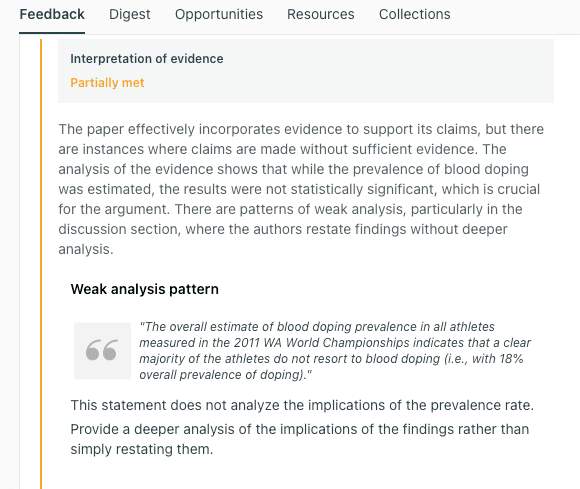
A typical "too descriptive" error: reporting a fact (18% prevalence) without explaining its significance to the argument.
How to Respond to Descriptive Feedback
If your draft is flagged for lack of analysis, you need to explain explicitly how the evidence supports your thesis statement.
Use these three questions to generate analytical content:
Why did this result occur or why did the author make this claim?
How does this specific piece of evidence change our understanding of the topic?
So what? If this evidence is true, what is the consequence for your overall argument?
Connecting Facts to the Thesis Statement
Effective feedback targets the gap between reporting a fact and constructing an argument. In this critique of a draft analyzing the social implications of neuroscience (Singh, 2013), the author stops at a definition rather than a conclusion.
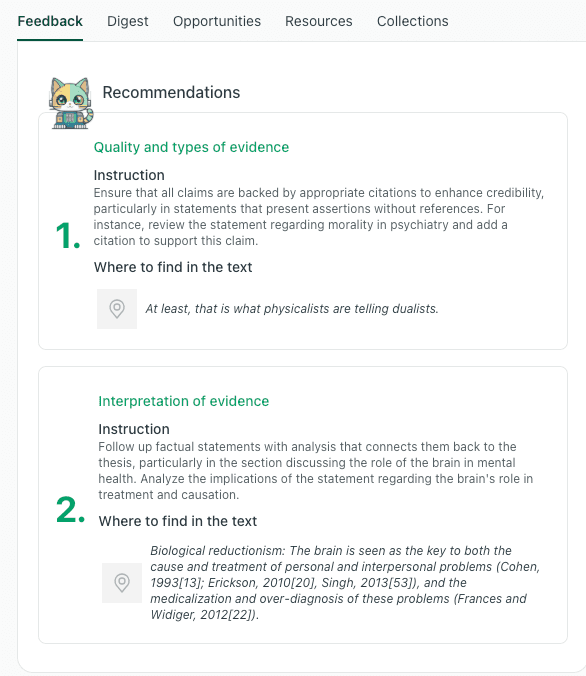
The "fix" for descriptive writing: Instruction 2 emphasizes connecting factual statements regarding biological reductionism back to the core thesis.
Next Steps: Seeking Further Support
If you are still struggling to strengthen your analysis, get feedback on specific paragraphs.
Meet with Tutors: Bring specific paragraphs that were flagged as "too descriptive" and ask them to help you verbally explain the "so what."
Writing Centers: Peer tutors are trained to spot summary-heavy writing and can help you brainstorm the reasoning needed to support your claims.
Discipline‑Sensitive Analysis Tips
Analysis does not look exactly the same in every field. The underlying task changes across disciplines, so the standard for strong analysis changes with it. A paragraph in a literature essay may need to interpret language and conceptual tension, while a paragraph in a social science or health research paper may need to explain the significance of a pattern, result, or institutional implication. The key question is not whether a sentence sounds academic. It is whether it does the kind of analytical work your discipline expects.
Humanities and Theory-Led Writing
In humanities and theory-led writing, analysis usually depends on interpretation. Your task is often to explain what a concept, distinction, formulation, or example reveals, and why that matters for the broader theoretical argument. A paragraph becomes weak when it introduces a powerful idea but leaves its conceptual or ethical implications underexplored.
This is especially important in essays that engage with abstract categories such as subjectivity, suffering, trust, legitimacy, or social recognition. In those contexts, strong analysis does not stop at naming the issue. It clarifies what the concept does in the argument and what follows from it.
To strengthen analysis in humanities and theory-led essays, explain:
What the wording, concept, or distinction reveals
Why that point matters for the paragraph’s argument
What tension, contradiction, or implication the example exposes
How the point connects to the broader theoretical debate
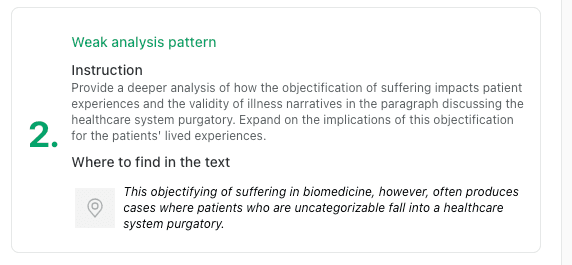
thesify shows that theory-led analysis needs to explain the significance of a concept, not just introduce it.
Social Science Research Papers
In social science writing, analysis usually depends on explaining patterns, mechanisms, and context. It is not enough to report what the data suggests or restate the main claim in different language. Stronger analysis shows how the evidence supports the argument, what contextual factors shape the finding, and why the result matters for the broader social question.
This matters especially in research on institutions, policy, inequality, and behavior. A paragraph may cite relevant data, but still remain analytically weak if it does not clarify what the pattern means, how it should be interpreted, or what competing explanation needs to be addressed.
To strengthen analysis in social science research papers, explain:
What pattern or relationship the evidence actually establishes
What mechanism or context may account for that pattern
Why the finding matters for the paper’s larger argument
Which alternative interpretation or limitation still needs to be considered
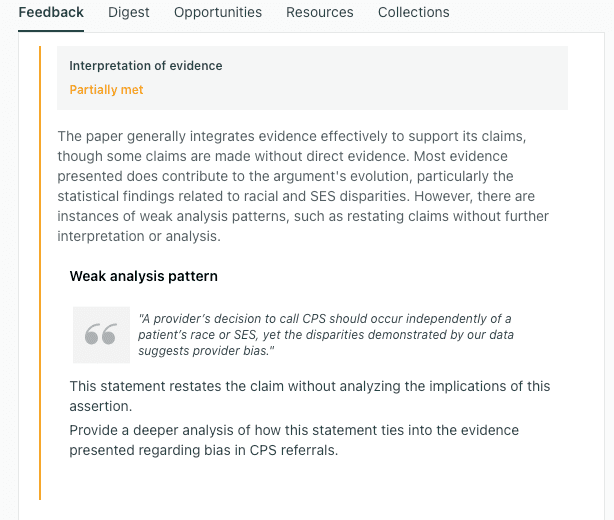
thesify shows that social science analysis needs to interpret what a pattern means, not just restate the claim it appears to support.
STEM and Applied Health Research
In STEM and applied health writing, analysis often depends on interpreting the significance of findings rather than simply reporting them. A result may be clearly stated, but the analytical work begins when you explain what that result means, how it relates to existing knowledge, what limits affect its interpretation, and what implications follow for practice or future research.
This is especially important in discussion sections. A paragraph can include data, citations, and technical language, yet still remain analytically thin if it does not explain why the finding matters or how the reader should understand it.
To strengthen analysis in STEM and applied health research, explain:
What the result means in scientific or practical terms
Why the finding matters for the study’s argument
What methodological or contextual limits shape the interpretation
What the result implies for practice, intervention, or future research
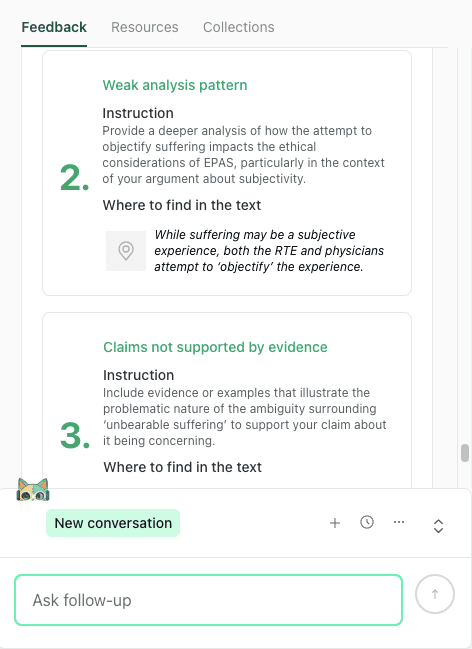
thesify shows that analysis in STEM and applied health writing must explain the significance of a result, not just report it.
A Quick Discipline Check
Before revising a paragraph, ask what kind of analysis the discipline actually requires:
In a humanities essay, the missing step may be conceptual interpretation.
In a social science paper, it may be contextual explanation or engagement with alternative explanations.
In STEM or applied health research, it may be the significance, limitation, or implication of a result.
The stronger your answer to that disciplinary question, the more precise your revision will be.
Tools and Strategies to Improve Analysis
Transitioning from description to interpretation requires a structured approach to your draft. By using the right frameworks and writing tools, you can systematically identify where your reasoning ends and where your analysis needs to begin.
1. Formulate Analytical Questions
One effective way for how to improve analysis is to interrogate your own evidence. Following Harvard’s writing guidelines, move beyond "Who" and "When" to ask "How" and "Why."
The "How" Question: How does this specific piece of data function within the larger system you are studying?
The "So What?" Question: If this evidence is true, what are the implications for your thesis statement? If you cannot answer this, your evidence is likely just filler.
2. Use Analytical Matrices and Mind Maps
Before you write, use an analytical matrix to map your sources against your key themes. This prevents you from simply summarizing one author at a time. A mind map helps you visualize the connections between disparate facts, making it easier to identify the "bridge" of reasoning needed to link them.
3. Critical Reading and Brainstorming
Critical reading involves looking for gaps in existing research. When you find a study that establishes a fact, brainstorm three different ways that fact could be interpreted. If you are still struggling to strengthen your analysis, get feedback on specific paragraphs.
4. Use thesify for Targeted Academic Feedback
Manually auditing every sentence for analytical depth is time-consuming. thesify functions as a pre-submission diagnostic tool that flags weak analysis patterns in real-time. Instead of just telling you that a section is "too descriptive," it provides specific, actionable instructions on how to deepen your reasoning.
Actionable Revision Advice
The screenshot below shows how thesify moves beyond simple error detection to provide a roadmap for revision, using text adapted from a published study on intimate partner violence (IPV) interventions (Tol et al., 2017). thesify identifies a "fact" (an integrated approach to IPV) and instructs the writer exactly how to explicitly address the cycle of violence rather than just stating it exists.
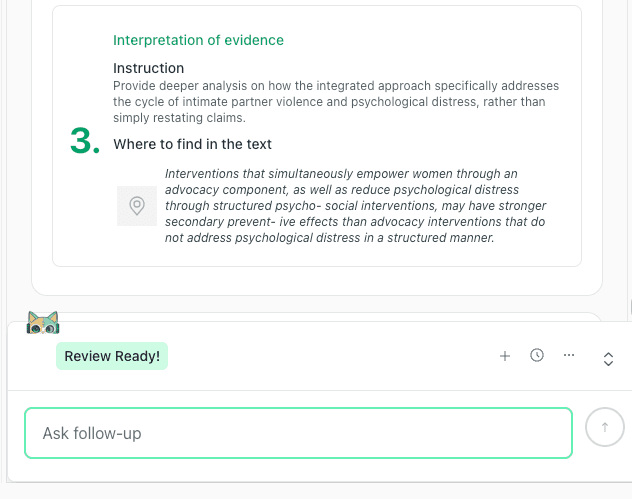
thesify provides a specific prompt: move from "stating" a fact to "analyzing" its implications for the cycle of violence.
Identifying Interpretive Gaps
When you introduce a new, complex idea—such as the "abstract nature" of a theoretical context—it is easy to forget to explain its significance to the reader. These are the moments where the reasoning "drops off."
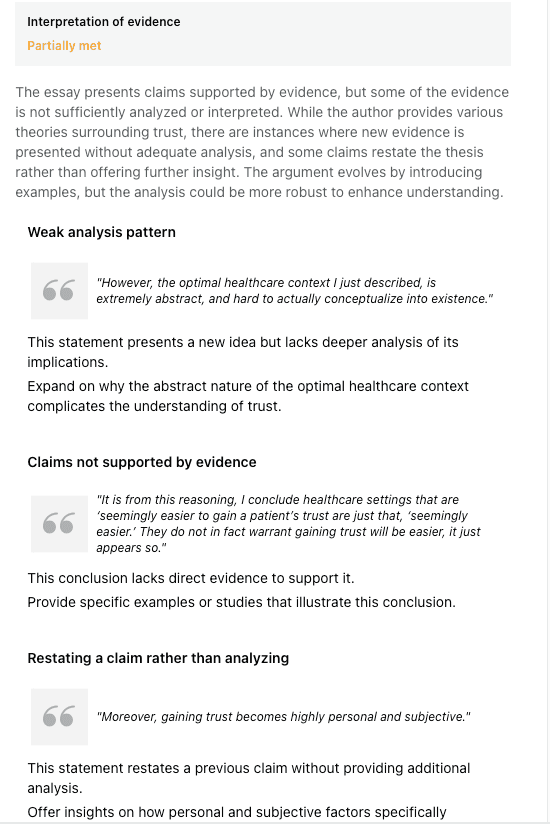
When a statement is flagged as a "new idea" without analysis, it is a signal to pause and explain how that concept changes the reader's understanding of the topic.
Conclusion: Building Strong Analytical Habits
To build a defensible argument, you must move beyond reporting facts to explaining their significance and how they specifically support your thesis statement.
The six patterns we’ve covered—from unexplained consequences to vague comparisons—all happen when a writer stops their thought process too early. Effective revision requires a consistent shift from reporting to interpreting. By explicitly addressing why a point matters and how it advances the broader thesis statement, you move beyond reporting information and into interpretation. Don’t leave the "So what?" for your reader to figure out.
The key is to check your analysis continuously. Every time you cite evidence or make a claim, ask if you have explicitly shown its importance. Rigorous interpretation, rather than a higher volume of data, is what ensures an argument's persuasiveness.
Try thesify for Free
If you want structured feedback on weak analysis patterns in your own draft, you can try thesify for free and see exactly where your reasoning needs to go further.

Related Posts
How to Fix Weak Evidence in Essays: A Guide for Academic Writers: Strong academic writing is about clarity, structure, and analysis — and evidence plays a central role in all three. Improving how you use evidence is one of the fastest ways to boost your overall grade or improve academic writing. Feedback from writing AI tools highlights this regularly. In hundreds of drafts, common patterns appear: claims are made without backing, quotations appear without explanation, and sources are chosen without clear alignment to the thesis. These issues can make a well-intended essay seem vague, underdeveloped, or even uncritical — all of which can affect marks. This article examines how to recognize and revise these patterns using practical strategies drawn from real research paper feedback tools. Find out why weak evidence hurts good essays and common signs your evidence isn’t working.
Using Theory in Academic Writing: Guide for Master’s Students: Theory at its most basic level is an attempt to explain something. When you conduct research, you encounter two kinds of sources: theory and applied research. Applied research gathers data—finding participants, analysing results and drawing conclusions—to test or develop a theory. Theory, by contrast, offers an overarching explanation for a phenomenon; it is not set in stone but is constantly tested, refined and sometimes refuted. Learn how to effectively incorporate theoretical frameworks into your essays and theses. This guide covers why theory matters, how to apply it step-by-step, common pitfalls to avoid, and tools to improve your writing.
Scientific Paper Discussion Section: How to Stress-Test Your Draft: Is your discussion just repeating results? Learn how to stress-test your draft for causal overreach, specific limitations, and actionable future research with thesify. The Discussion section can be the most difficult part of a scientific paper to write—and the easiest to mess up. It is where you must bridge the gap between your raw numbers and the broader field, answering the "So What?" question without overstepping your evidence. Learn how to build a claim-to-result link for every paragraph, avoid casual slips, and integrate null and mixed findings instead of hiding them.