How to Respond to Journal Reviewer Comments and Conflicting Reports

Receiving a decision letter means your manuscript has cleared an important threshold in journal peer review, but most papers are not accepted without further revision. At this stage, the question is not only how to improve the manuscript, but also how to respond to reviewer comments in a way that editors can evaluate quickly and fairly.
Established guides on response to reviewers letters, such as Noble’s (2017) “Ten simple rules for writing a response to reviewers,” emphasize two core expectations:
Provide a brief overview of major changes.
Then respond point by point to the full set of reviews, quoting comments and indicating where each revision appears in the manuscript.
More recent advice from publishers adds that you should treat reviewer feedback as a set of “essential” and “unessential” requests, and track your responses systematically rather than reacting comment by comment.
This article focuses on how to respond to reviewer comments on a journal article in a structured, repeatable way. It brings together evidence-based recommendations on what editors look for, how to map and prioritize journal reviewer comments, how to handle conflicts and infeasible requests, and how to draft a response to reviewers letter that is clear, professional, and easy to read.

What Editors Look For in Your Response to Reviewer Comments
When you write a response to reviewers letter, you are not only addressing individual comments. You are also providing the editor with evidence that you have engaged seriously with the peer review reports and that the revised manuscript is ready for another decision.
Across publisher guidance and methodological articles, a consistent pattern emerges:
A short overview of major changes.
Noble’s “Ten simple rules” recommends beginning with a concise overview that lists the main revisions, including new analyses, restructured sections, or added controls. This overview prepares reviewers and editors for the detailed responses that follow.A complete, point-by-point structure.
Quote the full set of reviews and respond to each numbered comment in turn, rather than selecting only a subset. Publisher resources on how to receive and respond to peer review feedback similarly stress that you should treat every comment as something that deserves a visible response, even if the final change is small.Clear links between comments and revisions.
Tell the editor exactly where each change appears, for example by providing page and line numbers or brief quotations of revised text in your response. This allows reviewers to confirm changes quickly, rather than searching through the entire manuscript.A professional, measured tone.
Noble explicitly frames politeness and respect as a separate “rule,” emphasising that polite responses, even when you disagree, make it easier for reviewers to stay open to your arguments. Community resources on using reviewer feedback and dealing with negative peer review likewise encourage authors to acknowledge the work that went into the reviews, express appreciation, and keep emotional reactions out of the response document.Evidence of prioritisation rather than panic.
Distinguish “essential” from “unessential” requests when you plan your revisions, instead of treating every suggestion as if it carried the same weight. Translate comments into “suggested actions” and log what they chose to do in response.
Taken together, these sources imply a useful mental model: the editor reads your response to reviewer comments as a structured argument that you have understood the reports, made justified changes, and can explain any decisions not to follow a suggestion.
In practice, you can make an editor’s job easier if your letter answers three questions clearly:
What were the main concerns?
What did you change in response?
Where can the reviewer find those changes?
The rest of this article shows you how to structure your letter around those questions.
Prepare Before You Respond: Read, Pause, Then Plan
When you first receive reviewer feedback, it is tempting to start drafting a peer review rebuttal immediately. That usually produces defensive responses and missed points. A common recommendation is to read the reviews once, then deliberately step away for a day or two before planning changes, so you can separate defensiveness from genuinely helpful critique.
Instead:
Read everything once.
Read the editor’s decision, then each reviewer report, in full. Do not take notes yet.Pause deliberately.
Give yourself time away from the comments, even if it is just the rest of the day. This helps you separate the emotional reaction from the substantive issues.Share with coauthors.
Once you have taken that pause, share the reports with coauthors or trusted colleagues. Ask them what they see as the main concerns and where they agree or disagree with reviewers.
This short preparation phase means that when you start responding to reviewer feedback, you are doing it strategically instead of reactively.
Map Journal Reviewer Comments Into Actionable Categories
The next step is to map the journal reviewer comments into a structure you can work with. A simple spreadsheet or table is usually enough.
Create columns for:
Reviewer (editor, Reviewer 1, Reviewer 2, and so on).
Comment number.
Comment text (copied verbatim).
Category.
Planned action.
Location in the revised manuscript.
Then classify each comment into one of four categories:
Major conceptual or methodological issues
These affect the core argument, design, analysis, or interpretation. They usually require substantial changes or additional analyses.Clarification and explanation issues
These indicate that something was unclear, poorly motivated, or missing context. Often you can address them with better framing or additional sentences.Infeasible or out-of-scope requests
These include requests for new data, entirely new analyses, or changes that would produce a different paper. You will likely need to explain why you cannot do exactly what was requested.Minor issues
Typographical errors, small stylistic suggestions, and straightforward reference updates.
This mapping gives you a practical overview of the work. It also shapes your revise and resubmit response: major issues inform your opening summary, while clarification and minor issues are handled in the detailed responses.
Structure a Response to Reviewers Letter That Editors Can Scan
Editors and reviewers often skim response documents under time pressure. A clear reviewer comments reply format helps them see your work.
A robust structure looks like this:
Salutation
Address the editor and reviewers: “Dear Dr [Editor surname] and Reviewers.”Opening paragraph
Thank the editor and reviewers.
Refer explicitly to the decision (for example, “revise and resubmit”).
Summarize the most significant changes in one or two sentences.
Summary of major revisions
A short bullet list with three to six items, each pointing to sections or figures. This anchors the revise and resubmit response.Point-by-point responses
Organize by reviewer. For each reviewer, number the comments and use a consistent format:The comment, copied verbatim.
Your response, clearly marked.
Page and line references to the revised manuscript.
If helpful, a brief quotation of revised text.
Closing paragraph
A brief note stating that you hope the revisions and responses address the concerns and that you are happy to provide further clarification.
This format is predictable, which is exactly what you want. When an editor can quickly match each reviewer comment to a clear, specific response, you lower friction in the peer review process. For more guidance, see an example response-to-reviewers letter in APA format.
How to Respond to Reviewer Comments Point by Point
Within that structure, you still need to decide how to respond to each comment.
For each item in your table:
Label the comment.
Example: “Reviewer 2, comment 4.”Quote the comment.
Copy it exactly, including any emphasis. This avoids disputes about what was said.State your overall stance.
Open with a neutral phrase that signals agreement, clarification, or polite disagreement:“We thank the reviewer and agree that …”
“We appreciate this point and realize that our original explanation was unclear …”
“We thank the reviewer for this thoughtful suggestion. After careful consideration, we decided not to implement it because …”
Describe the action.
Specify what you changed. Mention the relevant section, page, and line range so the reviewer can find it quickly.Link back to your categories.
For major issues, connect your response to the broader revisions summarized in the opening section. For clarification or minor issues, keep the response concise.
This point-by-point pattern keeps your peer review rebuttal letter readable and makes it clear that you have taken each comment seriously.
Handling Conflicting Reviewer Comments and Infeasible Requests
Conflicting reviewer comments are one of the most stressful parts of responding to reviewer feedback. You may find that Reviewer 1 wants more detail where Reviewer 2 wants less, or that they propose incompatible changes to the analysis.
You can approach conflicting reviewer comments systematically.
Clarify the conflict.
Write down, in your own words, what each reviewer is asking for. Sometimes the conflict disappears once you restate the requests more precisely.Identify what the editor needs to know.
The editor needs to see that you recognized the conflict, considered both positions, and chose a defensible solution. Your goal is to justify your choice, not to “win” against one reviewer.Seek internal consensus.
Discuss conflicting reviewer comments with coauthors or senior colleagues. Ask which path is more consistent with the goals and constraints of the study.Explain your choice in the response.
In the main response to reviewers letter, address each reviewer separately. For example:To Reviewer 1: explain why you did not shorten the section and how you improved clarity instead.
To Reviewer 2: explain what additional explanation you added and why you kept the overall length similar.
Consider a short note to the editor.
If the conflict is sharp, it can help to write a concise note to the editor describing the disagreement and the rationale for your decision. Keep it factual and focused.
For infeasible requests, such as additional experiments that require a new grant or access to data you do not have, the pattern is similar:
Acknowledge the value of the suggestion.
Explain clearly why you cannot implement it in this manuscript.
Add or strengthen a Limitations section note to reflect that constraint.
This addresses the concern without overstating what your study can do.
Language Patterns for Your Peer Review Rebuttal Letter
Tone is where many otherwise strong responses fail. Below are language patterns you can adapt when you decide how to respond to reviewer comments in your own letters.
Agreement and revision
“We thank the reviewer for drawing attention to this issue. We have revised the Methods section to clarify the sampling procedure (page x, lines xxx–xxx).”
“We agree that the original discussion overstated the implications. We have reduced speculative language and added a paragraph on limitations (page x, lines xxx–xxx).”
Clarification after misunderstanding
“We apologize for the lack of clarity in our description of X. Our intention was to indicate that Y. We have rewritten the relevant paragraph and added an explicit definition (page x, lines xx–xxx).”
“We understand the reviewer’s concern and recognize that the original wording could be read in this way. We have rephrased the sentence to avoid this ambiguity (page 7, lines xxx–xxx).”
Respectful disagreement and how to disagree with a reviewer
“We thank the reviewer for this thoughtful recommendation. After careful consideration, we decided not to perform the additional experiment because it lies outside the scope of the present study and would require a new data collection. We have acknowledged this limitation explicitly and noted it as a direction for future research (page X, lines XXX–XXX).”
“We appreciate the suggestion to remove Table X. However, we consider it useful for readers who need a concise overview of the sample. We have shortened the table and clarified its purpose in the text, which we hope addresses the concern.”
These patterns keep the focus on the science rather than on personalities and help you maintain a consistent tone across the peer review rebuttal letter.
A Workflow From Revise and Resubmit Decision to Resubmission
To make this repeatable, it helps to think in terms of a workflow that you can reuse for each revise and resubmit response.
Decision received
Read all journal reviewer comments once, then pause.
Share the decision with coauthors after that initial pause.
Mapping and planning
Build your table of comments.
Assign categories and responsibilities.
Identify dependencies (for example, analyses that must be run before writing certain responses).
Revising the manuscript
Address major conceptual and methodological issues first.
Fold in clarification changes as you go.
Log changes in a way that will make referencing page and line numbers straightforward.
Drafting the response to reviewers letter
Write the opening and summary of major revisions.
Use your table as a checklist to draft point-by-point responses.
Insert page and line references systematically.
Cross-checking and polishing
Verify that every reviewer comment has a matching response.
Confirm that every claimed change in the letter appears in the manuscript.
Read the entire peer review rebuttal letter in one pass, checking tone and coherence.
Final submission
Upload the revised manuscript, the response to reviewers letter, and any other requested files.
Keep your table and letter as a template for future submissions.
Once you have this workflow in place, responding to reviewer feedback becomes less chaotic and more like a structured part of your research process.
Use Pre-Submission Review to Anticipate Journal Reviewer Comments
Editorial analyses of peer review and rejection letters repeatedly point to a familiar cluster of problems: unclear or weakly motivated research questions, poor writing and presentation, incomplete or poorly reported analyses, untidy tables and figures, and underdeveloped discussion sections. These are not the only reasons reviewers recommend major revision or rejection, but they form a substantial share of the concerns that require extensive rewriting rather than new data collection. In principle, many of these issues can be identified before you ever receive reviewer comments, provided the manuscript undergoes structured pre-submission review.
Pre-submission review can be informal or formal:
circulating a near-final draft to colleagues who were not directly involved in the project
presenting the paper in a departmental or lab writing group
using structured pre-submission assessment tools that model the kinds of questions reviewers ask about clarity, evidence, and presentation
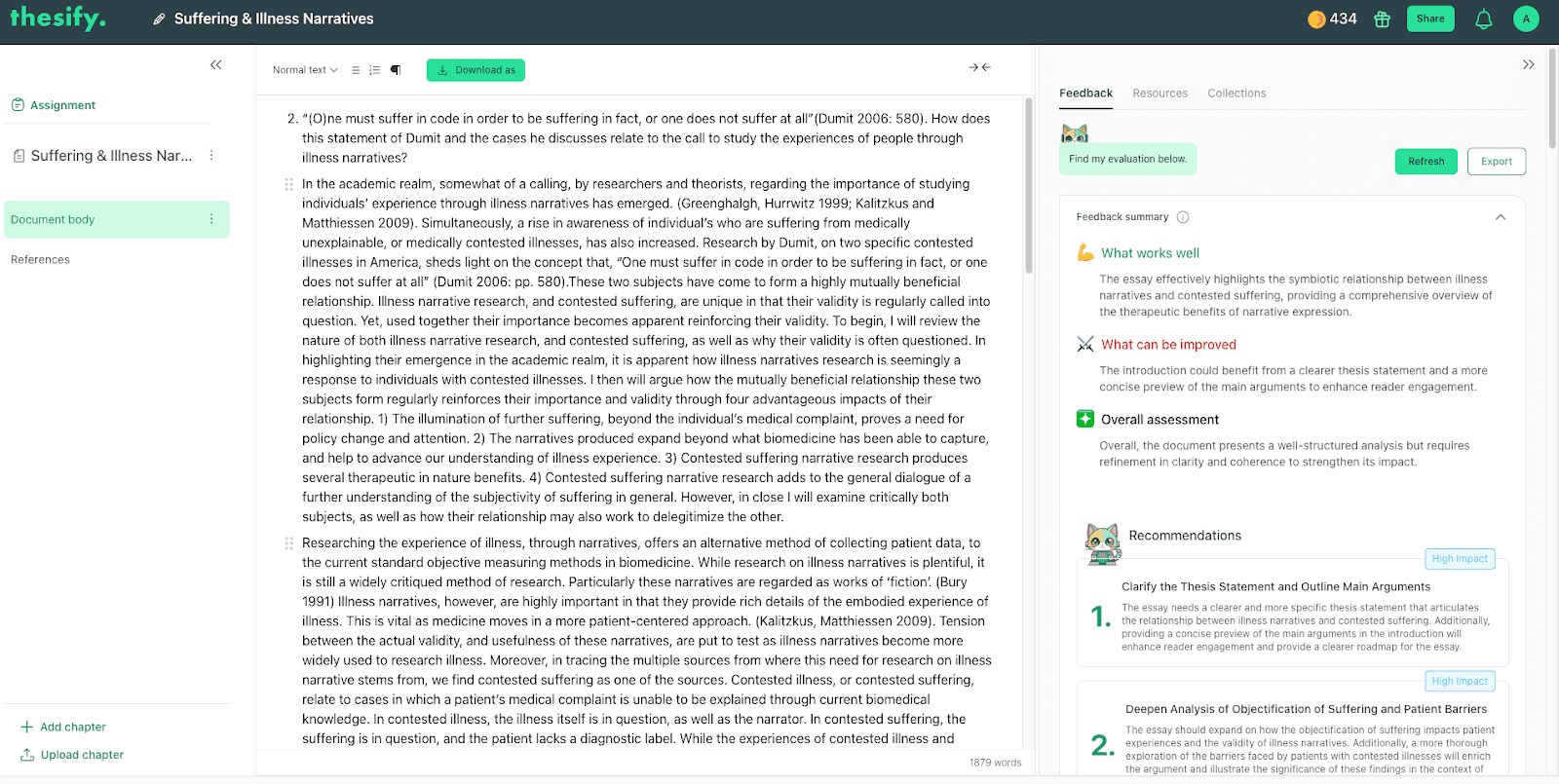
Overall feedback view in thesify, with summary judgements and high-impact recommendations that mirror the structure of an editor’s decision letter.
As one example of a structured assessment, thesify provides an overall feedback panel with “what works well,” “what can be improved,” and a short list of high-impact recommendations. The format is intentionally similar to a decision letter: you see a brief evaluation of the manuscript as a whole, followed by a small number of priorities that would need to be addressed before the paper is ready for journal peer review.
The system then moves from this global view to criterion-level diagnostics that resemble the categories many reviewers use when commenting on manuscripts.
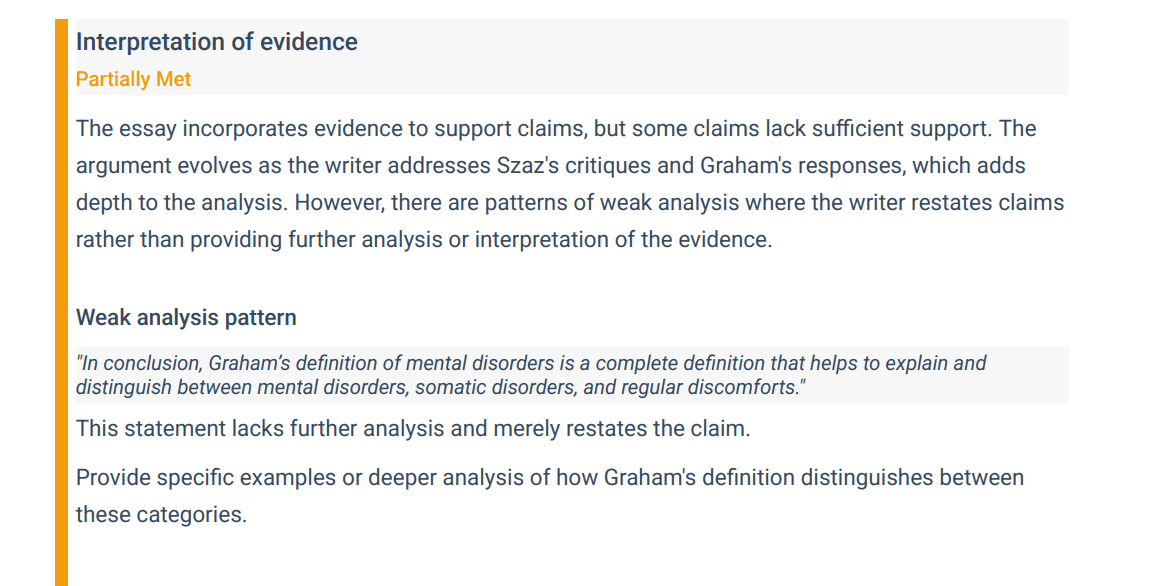
Criterion-level feedback on interpretation of evidence, quoting a sentence and explaining what deeper analysis is needed.
For interpretation of evidence, for instance, thesify flags sentences that restate claims instead of analyzing them, conclusions that are not clearly supported by cited sources, or passages that introduce new ideas without explaining their implications. The feedback quotes the original sentence and spells out what kind of analytical move is missing. This is very similar to a reviewer’s line-level comment pointing out where the argument does not yet follow from the evidence.
Pre-submission Review in thesify also extends to tables and figures, which are frequent sources of reviewer concern about presentation and data integrity.
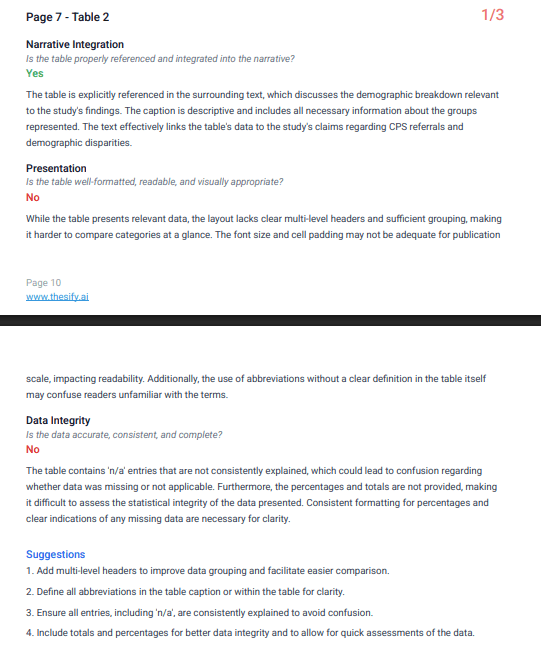
Page and table level feedback on narrative integration, presentation, and data integrity, similar to how journal reviewers comment on tables and figures.
In the table feedback view, thesify evaluates whether a table is properly referenced in the surrounding text, whether the layout and labelling make the data easy to read, and whether entries, percentages, and abbreviations are consistent. The associated suggestions translate these judgements into specific revision tasks, such as introducing multi-level headers, defining abbreviations, or adding totals and denominators. This mirrors the kind of detailed, table-focused comments many authors receive during peer review, but it arrives earlier in the process, when substantial changes to layout are easier to make.
None of these pre-submission steps replaces journal peer review, and they will not resolve deeper problems of design, data quality, or theoretical contribution. However, they can substantially reduce the number of preventable issues that occupy space in reviewer reports.
When you eventually receive a revise and resubmit decision and start drafting your response to reviewer comments, you are more likely to be dealing with substantive, field-specific questions rather than avoidable problems in clarity, structure, or presentation.
For readers who want to think about pre-submission review and journal peer review in a broader context, check out What Authors Need to Know About Pre-Submission Review vs Peer Review. To help build a repeatable system that uses both formal and informal feedback, you can also read more on our substack Build a Review Pipeline For Your Work.
Key Points to Remember When You Respond to Reviewer Comments
When you think about how to respond to reviewer comments on journal articles, you are really designing a communication strategy for revise and resubmit decisions:
Treat the response to reviewers letter as part of your argument for publication, not as a formality.
Map journal reviewer comments into categories so you can prioritize major changes and handle conflicting reviewer comments in a transparent way.
Use a clear reviewer comments reply format that editors and reviewers can scan quickly.
Develop language patterns for agreement, clarification, and respectful disagreement so you can respond consistently under pressure.
Build a workflow and pre-submission review practices, including tools like thesify, so that each round of peer review improves both your manuscript and your process.
If you combine these elements, your next peer review rebuttal letter will be easier to write, easier to read, and more likely to move your manuscript toward acceptance.
Use thesify to run a pre-submission check on your next draft
A pre-submission assessment in thesify gives you structured comments on clarity, argument, and evidence, so you can anticipate likely reviewer concerns before formal peer review. Sign up for free and test it on your manuscript today.

Related Posts
Pre‑Submission vs Peer Review: Key Differences & AI Insights: Learn how pre-submission review and journal peer review fit into the publication process, and what each stage contributes to the quality and clarity of your manuscript. Find out more about the many author-facing tools that now offer structured reviews of drafts before submission. They highlight missing sections, unclear arguments, potential reporting issues, or weak presentation of results. Some services price each “AI peer review” as a standalone product and provide several hundred words of comments that look similar to human reviewer reports. Although the branding suggests peer review, these systems are best understood as pre-submission review tools. They are author-controlled, advisory, and focused on helping you revise before your work reaches a journal decision stage.
Mastering the Peer Review Process: Essential to maintaining academic integrity, peer review ensures only high-quality research contributes to the body of academic knowledge.This article offers a clear breakdown of the typical steps to academic peer peer review. We cover the submission and editorial check, where initially editors assess your manuscript to ensure it aligns with the journal's scope and meets basic submission requirements, all the way to editorial decisions. We also cover the basics of responding to peer review comments and revisions. Receiving peer review feedback can be daunting, but responding constructively is crucial. We illustrate how to carefully and objectively analyze reviewers' comments, distinguishing major from minor issues. Learn how to create a structured, respectful response addressing each comment clearly, even when disagreements occur—and how to politely justify your reasoning.
From Feedback to Revision Plan: Chat with Theo Guide: Find out how to use thesify’s Chat with Theo to turn feedback into a revision plan. While some PDF chat tools lack feedback integration or integrity safeguards, Theo is designed to act as an academic-focused “chat with your draft” solution. Emphasizing pedagogy first: Theo helps you understand and improve your work (with citations and integrity). We walk through examples of how to use Chat with Theo to ask your paper digest and as a thesis structure chat. This guide covers everything you need to know about our AI writing assistant for revision.