EU Grants and AI Use: Responsible AI Practices for Horizon Europe Proposals

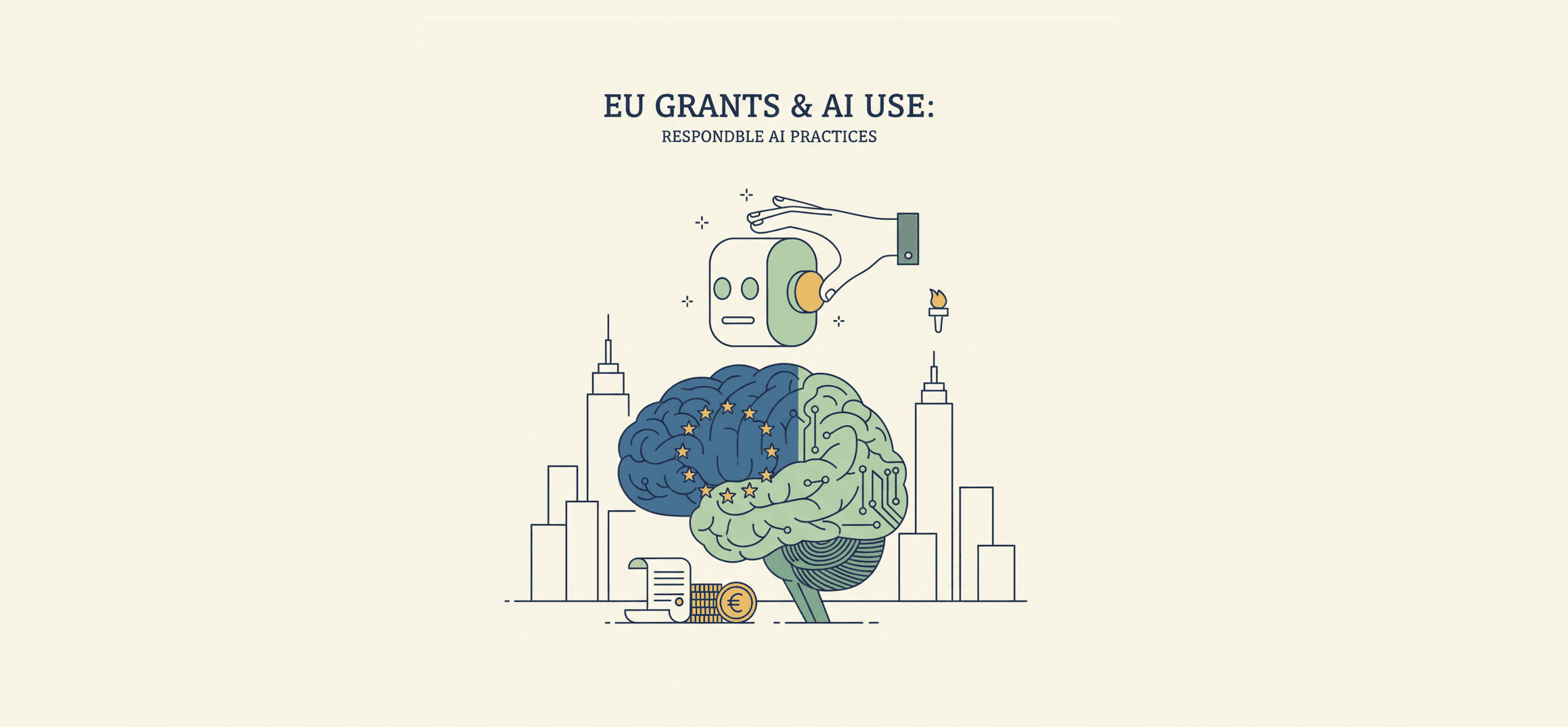
The European Commission does not impose a blanket ban on artificial intelligence in Horizon Europe proposal preparation. Horizon Europe’s Part B template permits the use of generative AI tools, while requiring applicants to review AI-assisted content, verify citations, check sources, manage plagiarism risk, and disclose which tools were used and how they were used.
For Horizon Europe AI grant proposals, ultimate accountability rests with the investigators. While AI may support drafting, editing, or structural review, the proposal’s scientific direction must remain entirely human-led. This includes the research aims, methodology, work package logic, impact pathway, and final claims.
This becomes harder in multi-partner EU grants. A proposal may pass through PIs, work package leads, research managers, institutional support teams, industry partners, and external grant consultants before submission. One unapproved AI tool can expose confidential partner material, create inconsistent disclosure records, or introduce unverified claims into the shared draft.
This guide explains what the EU AI policy landscape means for Horizon Europe applicants and what proposal teams should do before using AI to draft, edit, or review the Part B Technical Description. For a broader comparison across funders, see our guide to funding agency AI policies.
Executive Summary: Horizon Europe AI Use in Brief
AI use in Horizon Europe proposal preparation is permitted, but it is not risk-free. The European Commission allows assistive use of generative AI, provided the proposal remains accurate, original, confidential, transparent, and researcher-led.
Before coordinating a multi-partner draft or routing the Part B narrative through institutional review channels, consortium leads should enforce five operational baselines:
AI is allowed for bounded support. You can use AI tools for copyediting, grammar checks, formatting, translation support, and structural review of researcher-authored text.
Human responsibility remains. The applicant team remains accountable for the scientific accuracy, source integrity, originality, and final wording of the submitted Part B Technical Description.
Disclosure should be specific. If AI meaningfully shapes the proposal, record which tool was used, where it was used, and what human verification followed.
Sensitive data should stay out of public tools. Partner CVs, unpublished findings, budget details, patient or participant information, consortium strategy, and patentable ideas should not be entered into public or unapproved AI systems.
Consortium rules should come first. Coordinators should agree on AI-use rules across partners, consultants, work package leads, and research support teams before collaborative drafting begins.
These expectations sit within a wider EU research governance landscape shaped by the May 2026 ERA Living Guidelines, the ALLEA European Code of Conduct for Research Integrity, Horizon Europe application guidance, GDPR, and the EU AI Act’s broader risk-based framework.
The EU AI Policy Landscape for Horizon Europe Applicants
There is no single “EU rule” for AI use in Horizon Europe proposals.
Responsible AI use in EU grants sits across several policy layers: research integrity guidance, Horizon Europe application instructions, data protection law, institutional policy, and consortium-level agreements. The EU AI Act is part of that landscape, but it is not the only source applicants need to understand.
Before drafting begins, proposal teams should map which policy requirements apply to each stage of Part B preparation: drafting, editing, partner integration, internal review, final verification, and submission.
A tool may be acceptable for language editing, but unacceptable for processing partner CVs, unpublished findings, budget details, or patentable ideas. A proposal may use AI responsibly and still fail if the final text contains unverified claims, fabricated citations, weak methodology, or undisclosed substantive AI use.
The safest approach is to map the relevant policy layers before drafting begins.
Policy Source | What Researchers Need to Know | Proposal Workflow Implication |
AI use should remain transparent, accountable, confidentiality-aware, and human-led. The May 2026 update also raises concerns about hidden prompts and unvetted third-party AI tools. | Document meaningful AI use. Keep scientific reasoning, claims, and final decisions with the research team. | |
Applicants must review AI-assisted content, verify sources and citations, manage plagiarism risk, and disclose AI tool use where relevant. | Build human review into the drafting process before submission, especially for AI-edited sections. | |
The ALLEA European Code of Conduct for Research Integrity defines research integrity through reliability, honesty, respect, and accountability. | Do not outsource claims, evidence, literature synthesis, or authorship judgment to an AI system. | |
Personal data requires lawful processing, adequate protection, and appropriate safeguards. This may include CVs, staff profiles, partner details, or participant information. | Do not enter identifiable personal data into public or unapproved AI tools. Use institutional guidance before processing sensitive information. | |
The EU AI Act establishes the statutory risk-based framework for artificial intelligence across member states. It becomes directly legally binding when a research project develops, deploys, or actively studies algorithmic systems as a core deliverable. | Distinguish AI used to prepare the proposal from AI systems proposed as project outputs, deliverables, or research infrastructure. | |
Universities, research organisations, and consortia may impose stricter rules than the application guidance itself. | Check internal policy before consortium-wide AI use. Set shared rules for partners, consultants, and work package leads. |
This layered policy environment matters because Horizon Europe proposals are rarely drafted by one person. A coordinator may write the main narrative, a work package lead may revise the methodology, a project manager may edit the implementation plan, and a consultant may review the impact section. If each person uses a different AI tool under different privacy settings, the consortium loses control over disclosure, confidentiality, and source verification.
Proposal teams should focus on controlled, documented AI use. For a broader comparison across funders, see our guide to funding agency AI policies.
What Horizon Europe Applicants Need to Disclose About AI Use
While routine spell-checking does not require formal declaration, teams must internally log and evaluate for disclosure any generative AI deployment that materially shapes the proposal's text, structural architecture, literature summaries, or core argumentation.
The European Commission’s official Part B Technical Description template requires applicants to be transparent about which generative AI tools were used and how they were used. The ERA Living Guidelines place that requirement within a broader research integrity framework: AI use should remain accountable, transparent, and confidentiality-aware.
For Horizon Europe proposal AI use, record any AI assistance that affects the substance, structure, sources, or wording of the draft. At minimum, track the following:
Tool Name and Platform: Record the AI tool used, including the version or platform where available.
Date or Proposal Stage: Note when the tool was used, such as early outline, partner integration, final language review, or pre-submission check.
Proposal Section Affected: Identify the relevant Part B section, work package, impact subsection, methodology paragraph, table, figure caption, or summary.
Purpose of Use: Specify whether the tool was used for language editing, translation support, structural review, summarization, source support, formatting, or substantive drafting.
Input Type: Record whether the input was public, anonymized, researcher-authored, confidential, personal, unpublished, or commercially sensitive.
Data Removed Before Use: Confirm whether personal data, partner details, budget information, unpublished findings, or patentable content were removed before prompting.
Human Verification Steps: Record who reviewed the output, what they changed, and whether the final wording remained under the research team’s control.
Citation and Source Checks: Verify every source, DOI, factual claim, and literature summary manually. Do not rely on AI-generated references.
Disclosure Decision: Mark whether the use should be disclosed in Part B, retained only in internal records, or escalated to the coordinator, research office, or data protection team.
Example Part B AI Disclosure Note
Generative AI was used to support language editing and structural review of selected proposal sections. The applicant team reviewed all outputs, verified factual claims and references, revised the text manually, and retains full responsibility for the final proposal content.
This wording is only a starting point. Adapt it to the specific call, institutional policy, consortium rules, and application template. It should not be treated as universal legal language.
Grant proposal disclosure also differs from journal disclosure. In publishing, the emphasis often falls on authorship, manuscript transparency, and peer review restrictions. In Horizon Europe proposals, disclosure also connects to confidentiality, partner coordination, data protection, and eligibility risk. For a broader comparison, see our guide to AI disclosure rules in academic publishing.
Lower-Risk and Higher-Risk AI Uses in Grant Writing
Not every use of generative AI in grant proposals carries the same risk. The boundary is functional.
The ERA Living Guidelines on the responsible use of generative AI in research place responsibility on researchers to keep AI use transparent, accountable, and confidentiality-aware. Horizon Europe’s Part B proposal guidance also makes applicants responsible for reviewing AI-assisted content, checking sources, managing plagiarism risk, and disclosing tool use where relevant. The Netherlands Enterprise Agency’s Horizon Europe and Eureka AI proposal guidance reaches the same conclusion: proposal teams need to ask what tool is being used, what data enters it, and who controls the output.
Lower-risk use improves text the research team has already written. It can clarify expression, check consistency, organize formatting, or identify readability problems. Higher-risk use changes the substance of the proposal. That includes generating aims, reshaping hypotheses, drafting methodology, building work packages, assigning deliverables, calculating budgets, or producing literature claims.
Risk increases when AI begins shaping the proposal’s intellectual content.
For responsible AI use in Horizon Europe proposals, keep AI close to language support and far from scientific authorship.
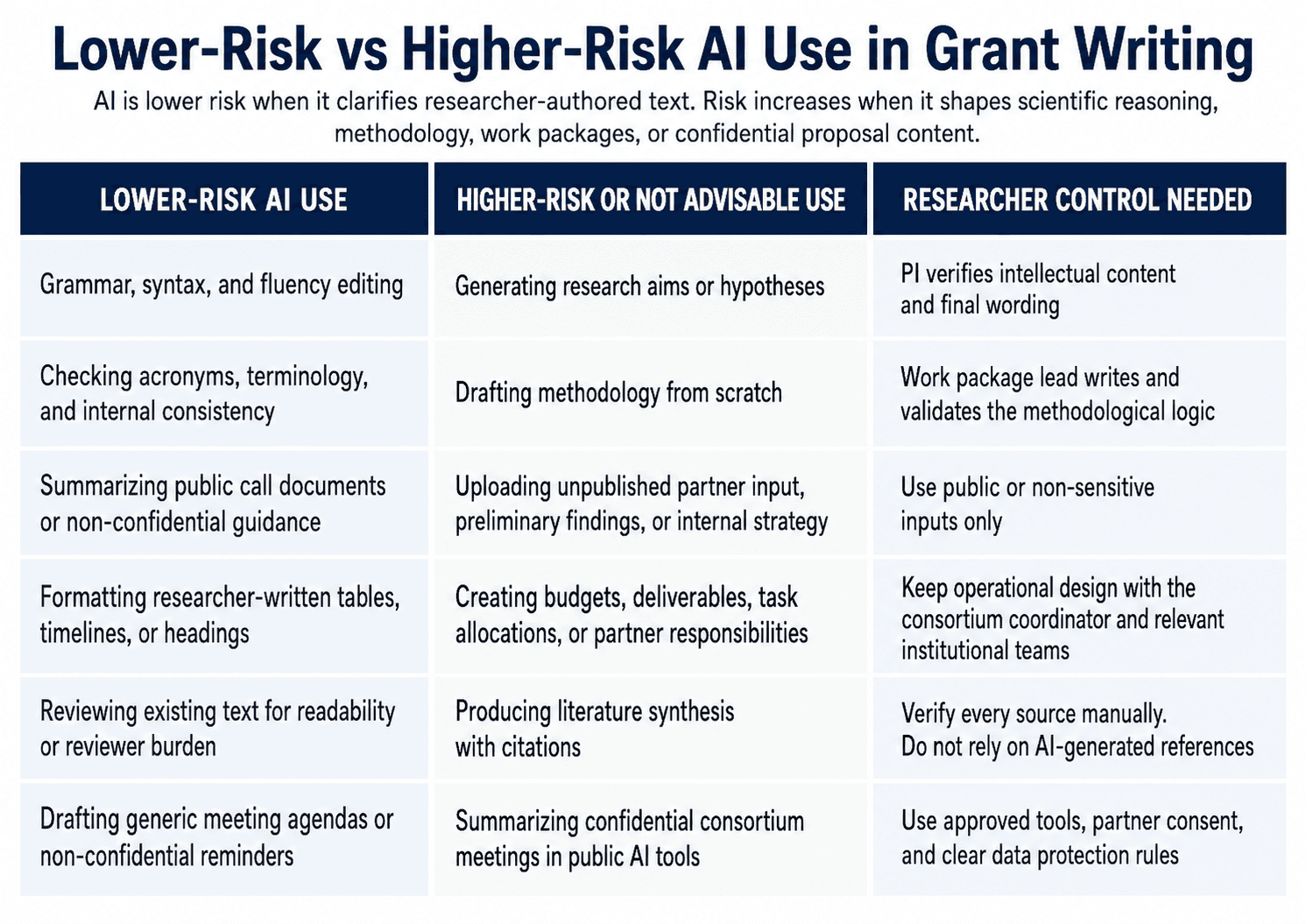
AI is lower risk when it clarifies researcher-authored text. Risk increases when it shapes scientific reasoning, methodology, work packages, or confidential proposal content.
Fluency Can Hide Weak Proposal Logic
AI can make weak proposal text sound smoother. That is useful only up to a point.
Expert evaluators are not assessing fluency alone. The Part B template asks applicants to explain clear objectives, methodology, work plan, work packages, deliverables, resources, and participant roles. A polished paragraph can still contain a vague impact pathway, an unrealistic timeline, or a method section that does not support the stated objectives.
This is the risk of surface-level editing. AI can improve readability while weakening technical precision, especially when it replaces field-specific language with cleaner but less exact phrasing. Our note on how AI can flatten technical precision addresses this problem in more detail.
For Horizon Europe applicants, clearer scientific reasoning should remain the priority. AI can reduce friction for the reader, but the proposal’s logic, evidence, and strategic choices should remain under human control.
For comprehensive application strategy, review our guide on grant writing for review panels, which details how to reduce evaluator cognitive load without flattening your technical precision.
Consortium AI Use Creates Shared Risk
In a single-author workflow, AI use is easier to control. Horizon Europe proposals rarely work that way.
A consortium draft may move through PIs, work package leads, institutional research offices, industry partners, public-sector partners, patient organisations, and external grant consultants. Each person may use a different tool. Each tool may have different privacy settings. Each prompt may contain different levels of confidential information.
This distributed workflow makes AI use harder to supervise.
One partner may paste draft methodology into a public AI tool without telling the coordinator. A consultant may upload an impact section that includes partner strategy. A work package lead may summarize unpublished data in an unapproved system. Even if the final text looks clean, the drafting process may have already created confidentiality, GDPR, intellectual-property, disclosure, or consistency risks.
Horizon Europe’s Model Grant Agreement places strong expectations on beneficiaries around proper implementation, confidentiality, data protection, and intellectual-property management. Proposal teams should therefore treat AI use as a shared governance issue from the beginning, especially when the draft includes partner data, preliminary findings, or exploitable results. Patentable ideas require particular care, since public disclosure can affect novelty under European patent law.
Coordinators should set AI-use rules before technical drafting begins.
Some consortia may choose to reflect AI-use expectations in a proposal preparation protocol, memorandum of understanding, institutional routing checklist, or consortium agreement process. The purpose is to make sure every partner follows the same rules for tool use, data entry, disclosure, and human review before the proposal is submitted.
The same logic that supports clear authorship roles and collaboration rules in co-authored academic writing applies to Horizon Europe proposal development. When multiple people shape a shared text, role clarity protects the final document.
Consortium AI Use Checklist
Before partners begin drafting, the coordinator should establish clear answers to the following questions:
Which AI tools are approved for proposal preparation?
List the tools that partners may use for editing, formatting, translation support, structural review, or internal feedback.Are public AI tools prohibited for confidential material?
Specify whether partners may use public systems at all, and define which proposal content must remain outside those tools.Can model training be disabled?
Check whether prompts, uploaded files, and outputs can be excluded from model training or retained by the provider.Where is the tool hosted?
Identify whether the system is hosted inside or outside the European Economic Area, and whether that creates institutional data-transfer concerns.Who can access prompt history and outputs?
Clarify whether prompts are visible to individual users, administrators, tool providers, or external vendors.What content categories are prohibited?
Prohibit the use of public or unapproved AI tools for partner CVs, staff details, budgets, unpublished findings, patentable ideas, participant data, reviewer comments, and consortium strategy.Who maintains the AI-use record?
Assign responsibility for tracking which tools were used, which sections were affected, and what human verification followed.Are external consultants covered by the same rules?
Require consultants, freelance grant writers, and subcontracted reviewers to follow the same AI-use limits as consortium partners.Who signs off on final disclosure language?
Decide whether the coordinator, PI, institutional research office, or legal/data protection team will review the final AI-use statement.What happens if sensitive content has already been entered into an AI tool?
Create an escalation route. The coordinator should know who to contact internally, such as the research office, data protection officer, technology transfer office, or legal team.
Consortium AI rules will not resolve every ambiguous case, but they help coordinators identify tool, data, and disclosure issues before submission. For a structured approach to ambiguous cases, see our post on clear rules for AI edge cases.
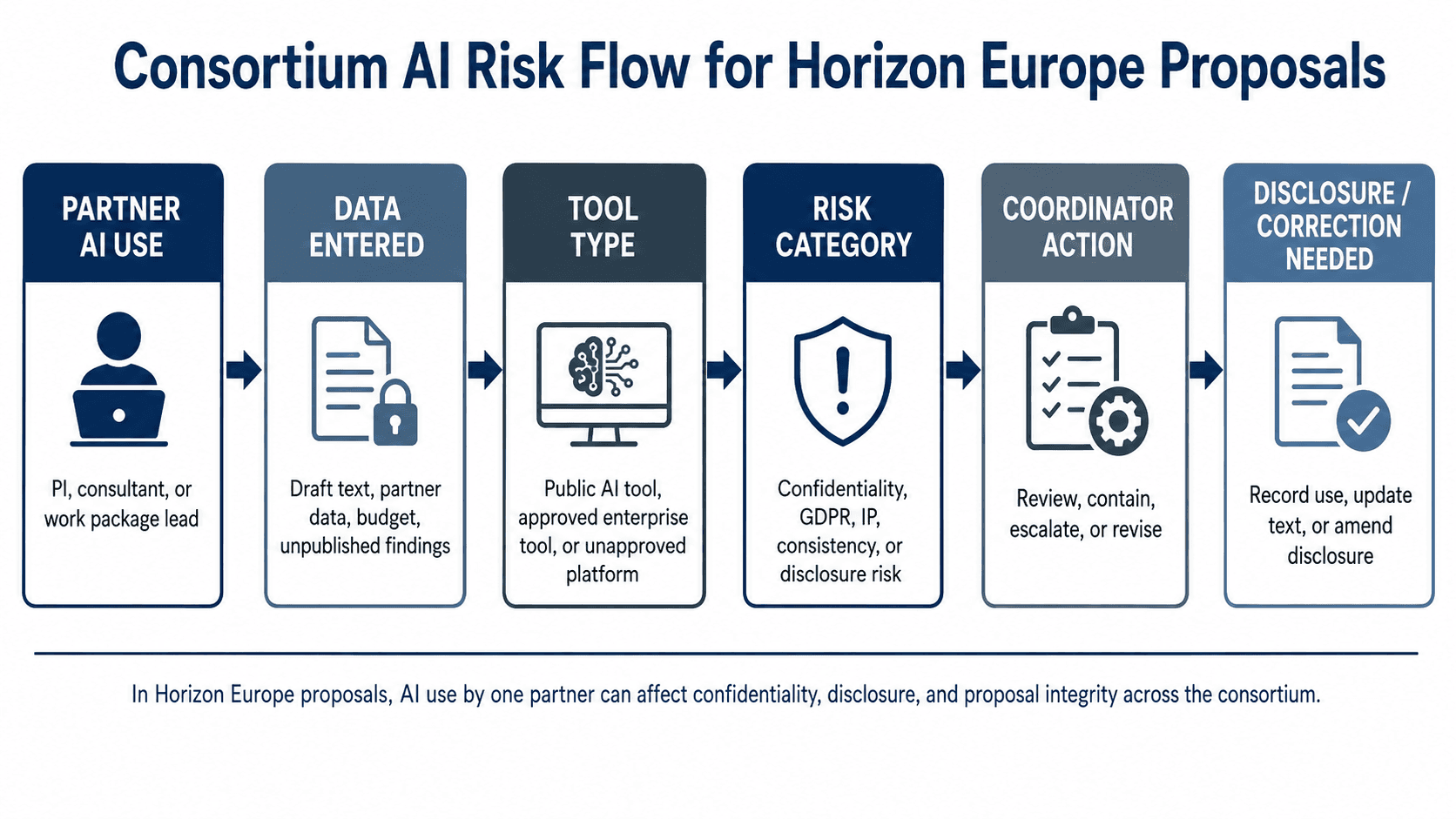
In Horizon Europe proposals, AI use by one partner can affect confidentiality, disclosure, and proposal integrity across the consortium.
Data Isolation Boundaries: What to Keep Offline
Public or general-purpose AI tools should be treated as unsuitable for sensitive proposal material unless the institution has approved the system and verified its data protections. For Horizon Europe applicants, proposal privacy begins with data classification.
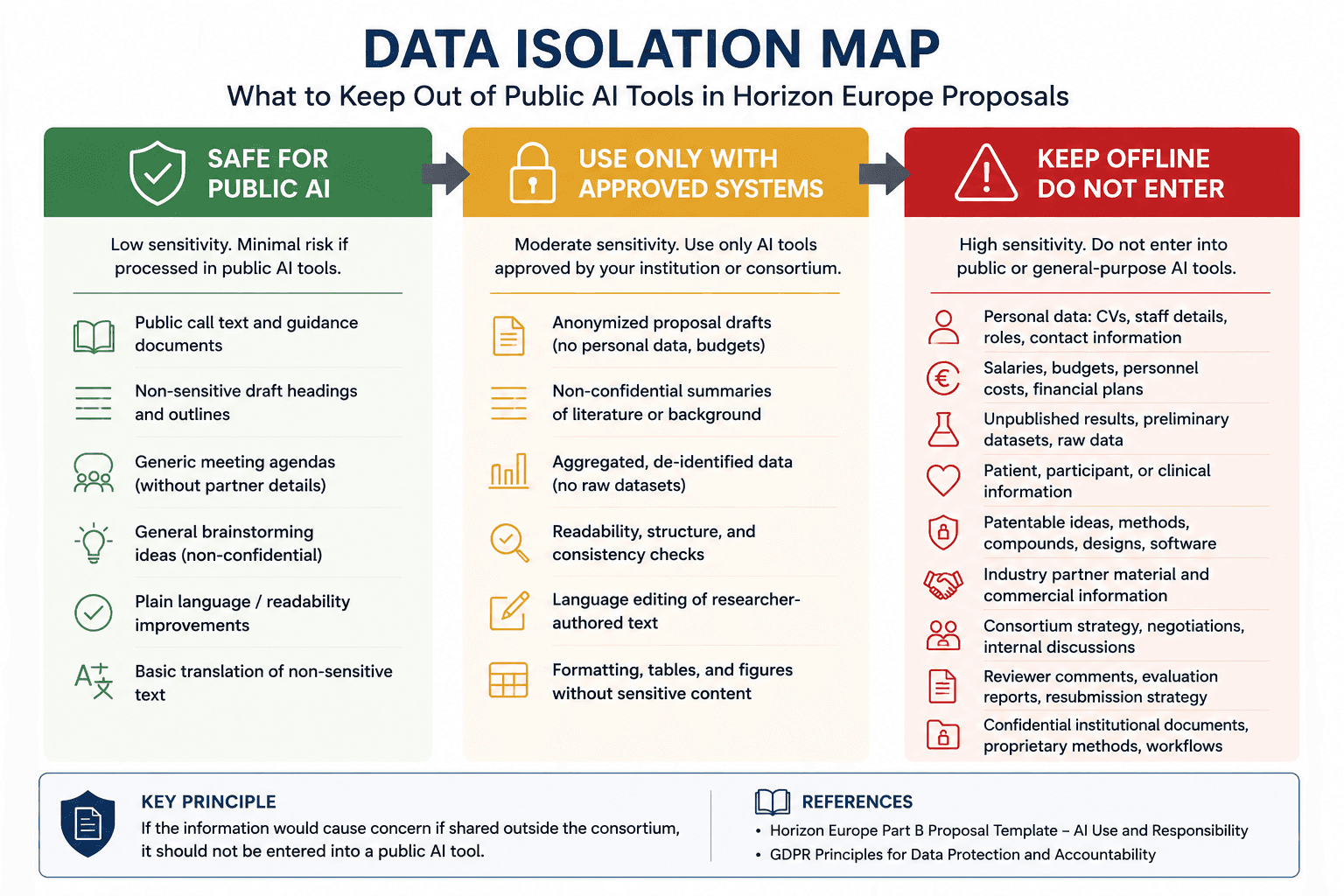
Proposal teams should classify information before using AI tools, especially when drafts include personal data, unpublished findings, budget information, or patentable ideas.
Collaborative drafting often involves personal data, unpublished findings, budget information, and commercially sensitive results. If that material is entered into a public or unapproved AI tool, the consortium may lose control over confidentiality, IP protection, and data handling. Tool terms vary, so teams should not assume that prompts or uploaded files remain private.
Public or general-purpose AI tools may store prompts, retain uploaded files, or use inputs for service improvement or model training, depending on the provider and account settings. Proposal teams should not treat those systems as confidential unless the institution has reviewed the tool and confirmed the relevant data protections.
To mitigate shared institutional liabilities, proposal teams must enforce an objective data classification protocol before any partner interfaces with an automated tool.
Horizon Europe Data Containment Matrix
Data Asset Class | Compliance Risk Profile | Permitted Governance Protocol |
CVs & Personnel Profiles | Exposes personal data, recruitment metrics, and identifiable institutional profiles under GDPR. | Process exclusively within secure institutional environments or work from fully anonymized text summaries. |
Partner Contact Registries | Violates privacy compliance by uploading identifiable personal and organizational information. | Restrict entirely to local institutional records or controlled internal consortium databases. |
Salary, Budget, & Cost Metrics | Discloses confidential financial planning, internal resource allocations, and institutional overhead structures. | Isolate within protected university budgeting tools and encrypted document channels. |
Unpublished Raw Findings | Compromises scientific priority, novelty claims, and subsequent peer-reviewed journal publications. | Keep completely offline or deploy secure, self-hosted institutional software tools. |
Preliminary Datasets | Exposes non-public research outputs that may contain sensitive or protected partner metrics. | Restrict analysis to approved, siloed research infrastructure and local servers. |
Patient or Clinical Trial Data | May involve personal or sensitive data subject to ethics, data protection, and institutional governance requirements. | Do not process in public AI tools; enforce absolute data isolation protocols. |
Patentable Technologies & Software | May create novelty or disclosure risk if the information becomes available outside the controlled research team or is retained under terms that permit reuse. | Secure formal clearance from your institutional technology transfer office prior to any software interaction. |
Industry Partner Material | Breaches commercially sensitive industrial data parameters and signed non-disclosure agreements. | Maintain strictly within secure, partner-approved enterprise environments. |
Consortium Strategy & Allocations | Exposes internal negotiation positions, task splits, and strategic partner configurations. | Retain exclusively inside human-authored internal proposal documents. |
Evaluation Summary Reports (ESRs) | Violates the confidentiality parameters governing prior reviewer comments and evaluative feedback. | Prohibit entry into public models; draft resubmission text completely offline. |
Resubmission Strategy | Reveals internal weaknesses, technical risks, and panel response vulnerabilities to external systems. | Keep within the coordinator's secure, human-led workflow. |
Confidential University Records | Compromises internal governance protocols, structural legal approvals, and administrative compliance planning. | Restrict access to designated internal university IT systems. |
Proprietary Methods & Workflow Logic | Dilutes localized know-how, unique laboratory paradigms, and underlying research advantage. | Keep completely offline or use secure, isolated infrastructure. |
For multi-site writing teams, the rule should be conservative: if a narrative element or dataset would cause administrative, legal, or competitive concern outside the consortium, it should not enter a public or unapproved AI system.
To build an explicit prompt-boundary checklist before your authors interface with automated software, you can review our technical briefing on before AI sees your grant. For an institutional framework on evaluating software based on privacy, reproducibility, and source traceability, research leads can consult our strategic review of criteria for academic-grade AI tools.
Patentable Ideas Require Special Caution
Patentable or commercially sensitive material should not be processed through public generative AI tools. If AI use is needed, use only systems approved by the institution and cleared by the relevant IP or technology transfer team. This categorical exclusion encompasses chemical compounds, novel device concepts, software logic arrays, assay designs, and technical workflow descriptions that will eventually form the basis of a formal patent filing.
The legal risk is material. Under European patent law, novelty depends on whether an invention forms part of the state of the art before filing. If invention-related material is entered into an external AI system under terms that permit retention, reuse, or wider access, the team may create disclosure or novelty concerns. Treat patentable material as offline by default until the technology transfer office or institutional IP team has advised otherwise.
Before any partner processes invention-related text, the consortium coordinator must consult the university's technology transfer office, legal counsel, or institutional IP directors. If an AI tool is cleared for use, it should be restricted to institutionally approved systems with documented data protection, retention, and access controls.
Partner and Participant Data Require Governance
Managing personal data requires strict administrative oversight well before an application enters official submission channels. In complex collaborative proposals, personal information is routinely embedded within investigator CVs, staff profiles, institutional contact registries, and participant clinical records.
This represents an immediate workflow governance issue. Proposal teams must determine in their early staging cycles exactly which data tiers are permitted to interface with software, which enterprise platforms are contractually cleared, and which elements must stay completely offline.
Consortium coordinators are responsible for making these parameters explicit before any partner begins writing. Leaving software usage to individual partner discretion causes standard compliance boundaries to vary across separate institutions, work package leaders, and third-party consultants. Where identifiable or regulated records are processed, public AI platforms must be treated as strictly off-limits.
Hidden Prompts and Third-Party AI Risks
The May 2026 update to the European Commission’s ERA Living Guidelines on the Responsible Use of Generative AI in Research introduces a warning for proposal workflows: organisations should be aware of hidden prompts and third-party AI use in meetings, document summaries, and information management.
The ERA Living Guidelines define a hidden prompt as an instruction secretly embedded in a document or input for an AI system, hidden from the human reader, and designed to influence how the AI responds. These instructions are typically hidden via microscopic fonts, metadata manipulation, or white text layers matching the document background.
For Horizon Europe applicants: do not include hidden text, invisible instructions, prompt fragments, or metadata intended to influence AI-assisted processing. Even where evaluators are not expected to rely on generative AI, hidden prompts raise research integrity concerns and create unnecessary risk if proposal files pass through institutional or funder systems.
The May 2026 guidelines also warn researchers and organisations to consider AI use by third parties, including tools used for meetings, note-taking, discussion summaries, or document overviews. In proposal development, these tools can expose confidential consortium discussions if they are used without consent, review, or approved data safeguards.
Using unvetted commercial AI tools to record or analyse multi-site discussions can create data protection risks. In a collaborative consortium, an unmanaged meeting-summary bot can silently capture confidential negotiations, strategic task allocations, unpublished laboratory findings, or internal resubmission strategies—caching proprietary data on external servers long before the final proposal is routed to the submission portal.
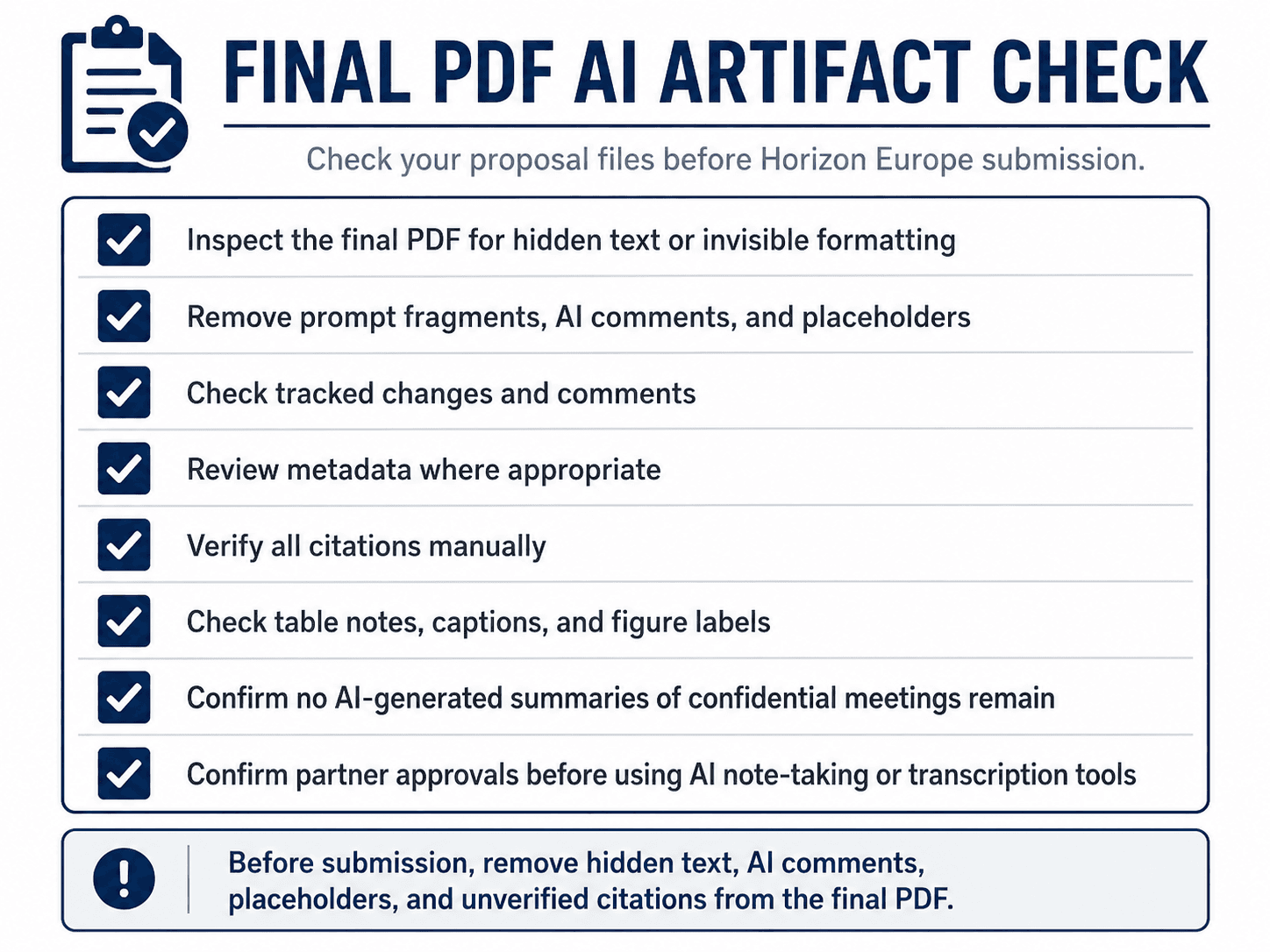
Before submission, proposal teams should remove hidden text, AI comments, placeholders, and unverified citations from the final PDF.
Pre-Submission AI Artifact Check
Consortium coordinators should require a pre-submission check of the final proposal package:
Hidden Text Scans: Inspect the final Part B PDF and native source files for white-on-white text blocks, hidden comment layers, or microscopic font strings designed to bypass normal reading views.
Prompt Scrubbing: Permanently delete leftover prompt fragments, chat-style instructions, machine placeholders, and automated layout annotations.
Revision History Mitigation: Purge all tracked changes, active edit histories, and internal comment bubbles to prevent exposing drafting disputes or confidential partner material.
Metadata Cleansing: Strip the document metadata profile of institutional identifiers, system names, and background processing histories before final compilation.
Manual Bibliographic Audit: Individually verify every single embedded citation against primary reference indexes to eliminate hallucinated DOIs, artificial co-authors, or fabricated study titles.
Captions & Index Inventory: Audit table notes, graphic captions, and figure labels separately, as automated placeholders frequently escape late-stage structural edits.
Consortium Record Verification: Confirm that no unverified machine-generated text blocks or automated meeting summaries have been copied directly into the technical narrative.
Transcription Software Alignment: Verify that every participating institution has formally approved the deployment of any note-taking or transcription software before using it in proposal preparation tracks.
This check reduces the risk that hidden prompts, placeholders, metadata, or unverified AI-generated material remain in the final submission. For a short workflow to record prompts, edits, and text provenance during drafting, see our guide on maintaining a simple audit trail for AI use. To understand how these pre-submission artifact checks intersect with the growing use of automated peer review systems and screening algorithms, authors can review our post on institutional AI screening tools.
Build a Simple AI Use Record Before Submission
A proposal team should be able to answer a basic question before submission: where was AI used, and who checked the result?
The record does not need to be long. It should be clear enough for the coordinator, PI, or research office to reconstruct AI use across the draft. This is especially important when several partners edit the same Part B file, or when external consultants support language editing, structural review, or proposal integration.
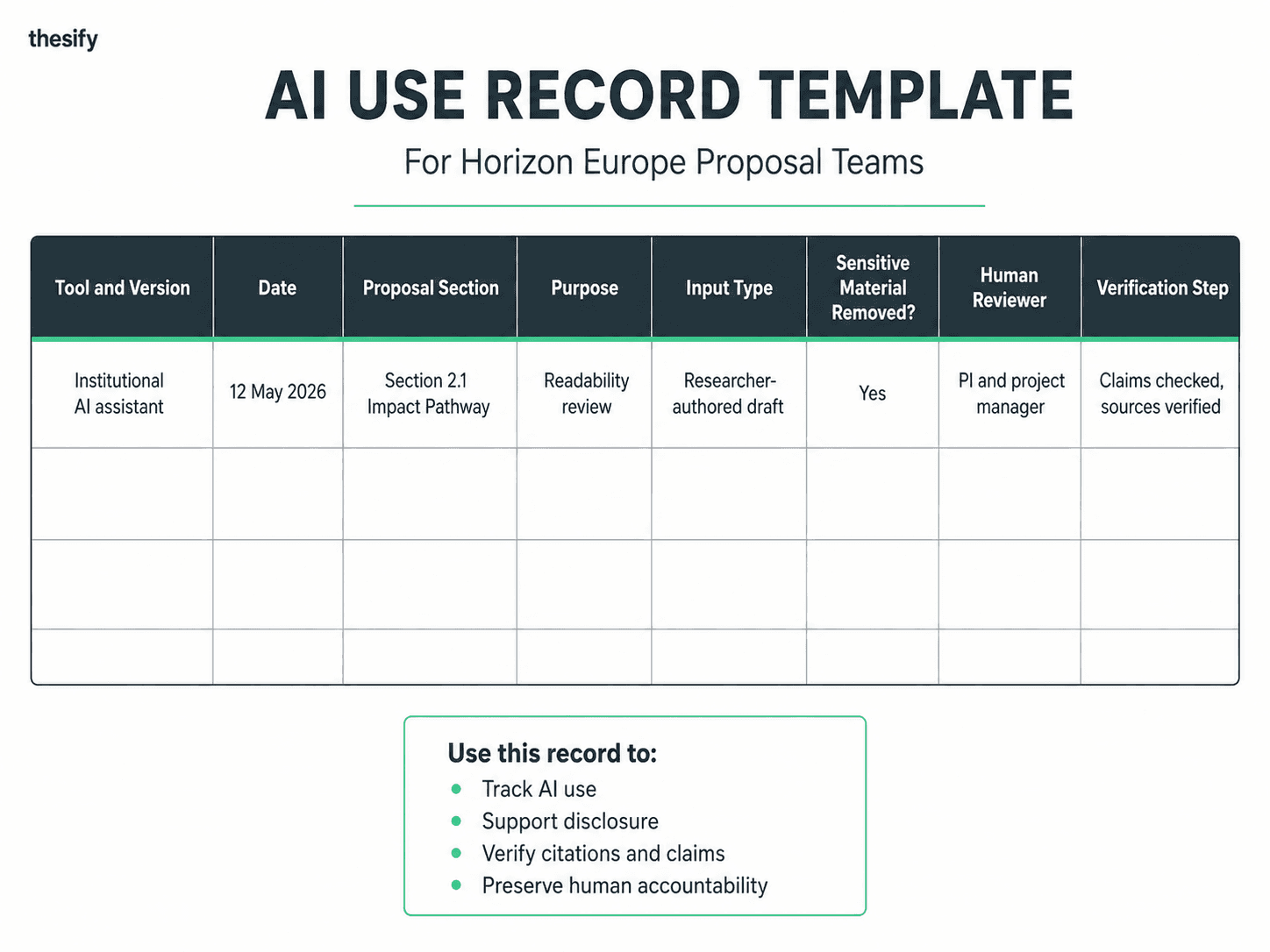
A simple AI use record helps Horizon Europe proposal teams track tool use, support disclosure decisions, verify claims and citations, and preserve human accountability.
Horizon Europe’s standard Part B application form makes applicants responsible for AI-assisted proposal content, including source checking, factual accuracy, plagiarism risk, and disclosure where relevant. The RVO’s Horizon Europe and Eureka AI guidance also recommends asking which AI tools are used, how data is handled, and whether partners or consultants are using AI during proposal preparation.
Use a simple internal log. One shared spreadsheet is usually enough.
Proposal Preparation Record
Tool & Version | Date of Use | Proposal Section | Operational Purpose | Input Security Status | Human Reviewer | Validation Step |
e.g., Institutional AI Assistant | 12 May 2026 | Section 2.1 Impact Pathway | Readability pass and language editing. | Researcher-authored draft text; sensitive inputs removed. | Primary PI and Project Manager | All data points cross-checked; sources and bibliography verified manually. |
e.g., Secure Transcribing Tool | 19 May 2026 | Section 3.1 Work Packages | Consortium meeting audio processing. | Enterprise-level account; data training loops deactivated. | Work Package 2 Lead Author | Verified technical task descriptions against raw human notes. |
Keep the Record Useful, Not Performative
The log should help the team make decisions. It should not become a second proposal.
Record AI use when it affects structure, wording, sources, summaries, methodology, work packages, partner input, figures, tables, or disclosure language. Do not spend time recording every spelling correction.
A useful AI-use record should help the coordinator:
Know what was used. Record the tool, version, and platform where available.
Locate affected sections. Identify the Part B section, work package, table, figure, or summary that passed through AI support.
Check claims and citations. Make clear who verified sources, DOIs, factual claims, and literature summaries.
Identify partner practices. Track whether different partners or consultants used different tools or privacy settings.
Support disclosure. Use the record to prepare accurate AI-use language for Part B if disclosure is required.
Preserve human responsibility. Record who reviewed the AI-assisted output and who approved the final text.
Avoid last-minute uncertainty. Resolve questions about tool use before institutional sign-off and final submission.
For a short workflow on recording prompts, edits, and provenance, see our note on a simple AI use record. If your team needs to share revision priorities across partners, our guide to our downloadable feedback report explains how to export feedback for pre-submission review.
How to Use Diagnostic AI Feedback Without Outsourcing Scientific Reason
A useful boundary for responsible AI use in Horizon Europe proposal writing is the difference between automated authorship and diagnostic review.
Generative outsourcing is high risk when an AI system drafts the intellectual substance of the application, including research aims, methodology, impact logic, deliverables, or citations. These elements define the proposal's scientific merit and must remain entirely under the control of the investigative team.
Diagnostic feedback reviews a draft the research team has already written. It can flag structural inconsistencies, missing call requirements, weak alignment between aims and work packages, or unnecessary reviewer burden. It should identify problems in the draft, not decide the science.
Ultimate scientific and structural judgment rests entirely with the Principal Investigator, consortium coordinator, and work package leads. A secure, policy-compliant workflow must move through explicit sequential checks to preserve human accountability:
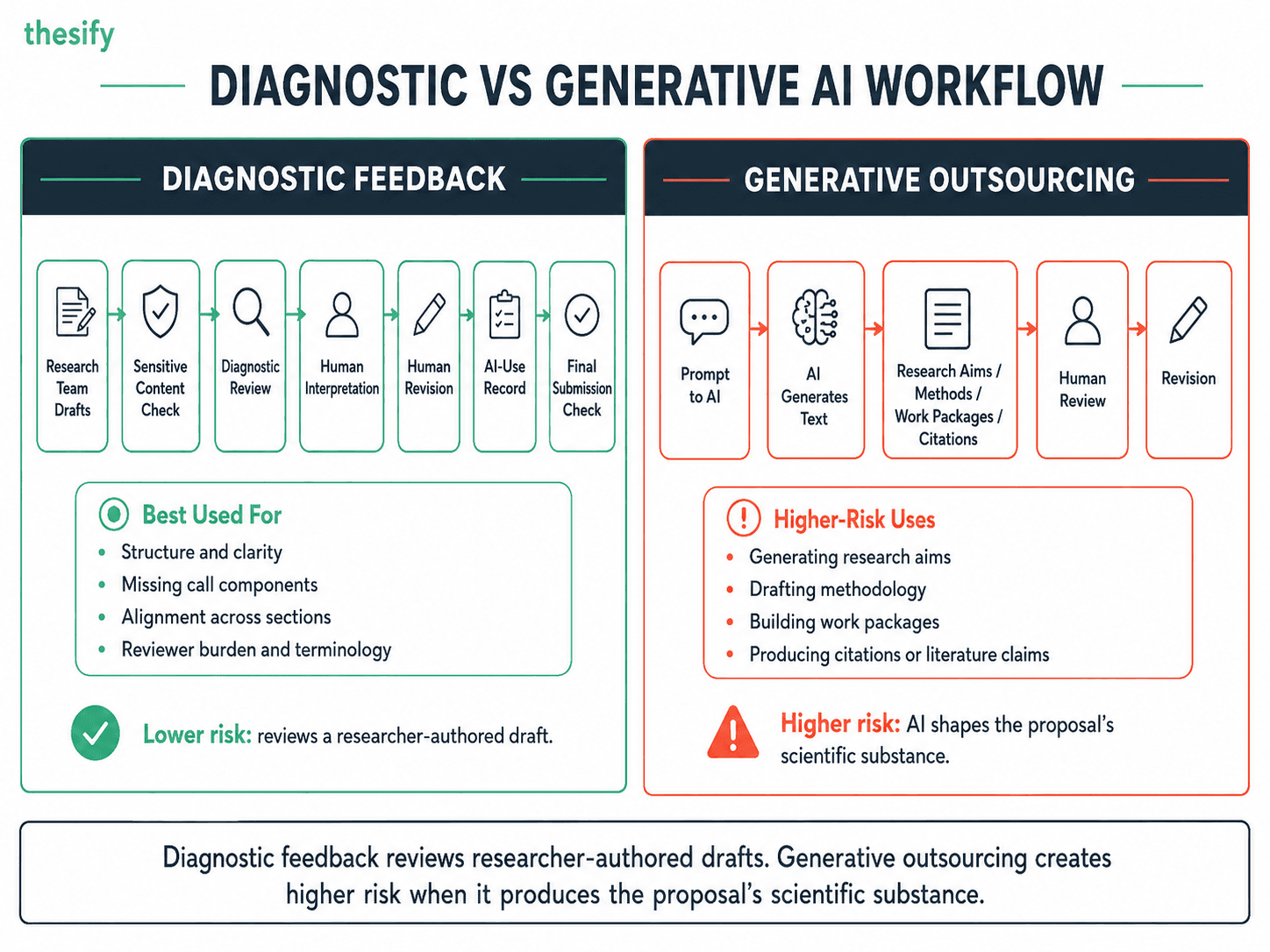
Diagnostic feedback reviews researcher-authored drafts. Generative outsourcing creates higher risk when it produces the proposal’s scientific substance.
Within this pipeline, feedback-oriented systems such as thesify serve an analytical role. When used for feedback on researcher-authored drafts, thesify can help identify missing components, structural gaps, and alignment issues while leaving the scientific reasoning and final revisions with the applicant team. As with any third-party research tool, proposal teams should review privacy, retention, vendor, and institutional data-handling requirements before uploading sensitive material.
No automated platform can certify Horizon Europe compliance. Final responsibility remains with the PI, coordinating institution, and consortium. Diagnostic feedback has a narrower role: it helps investigators identify reporting gaps before submission while keeping authorship with the research team.
To execute a section-by-section audit of your Part B text and locate missing framework components under current call templates, you can consult our guide on securing structured grant proposal feedback. For a precise framework on managing information density and reducing evaluator fatigue, authors can consult our strategic briefing on grant writing for review panels.
After diagnostic feedback, your team can use follow-up questions to turn feedback into a revision plan while keeping final wording with the authors. When managing complex, multi-author documents, coordinators can also review our post on how to run an integration pass to verify that cross-site contributions share uniform terminology and empirical evidence before final submission.
FAQ: AI Use in Horizon Europe Proposals
Is AI Use Allowed in Horizon Europe Proposal Writing?
Yes. Horizon Europe applicants may use generative AI to support proposal preparation. The risk depends on how the tool is used. The Horizon Europe Part B proposal template makes applicants responsible for AI-assisted content, including accuracy, source checking, plagiarism risk, and disclosure where relevant. AI may support editing or review, but the final proposal must remain under human control.
Do Applicants Need to Declare AI Use?
Yes, when AI use meaningfully shapes the proposal. Minor spelling correction or grammar support does not need to be treated the same as AI-assisted drafting, source summarization, structural revision, or methodology editing. The ERA Living Guidelines emphasize transparency, accountability, and responsible disclosure. Applicants should check the relevant application form, call conditions, institutional policy, and consortium rules before finalizing the disclosure language.
Can AI Write Horizon Europe Methodology or Work Packages?
This is high risk and should be avoided. AI can review a researcher-authored methodology or work package for clarity, consistency, formatting, or readability. It should not design the research method, assign tasks, define deliverables, create milestones, or generate the scientific logic of the project. Those decisions belong to the PI, coordinator, and work package leads. Evaluators assess feasibility, coherence, and fit with the call, not surface-level fluency.
Can Consortium Partners Use Their Own AI Tools?
Only if the consortium has agreed on the rules first. A partner’s tool choice can affect confidentiality, data protection, source verification, and disclosure. Before drafting begins, the coordinator should define approved tools, prohibited data categories, privacy settings, documentation requirements, and escalation steps. This is especially important when partners use external consultants. For wider context, see our guide to funding agency AI policies.
Does the EU AI Act Directly Regulate Proposal Drafting?
The EU AI Act provides the broader risk-based framework for AI systems in the EU. It is more directly relevant when a Horizon Europe project develops, deploys, or studies AI systems as part of the research itself. For ordinary proposal drafting, the more immediate sources are Horizon Europe application guidance, the ERA Living Guidelines, GDPR, institutional AI policy, and consortium-level rules.
What Should Never Be Entered Into Public AI Tools?
Do not enter sensitive proposal material into public or unapproved AI tools. This includes personal data, CVs, staff profiles, partner contact details, salary or budget information, unpublished findings, preliminary datasets, patient or participant information, patentable ideas, confidential partner material, prior evaluation summary reports, reviewer comments, and resubmission strategy. Teams evaluating AI tools should prioritize privacy, traceability, and source control. For tool selection, see our guide to criteria for academic-grade AI tools.
Responsible AI Use for Horizon Europe Applicants
Responsible AI use in Horizon Europe proposal preparation is a governance practice. The focus is whether the applicant can show that the final proposal remains accurate, original, confidential, transparent, and researcher-led.
That standard follows from several policy layers: the European Commission’s ERA Living Guidelines, the Horizon Europe application form instructions, the European Code of Conduct for Research Integrity from ALLEA, GDPR, and the EU AI Act as broader context for AI governance. As discussions about the next framework programme continue, AI-assisted proposal workflows are likely to remain part of the wider debate on research originality, administrative burden, and evaluation integrity.
For Horizon Europe applicants, the standard is:
Use AI for bounded support. Limit AI use to tasks such as language editing, formatting, readability review, consistency checks, and structural feedback on researcher-authored text.
Keep scientific reasoning with the research team. Research aims, methodology, work package logic, deliverables, impact pathways, and final claims should be written and approved by the PI, coordinator, and relevant work package leads.
Protect sensitive and confidential data. Do not enter personal data, unpublished findings, budget information, patentable ideas, partner strategy, or confidential consortium material into public or unapproved AI tools.
Coordinate AI practices across the consortium. Set shared rules before drafting begins, including approved tools, prohibited data categories, documentation requirements, and consultant expectations.
Document relevant AI use. Keep a simple internal record of tool use, affected sections, input type, human reviewer, and verification step.
Verify every claim, source, and citation. Check AI-assisted references, summaries, factual statements, and data points against primary sources before submission.
Check the final proposal file. Remove hidden prompts, AI comments, tracked changes, placeholders, metadata issues, and unverified content before uploading the final Part B PDF.
The core requirement is controlled use. Horizon Europe applicants should be able to explain how AI was used, what information was protected, who reviewed the output, and why the final proposal still reflects the judgment of the research team. For a broader comparison across funders, see our guide to funding agency AI policies.
Review Your Part B Draft Before Submission
Before you submit your Horizon Europe proposal, sign up for thesify for free and try the Grant Assistant to review your Part B draft for structural alignment, clarity, and missing call requirements.
Related Articles
AI in Grant Applications: Funding Agency Policies Researchers Need to Know: Generative artificial intelligence (AI) tools have matured rapidly. A few years ago they were curiosities; today they can produce passable grant narratives in minutes. Principal Investigators (PIs) have already experimented with AI to brainstorm ideas, compose sections and edit drafts. Some applicants, however, have gone further. Understand NIH, NSF, UKRI, Horizon Europe and funders’ AI policies. Learn what’s allowed, what’s prohibited and how to responsibly use AI in grant applications.
NIH AI Grant Policies 2026: The PI’s Guide to Compliance & Liability: The National Institutes of Health (NIH), responding to a systemic threat that compromised the peer review infrastructure, has operationalized a series of aggressive policy measures that fundamentally alter the strategic calculus of securing federal funds. Navigate the May 2026 NIH AI policies. Master NOT-OD-25-132 compliance, the 6-grant annual limit, and the critical difference between generative risks and safe diagnostic AI.
Beyond the Template: Advanced Grant Writing Strategies for High-Stakes Research: Stop writing generic grant proposals. Research shows that most reviewers form a subconscious "fund/no-fund" lean within the first two pages. To win, your proposal must survive the "Snap Judgment" phase. This means your Title, Abstract, and Page 1 must do more than summarize—they must signal authority. Learn how to audit your research narrative for rigor, transparency, and reviewer impact using thesify’s framework.