How Research Teams Can Review AI Contributions Before Submission


A co-authored manuscript reaches its most sensitive stage when the author team begins approving the submission version. At that point, AI-supported revisions need to be treated as retained interventions in the text. The manuscript lead has to know where those interventions remain, what part of the argument they touch and whether the relevant author has reviewed them.
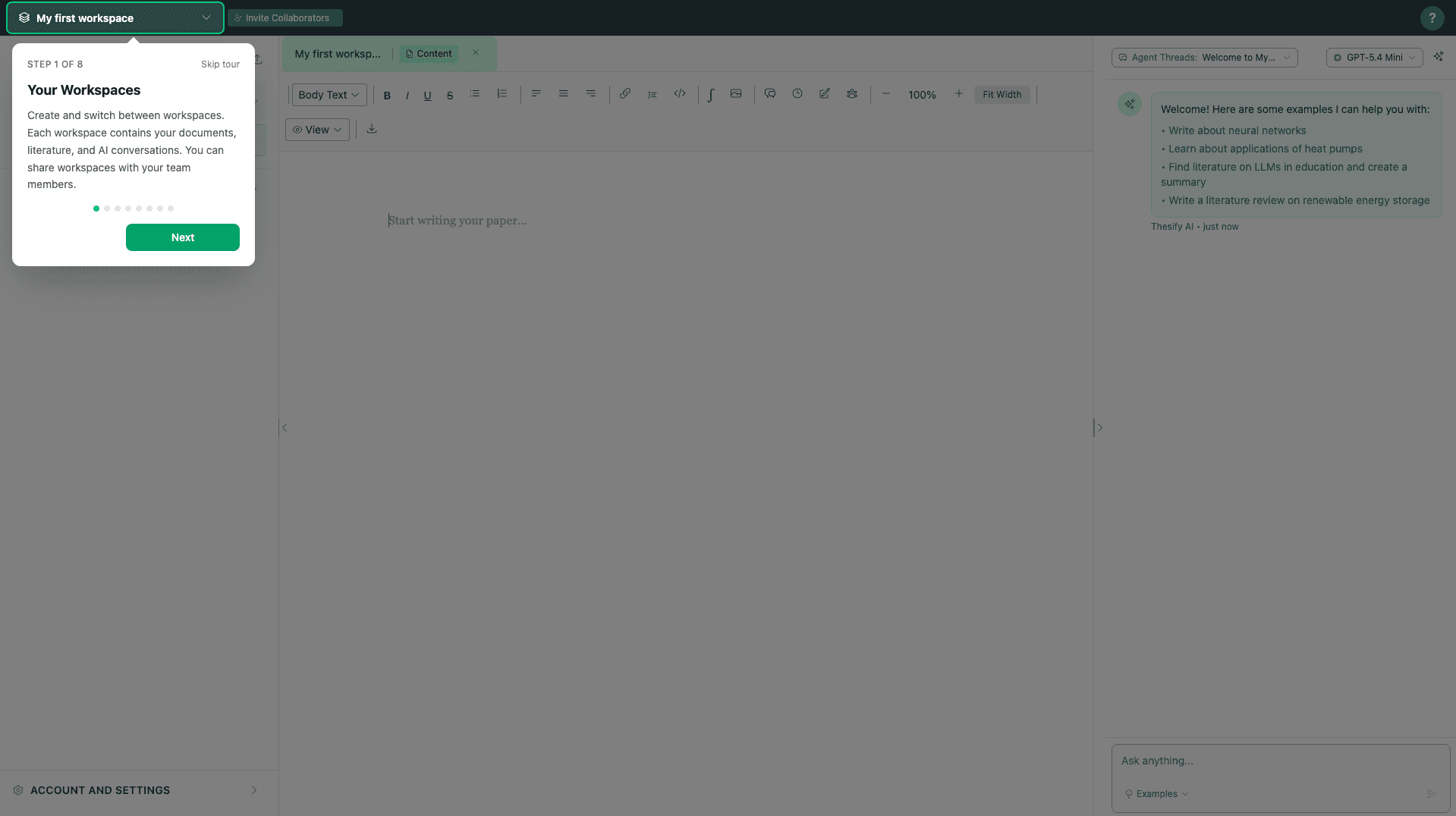
A correction to punctuation or duplicated wording carries a different burden from a revised limitation, a new citation, a rephrased interpretation of results or a stronger conclusion claim. AI contribution tracking helps the author team locate these retained changes inside the working draft. In thesify Coauthor, contribution visibility sits within a shared manuscript workspace, so AI-supported edits can be reviewed alongside the text, comments and author revisions they affect. The broader collaborative revision process is covered in our guide to collaborative manuscript revision with AI support.

What AI Attribution Means In A Shared Manuscript
AI attribution in academic writing refers to the ability to locate AI-supported text, edits or suggestions within the manuscript process. In a shared draft, attribution ensures the author team can see exactly where AI involvement remains in the text they are preparing to approve.
That boundary is important. Nature Portfolio’s guidance on AI authorship states that large language models do not satisfy authorship criteria because authorship carries accountability. It also states that there must be human accountability for the final version of the text. In a co-authored manuscript, attribution should therefore help the author team direct review, not blur the responsibility attached to the submitted paper.
Coauthor supports this review through AI + Human Provenance and contribution tracking, allowing authors to distinguish AI-supported input from author contributions inside the shared draft. To provide a clear comparative baseline,
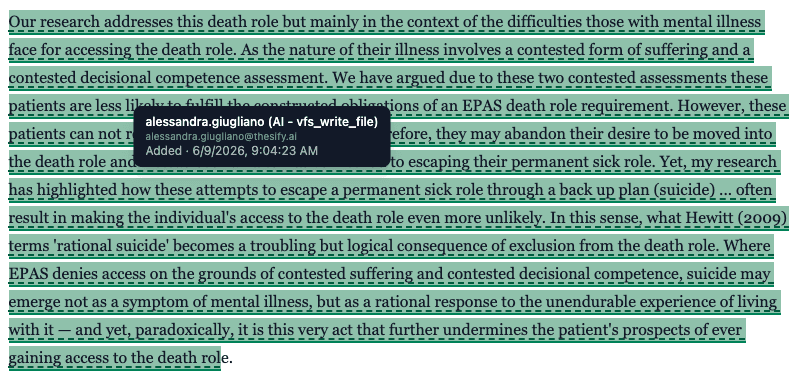
Attribution markers can help researchers identify where AI-supported changes remain in a shared manuscript.
Coauthor also indicates which changes in a draft came without AI assistance, simply listing the author's name rather than displaying an AI indicator. Used carefully, this layer of manuscript provenance helps a research team identify which retained changes require author review before final submission.

Conversely, purely researcher edits are attributed directly to the collaborator's account, clearly separating manual revisions from AI-supported drafting.
For teams still defining authority over sections, claims and final revisions, our guide to co-author roles and revision authority provides an operational starting point.
Separate AI Attribution From AI Detection
AI detection and AI attribution are two separate concepts, both relevant to researchers working with AI in their work flow:
AI detection tools evaluate finished prose and estimate whether it resembles AI-generated writing.
AI attribution inside a manuscript workspace concerns the draft history itself: where AI-supported text, edits or suggestions entered the document, and whether any of those interventions remain in the version under review.
A corresponding author rarely needs a general judgement about whether a paragraph “sounds AI-written.” Before submission, the more relevant questions are whether an AI-supported change remains in the manuscript, what claim or section it affects and whether the relevant author reviewed it.
In Coauthor, contribution tracking can attribute text to people or AI tools, with analytics designed to make AI involvement visible and traceable. That makes attribution useful for manuscript review, but not equivalent to detection. Use attribution to locate contributions inside the drafting process; use author judgement to decide what those contributions mean for the paper.
For a separate discussion of scanner limits, see our guide to AI detection and false positives.
Identify Which AI-Supported Changes Require Author Review
AI-supported contributions do not all carry the same scholarly burden. This heavily depends on your institutions’ AI policy. For a deep dive on various AI policies check out our guides to:
The author team should give closest attention to retained AI-supported changes that affect interpretation, evidence, methods reporting, limitation language, contribution claims or disciplinary terminology.
AI-Supported Change | Author Review Question | Why It Needs Attention |
Grammar, spelling or formatting correction | Did the correction alter meaning? | Usually lower risk unless terminology changed. |
Reworded limitation | Did the revision change the paper’s defensible scope? | Limitation language shapes what the authors can claim. |
Suggested citation | Does the source support the claim? | Citation changes can shift the evidence base. |
Revised conclusion sentence | Does the sentence change the contribution being claimed? | Conclusions are a common site of overstatement. |
New link between findings | Is the relationship supported by the results? | Synthesis must remain tied to the analysis. |
Claims in the discussion and conclusion deserve particular attention because small wording changes can alter the strength of the argument. For a fuller method of checking interpretation, limitation language and evidentiary support, see our guide to stress-test claims in a scientific paper discussion section.
This is also where track changes becomes more important than just editorial convenience. When authors use Coauthor's AI chat assistant to refine paragraphs or synthesize literature, they can insert the AI's suggestions directly into the document. In Coauthor, these inserted changes automatically appear as tracked edits. This ensures they can be reviewed through accept and reject controls before they are retained in the manuscript.
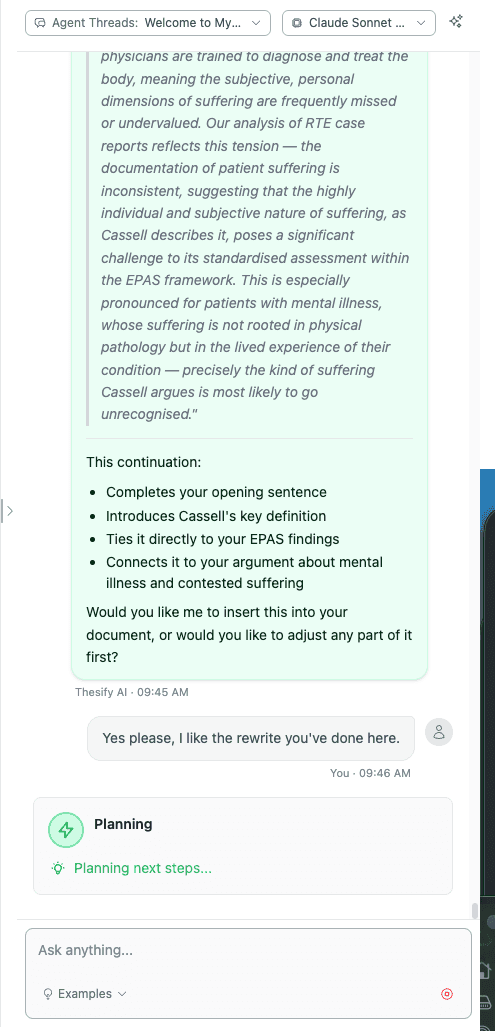
Authors can interact with the AI assistant in the sidebar and insert generated suggestions directly into the working draft.
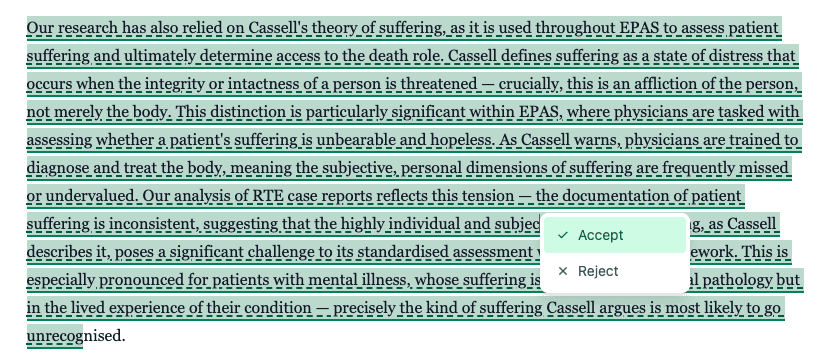
Track changes allow authors to accept or reject proposed wording before it remains in the manuscript.
Where a suggested edit changes a citation, limitation, result interpretation or conclusion claim, the relevant author should check the change against the paper’s evidence before accepting it. Elsevier’s guidance on AI-assisted manuscript preparation similarly places responsibility on authors to review and verify AI-assisted material, including source use.
Use Contribution Tracking To Review Retained AI Involvement
Contribution visibility is most relevant when the author team is reviewing the draft as a possible submission version. At that stage, the manuscript lead is no longer looking at AI use in general. The review concerns retained AI-supported changes: where they remain, what they affect and who has checked them.
Ask Which AI-Supported Changes Remain In The Draft
A focused review should answer four questions:
Which manuscript sections contain retained AI-supported changes?
Which of those changes affected claims, sources, methods, limitations or conclusions?
Which author reviewed the retained change?
Which changes may be relevant to the target journal’s disclosure requirements?
These questions keep AI contribution tracking tied to manuscript responsibility rather than general tool use. A rewritten sentence in the conclusion, a changed citation or a softened limitation should be visible to the author who is responsible for that part of the paper.
Use Attribution Information Without Treating It As Disclosure
In Coauthor, contribution tracking can attribute text to people or AI tools, with analytics that make AI involvement visible and traceable. That kind of contribution visibility can help an author team review where AI-supported involvement appears in the working draft.
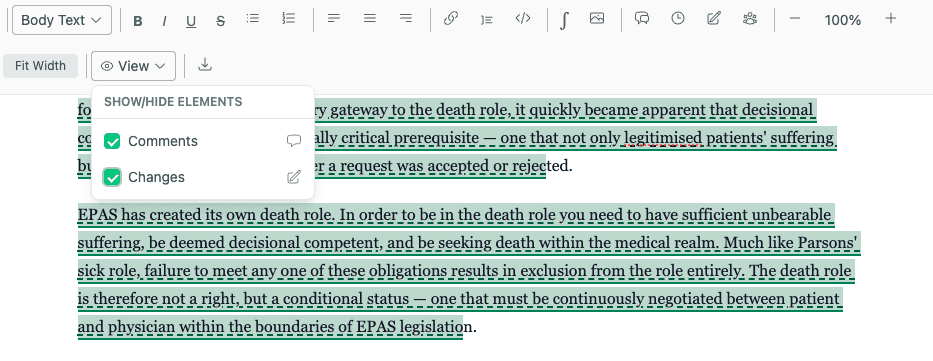
Keeping comments and changes visible helps the author team review retained AI-supported edits in the working draft.
The boundary should remain clear. Contribution tracking can help locate AI-supported changes in the workspace. It does not determine authorship, resolve journal AI-use policy or produce a disclosure statement.The author team still has to check retained changes against the study record, the source base and the target journal’s instructions. For a complementary way to document prompts, edits and decisions outside the manuscript itself, see our guide to creating a simple audit trail for AI use.
Check AI Attribution Before Manuscript Submission
Before approving the final draft for manuscript submission, the manuscript lead or corresponding author should review retained AI-supported changes against the target journal’s current author instructions. For example, the ICMJE guidance on AI use by authors states that journals should require authors to disclose whether they used AI-assisted technologies in producing submitted work, and to describe how those tools were used where applicable. The same guidance also states that AI-assisted tools should not be listed as authors because they cannot take responsibility for the accuracy, integrity and originality of the work. For a broader overview of current publisher expectations, see our guide to publisher policies on AI-assisted manuscript preparation.
Review Before Submission | Purpose |
Which sections contain retained AI-supported changes? | Defines the scope of AI involvement in the submitted draft. |
Which changes affected claims, sources, methods, limitations or conclusions? | Focuses review on scholarly content rather than incidental edits. |
Who reviewed those retained changes? | Confirms that the relevant author assessed the intervention. |
What does the target journal currently require? | Determines whether, where and how AI use should be disclosed. |
Attribution information can help the author team describe AI use with more precision, but it does not replace the journal’s instructions or the authors’ own review of the submitted manuscript.
Where Coauthor Fits In The Manuscript Review Process
Coauthor fits this process when research teams need a shared manuscript environment where AI-supported revision, reviewable changes and AI contribution tracking sit alongside the working draft. In a co-authored manuscript revision, retained changes can then be examined in relation to the surrounding text, author comments and contribution visibility. The platform’s role is to keep AI-supported involvement visible enough for author review. The judgement about what belongs in the final manuscript remains with the author team.

Coauthor workspaces help research teams keep manuscript documents and related materials in one place.
Sign Up To thesify To Test Coauthor
Sign up to thesify for free and test Coauthor’s AI contribution tracking in a shared manuscript workspace.
Related Articles
AI Coauthor for Research Papers: A Responsible Workflow: thesify’s Coauthor provides a shared manuscript workspace in which researchers can work with their co-authors while using AI-supported feedback, track changes and contribution attribution within the revision process. For teams managing substantive revisions across several authors, this is the appropriate setting in which to examine what AI adds to the draft and what the authors are prepared to retain. Learn more about thesify’s latest feature.
How to Co-Author Academic Papers Without Losing the Argument: In interdisciplinary projects, co-authored papers can begin to drift when each contributor writes from their own field’s assumptions about evidence, structure, and audience. This is not only a style issue. It can affect the manuscript’s argument, journal fit, and reviewer reception. Learn how to co-author an academic paper with clear roles, authorship order, first-author alignment, communication norms, and ethical AI use.
AI Detection in Academia: Tools, Accuracy & Ethics: In 2026, “how do professors detect AI” is rarely answered by one tool or one score. Instructors combine automated signals with process evidence: consistency with your past writing, credible citations, draft history, and your ability to explain your reasoning. Discover how professors detect AI writing, which tools universities use, their accuracy, and how to use AI responsibly. Learn to protect your academic integrity.