Using AI Support During Co-Authored Manuscript Revision


thesify has launched Coauthor, a shared manuscript workspace for researchers revising papers with their co-authors and drawing on AI support within the same document environment.
For a manuscript lead, the value of this arrangement appears during revision. A co-author can comment on a passage that requires clarification, a proposed change can be assessed before it enters the retained draft, and a selected section can be brought into an AI interaction when the team needs focused feedback on wording, structure or interpretation.
This article examines how research teams can use Coauthor to coordinate manuscript revision in a shared draft while drawing on AI support where it is relevant to the work under review.
Bring Co-Authors Into the Same Revision Workspace
As manuscripts move through revision, proposed edits, unresolved comments and drafting decisions often become distributed across separate files and private exchanges. Coauthor provides a shared draft in which co-authors can work on the manuscript while AI support remains available for defined revision tasks.
The workspace owner can invite co-authors with editing access to the shared manuscript. This gives the author team a common working document in which comments and proposed revisions can be considered before the submission version is approved.
Before substantive revision begins, the team should still agree who leads integration, who reviews changes to claims or limitations, and who approves the final submission version. For guidance on those decisions, see thesify’s article on How to Co-Author an Academic Paper Without Losing the Argument.
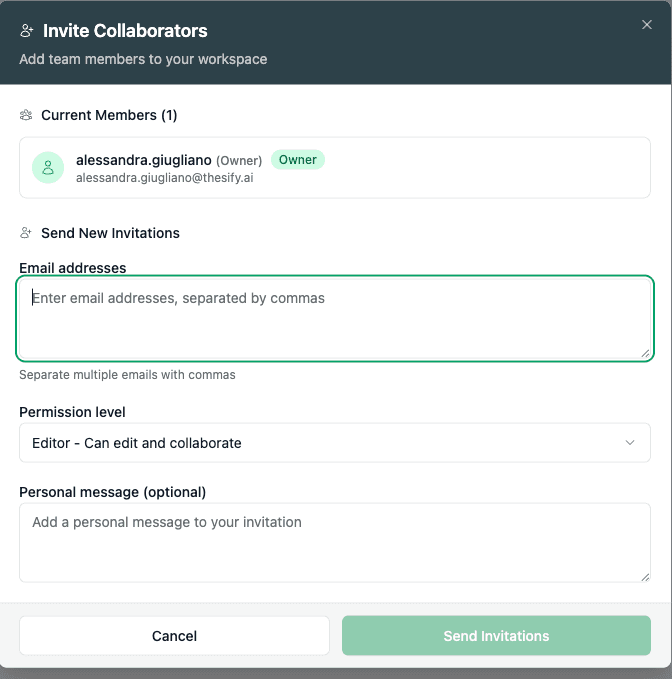
Workspace owners can invite co-authors to edit and collaborate on a shared manuscript.
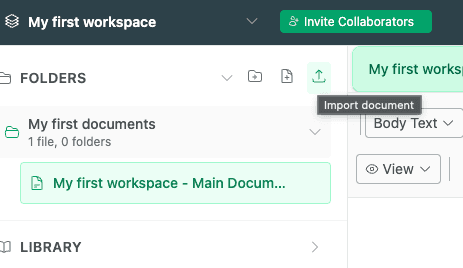
Research teams do not need to start from a blank page. The workspace allows users to import existing drafts and supporting literature directly into the shared environment.
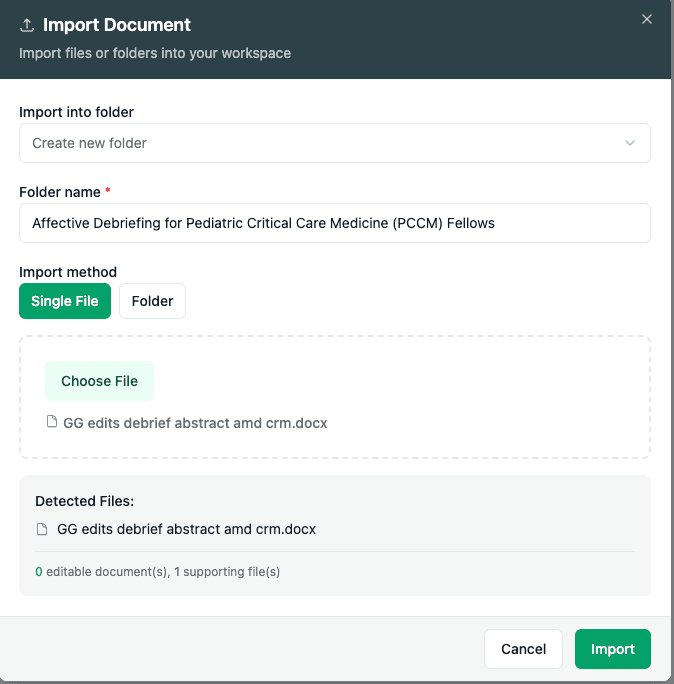
Research teams can import their existing drafts and supporting literature directly into structured workspace folders to review together.
Frame AI Feedback Around a Defined Manuscript Problem
Disclosure requirements vary across disciplines, publishers and individual journals, and they may change. Verify the target journal’s current author guidance before submission, and consult thesify’s overview of AI disclosure requirements in academic publishing for broader context.
Ask Where the Argument Exceeds the Evidence
AI feedback for manuscript revision is most useful in discussions and conclusions when it is directed towards the relationship between evidence and claim. Discussions and conclusions require particular attention because a more fluent revision can also widen the interpretation or alter the level of certainty in the claim.
Useful diagnostic questions include:
Where does this discussion make a claim broader than the reported results?
Which statements in the conclusion require closer evidentiary support?
Where has a limitation been softened or obscured during revision?
Which transitions imply relationships the study has not demonstrated?
Where is the manuscript repeating a finding rather than synthesising its implication?
In Coauthor, an author can select the relevant passage from the manuscript and bring it into the AI interaction with a question defined by the analytical issue under review.
For a fuller review of overclaiming, limitation language and interpretation in the discussion section, see thesify’s guide to stress-test claims in a scientific paper discussion section.
Distinguish Editorial Tidying From Substantive Revision
An observation that a paragraph repeats itself is an editorial diagnosis. A proposed sentence explaining why two findings relate is an interpretive intervention. A proposed citation creates an evidentiary task: the author must verify that the source supports the claim for which it is being used. A revised conclusion requires review of the contribution it attributes to the study and the claims the authors will be expected to defend.
Manuscript Concern | Useful AI Feedback Request | What the Author Must Decide |
Discussion overstates results | Identify statements that extend beyond the reported findings. | Whether to qualify, support or remove the claim. |
Conclusion summarises rather than integrates | Identify where findings are listed without a defensible relationship. | What synthesis the study can support. |
Citation burden is unclear | Flag claims requiring source verification. | Whether the cited literature supports the claim. |
Terminology has drifted | Identify inconsistent use of core terms across sections. | Which terminology accurately reflects the study design and analysis. |
Review AI-Supported Feedback Against the Manuscript
Feedback is useful in research manuscript revision when it returns the author to the evidence, the logic of the argument and the reporting standard the paper must sustain.
Evaluate Changes to Claims, Citations and Limitations
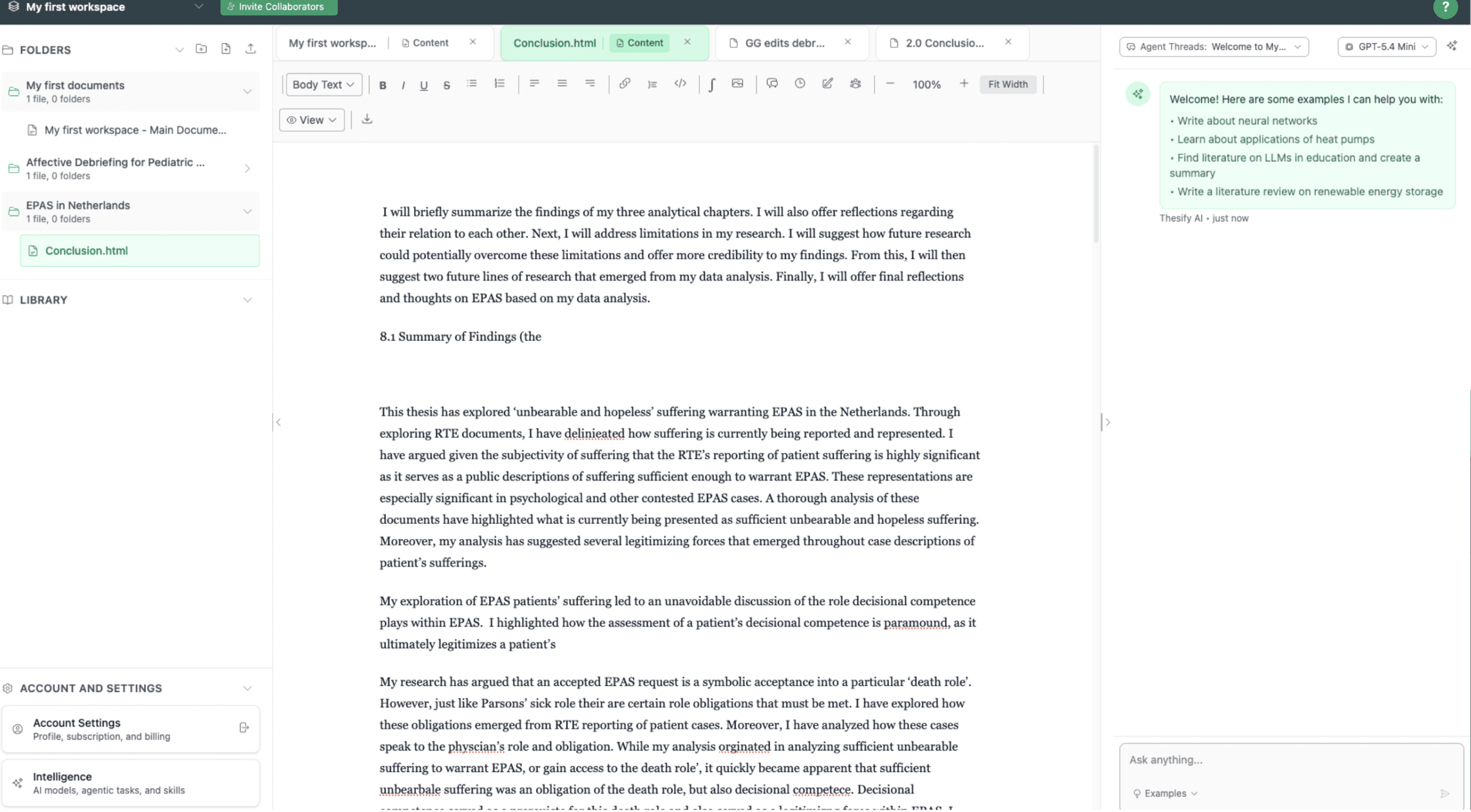
The conclusion section shown below provides one example of AI-supported revision within a shared manuscript. In this instance, the AI assistant identifies structural disorder, unfinished passages, missing citations, repetition and weak connections among the manuscript’s analytical themes. These observations give the author team a set of issues to examine against the paper’s findings and intended argument.
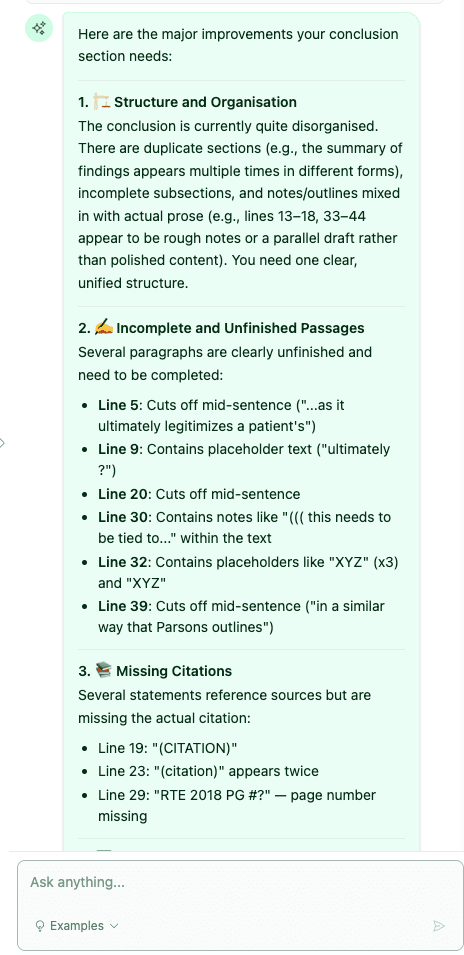
In this example, AI feedback identifies structural, completion and citation issues for the authors to examine in the conclusion section.
Some interventions require especially close review: a new connection between findings, a proposed explanatory mechanism, stronger language around effect, association or significance, a revised limitation statement, a suggested citation or a new account of the paper’s contribution. Each changes what the authors may be expected to justify from the evidence.
In Coauthor, the authors can assess AI feedback alongside the passage under revision. Any proposed reformulation still needs to be checked against the study’s evidence, argument and reporting standard before it enters the retained draft.
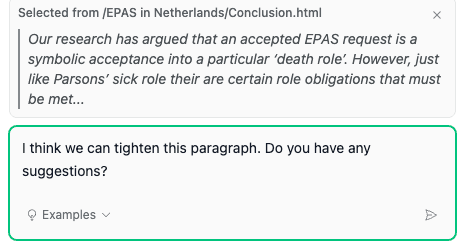
A request to tighten a selected passage can produce proposed wording that requires substantive author review.
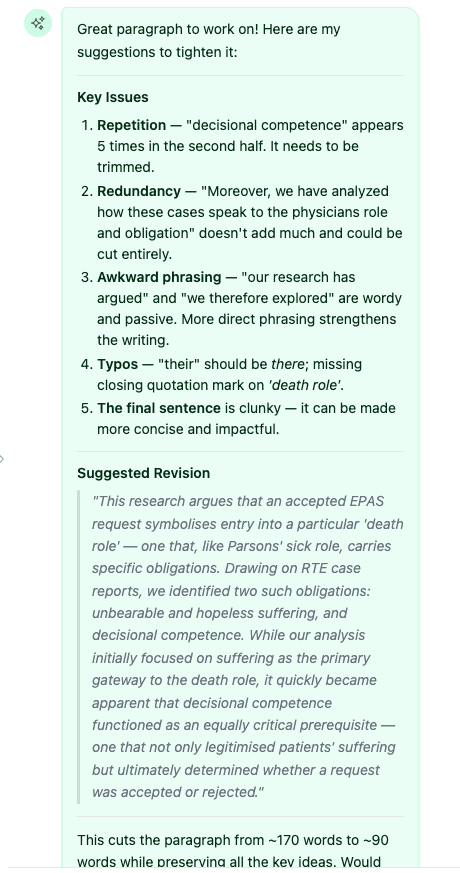
A proposed revision may improve concision while also changing the relationship asserted between the paper’s analytical claims.
Retain Disciplinary Precision During Revision
A revision can improve sentence-level flow while weakening the conceptual precision of the manuscript. This risk is particularly relevant in co-authored work, where sections may already reflect different disciplinary assumptions, vocabularies or standards of inference.
The revision lead should check whether AI-suggested revisions preserve methodological specificity, appropriate uncertainty, disciplinary terminology and the contribution the authors claim for the study. A stronger-sounding sentence may exceed the evidence; a more general term may remove a distinction on which the analysis depends.
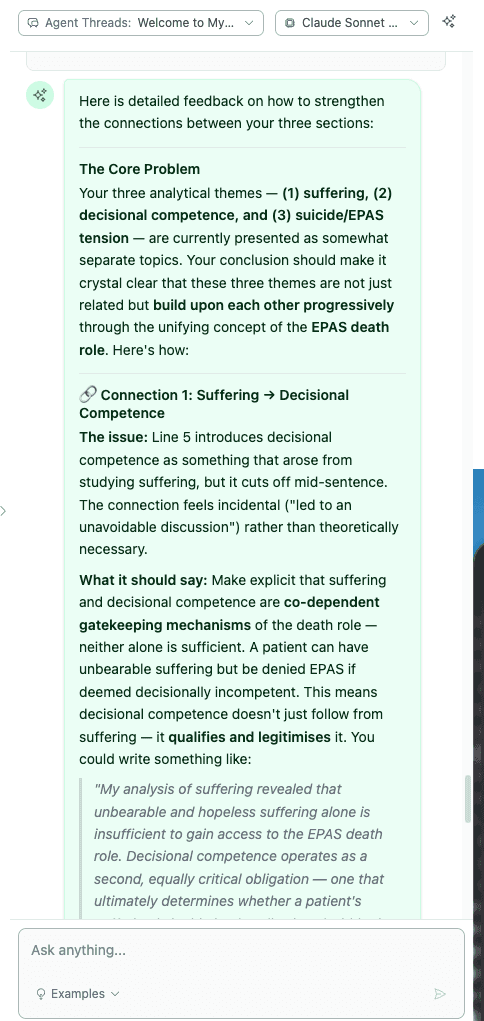
AI feedback may propose a stronger conceptual relationship between analytical themes; the author must judge whether that relationship is supported by the study.
Where AI-supported wording flattens field-specific reasoning or shifts the force of a qualified claim, the revision lead should restore the manuscript’s analytical register. See thesify’s guide on how to preserve your academic voice while using AI writing tools.
Review Proposed Changes With Co-Authors in the Shared Draft
Once a revision has been proposed, the author still needs to determine whether it improves the manuscript and whether it affects claims, interpretations or sections for which another co-author is responsible. Coauthor supports this review process by allowing co-authors to comment on specific passages and evaluate tracked revisions before they are incorporated into the draft.
Use Comments for Passages That Require Scholarly Discussion
Comments belong where the manuscript presents a specific problem: an imprecise term, a claim that lacks support, an interpretation that extends beyond the results, or a conclusion that overstates what the evidence shows.
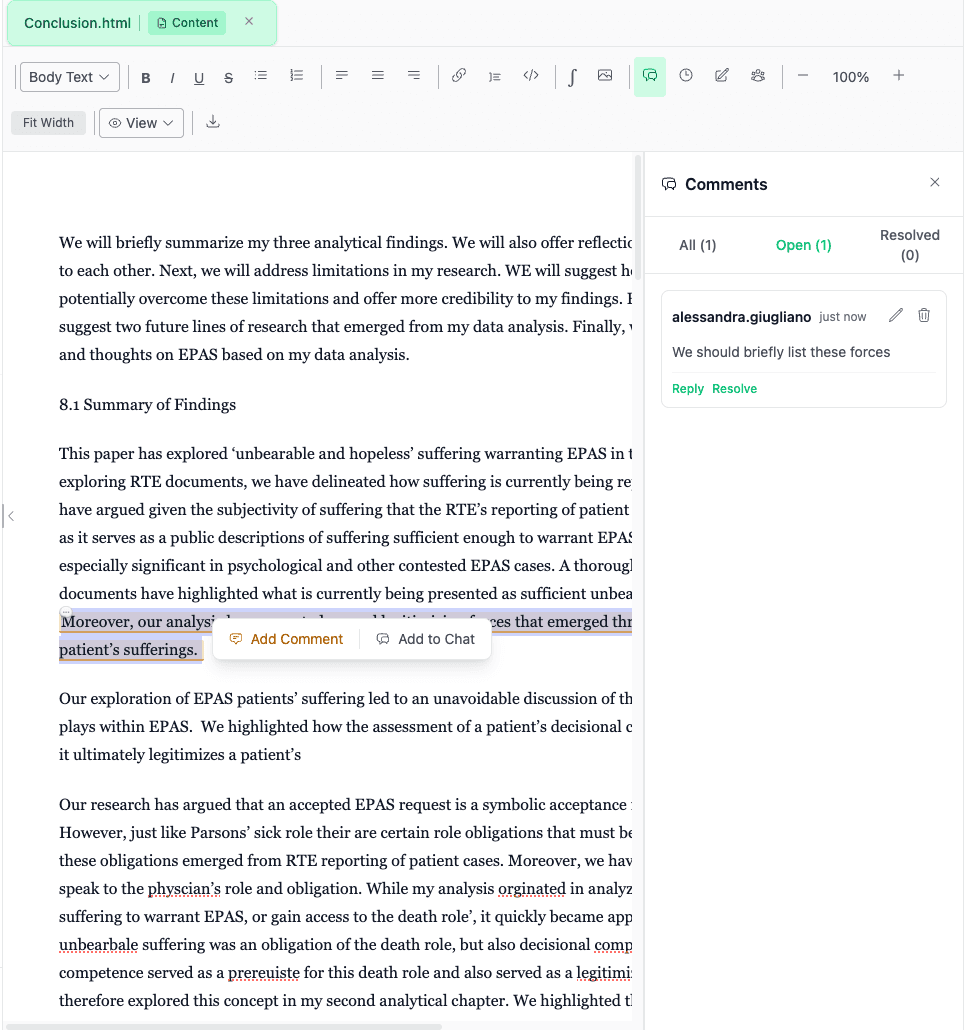
Co-authors can comment directly on manuscript passages where a revision question requires discussion.
Review Substantive Changes Before They Enter the Retained Draft
Tracked revision controls help authors inspect exactly what has changed when proposed wording affects the meaning of a finding, adds a claim that requires supporting evidence, alters the discussion of a limitation or changes how the paper’s contribution is described.
Lower-Stakes Editorial Assistance | Substantive Revision Requiring Author Review |
Identifying duplicated phrasing | Reframing the interpretation of a finding |
Flagging unfinished sentences | Adding or changing a citation used to support a claim |
Correcting obvious typographical issues | Revising a limitation or generalisability statement |
Noting inconsistent heading format | Strengthening the manuscript’s conclusion or contribution claim |
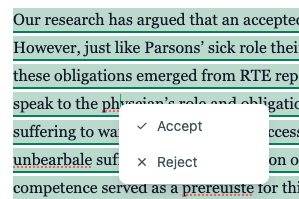
Tracked revisions remain available for author review before they are retained in the manuscript.
Run an Integration Pass Across Revised Sections
Substantive edits may remain defensible in isolation while weakening the paper as a whole. A revised discussion may no longer align with the results; a conclusion may claim a stronger contribution than the introduction establishes; a new citation may reposition the argument; or altered limitation language may extend the study’s defensible scope.
The first author, corresponding author or designated manuscript lead should therefore review how retained changes function across the complete draft, with attention to terminology, claim scope and evidentiary standards. For a structured approach to this stage of review, see thesify’s guide to run an integration pass across a heavily revised manuscript.
Check AI Use Before Manuscript Submission
Where AI support has informed wording or revision decisions in the submitted manuscript, the author team should check the target journal’s current disclosure requirements before submission. Requirements vary across disciplines, publishers and individual journals. For example, journals following ICMJE guidance on AI use by authors are expected to require disclosure of AI-assisted technologies used in producing submitted work, with authors describing how those technologies were used where applicable.
Review Before Submission | Why Review It |
Which manuscript passages were revised with AI support? | Establishes where AI entered the submitted draft. |
Were proposed changes retained in the final text? | Identifies the revisions potentially relevant to disclosure. |
What does the target journal require? | Determines the appropriate statement and placement. |
Check the Target Journal’s Current AI Disclosure Requirements
Disclosure requirements vary across disciplines, publishers and individual journals, and they may change. Verify the target journal’s current author guidance before submission, and consult thesify’s overview of AI disclosure requirements in academic publishing for broader context.
Frequently Asked Questions About Using Coauthor With a Research Team
How Can I Invite My Co-Authors Into the Manuscript Workspace?
From the Coauthor workspace, select Invite Collaborators to add co-authors to the shared manuscript environment. You can then enter their email addresses, assign the appropriate permission level and include a message with the invitation.
Select Invite Collaborators from the workspace to add co-authors to the shared manuscript.
Once an invitation has been sent, the invited co-author receives an email with a link to join the workspace and begin working in the shared manuscript.
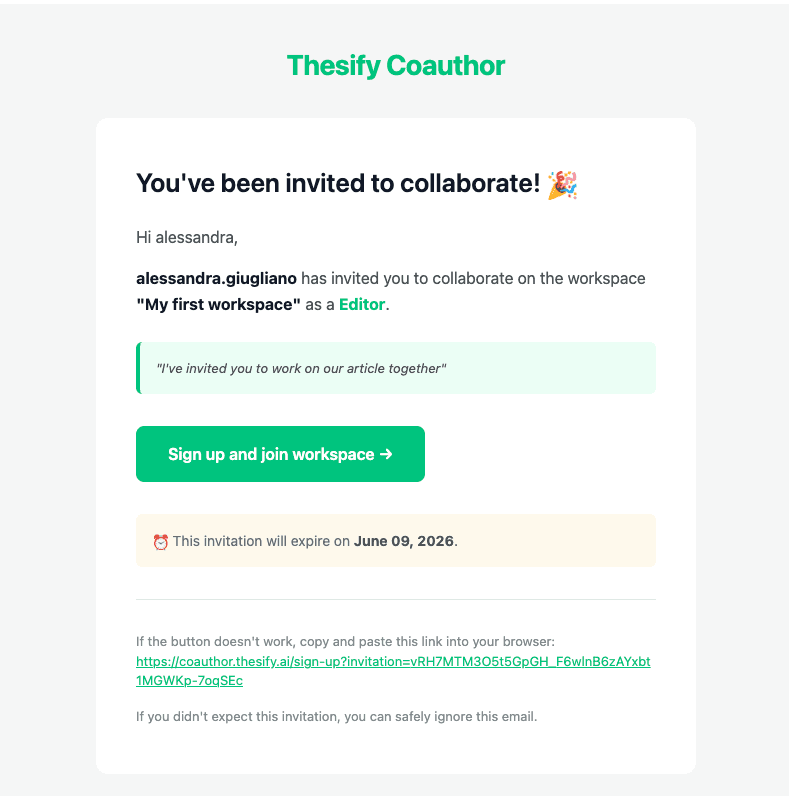
Invited co-authors receive an email invitation to join the shared manuscript workspace.
Can Co-Authors Comment on Specific Passages During Revision?
Yes. Co-authors can attach comments directly to selected manuscript text, keeping questions about interpretation, terminology or evidentiary support connected to the relevant passage.
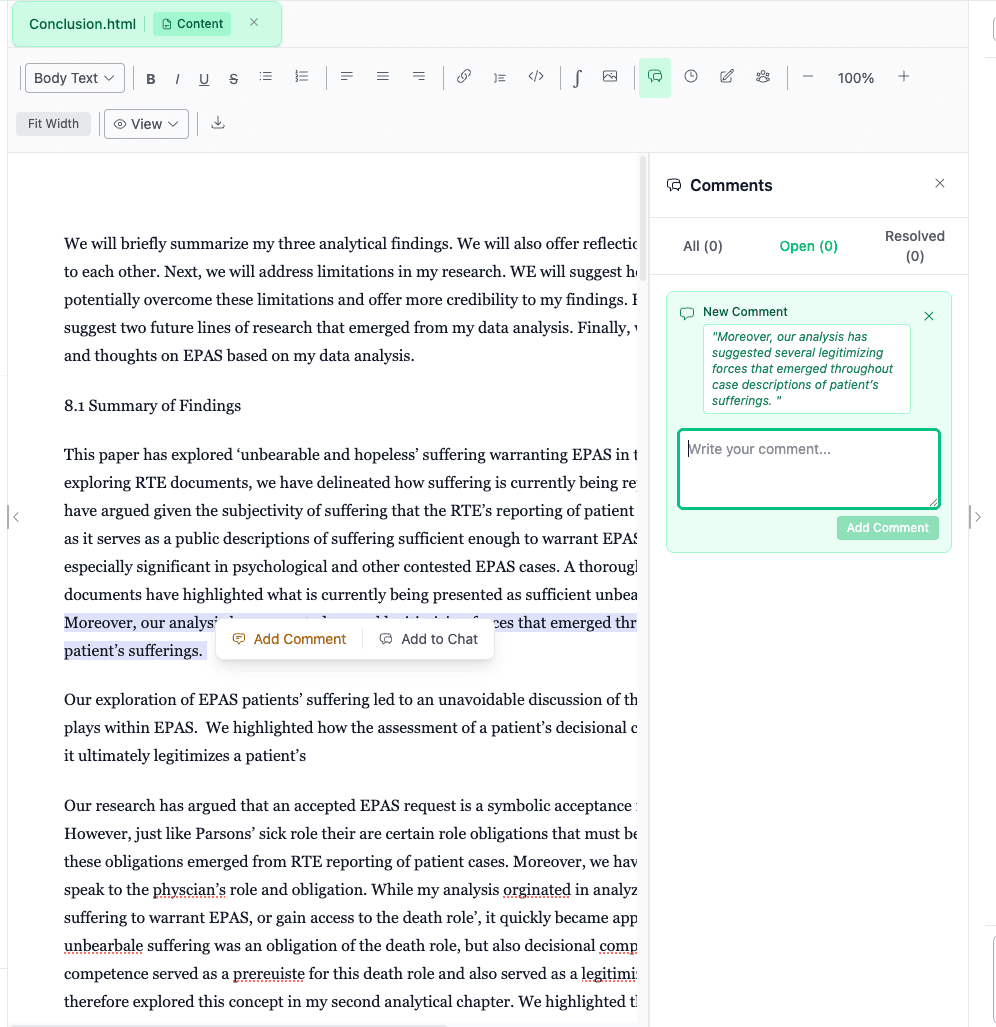
A co-author can attach a new comment to selected manuscript text and keep the discussion connected to the relevant passage.
Can Proposed Revisions Be Reviewed Before They Are Retained?
Yes. Coauthor supports tracked changes with accept and reject controls, allowing authors to assess proposed wording before it enters the retained draft. This is especially relevant for revisions to interpretations, limitations, citation-dependent statements or conclusions.
Can I Send a Specific Passage for AI-Supported Review?
Yes. An author can select a passage from the manuscript and bring it into the AI interaction with a defined revision question, such as whether a transition adequately connects two findings or whether conclusion wording remains proportionate to the analysis.
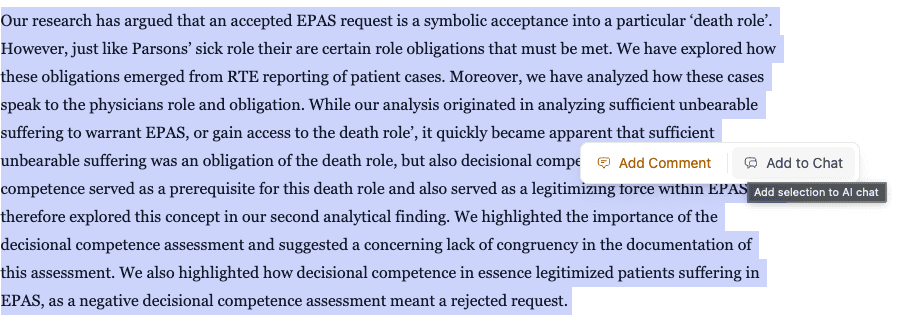
An author can select a manuscript passage and bring it into the AI interaction for focused revision feedback.
Does Coauthor Support LaTeX Manuscripts?
Yes. Coauthor supports rich-text and LaTeX document modes, including LaTeX compilation and inline error feedback.
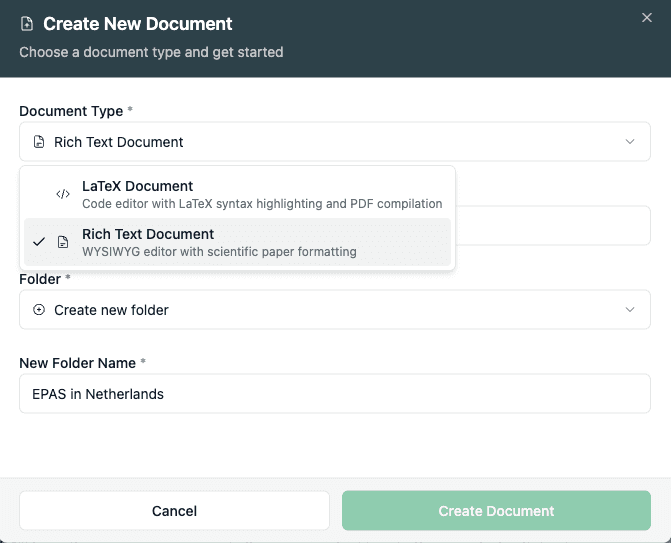
Coauthor supports both rich-text and LaTeX manuscript workflows.
Can I Export a Revised Manuscript for Further Review or Submission Preparation?
Yes. The workspace includes export options for DOCX and PDF files, allowing an author team to move a revised manuscript into subsequent review or submission-preparation steps after completing its internal checks.
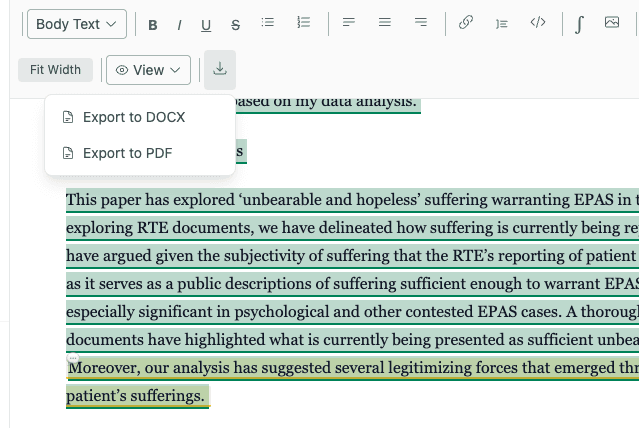
Revised manuscript files can be exported as DOCX or PDF for subsequent review or submission preparation.
Where Coauthor Fits in Collaborative Manuscript Revision
Coauthor places thesify’s AI support within the shared revision process used by human co-authors. Researchers can examine specific manuscript problems, discuss proposed revisions in context and decide which changes belong in the final draft.
For teams revising a co-authored paper, this keeps AI-supported feedback connected to the manuscript decisions for which the authors remain responsible.
Start a Free Trial and Test Coauthor With Your Research Team
Sign up to thesify for free, open a shared manuscript workspace, invite your co-authors and test how Coauthor supports review of AI-assisted revisions within a working draft.
Start a Free Trial of Coauthor
Related Articles
Navigating Disciplinary Drift: A 2026 Guide to Academic Co-Authorship: Early-career researchers (ECRs) are increasingly encouraged to participate in large-scale, multi-author consortia to tackle complex global problems. However, as the number of contributors grows, so too does the risk of "epistemic interdependence" failing to produce a unified argument. Master the "First Author Anchor" to prevent desk rejection. Learn how Slow AI acts as an epistemological bridge for aligning interdisciplinary research teams.
How to Preserve Your Academic Voice While Using AI Writing Tools: In the thesify interview series, Dr. Michael Meeuwis (Professor of English at the University of Warwick) cautions that overusing AI not only weakens your skills, but also prevents the development of your unique analytical perspective. Dr. Meeuwis warns that if you ask LLM’s to write a full paper for you that “you will never develop your own voice[...] It’s not developmental.” So what’s the solution? How can you still benefit from AI writing tools without outsourcing your ideas or style? The key lies in redefining your relationship with AI—not as a substitute, but as a support system for your thinking.
AI Policies in Academic Publishing 2025 – What Authors Need to Know: Academic publishers seem to have somewhat of a consensus when it comes to AI and Accountability, which holds that authors shall be responsible and accountable for all manuscript content; Transparency, requiring clear disclosure of any AI use; and Authorship, AI cannot be an author or co-author because it cannot be held accountable both legally and ethically, Find out how Elsevier, Springer Nature, Wiley, Taylor & Francis & SAGE handle AI. Learn disclosure requirements, exemptions and best practices.