Can I Resubmit a Rejected Paper? Guidelines & Next Steps


Can You Resubmit a Rejected Paper? What to Do Next
Yes. Once a journal has formally rejected your manuscript, you can submit it to a different journal. Resubmitting to the same journal is different: proceed only if the decision letter invites a new submission or the editor approves reconsideration. Do not submit elsewhere while an appeal is active. Always check the journal’s policy and letter.
A final journal rejection closes that submission. You can then revise the manuscript for another journal or, when the decision letter permits it, return a substantially revised version to the same journal.
The correct next step depends on the exact decision you received. A desk rejection, a rejection after peer review, an invitation to resubmit, and a transfer offer create different options. The wording of the editor’s letter matters more than whether individual reviewer comments seemed positive.
Check Your Revised Manuscript Before Resubmitting
Reviewer comments identify problems in the rejected version. thesify Reviewer evaluates the revised manuscript for contribution framing, methodological gaps, unsupported claims, section alignment, and other reviewer-facing weaknesses before you submit again.
Check Your Revised Manuscript Before Resubmitting
Read the Decision Letter Before You Resubmit
Editorial decision labels vary across publishers. Read the complete decision letter to confirm your exact manuscript status.
Decision | Is the submission still active? | Same journal? | Best next step |
Minor or major revision | Yes | Yes, through the existing revision process | Follow the journal’s revision instructions and deadline |
Reject and resubmit, or explicit invitation | Usually no, because the current version has been rejected | Usually yes, often as a new submission | Confirm the procedure and address the substantive feedback |
Final rejection with no invitation | No | Generally not without editor approval or a successful appeal | Revise and select another journal |
Desk rejection | No | Usually not, unless the editor permits reconsideration | Determine whether the issue was fit, priority, article type, or an administrative problem |
Reject and transfer | No at the original journal | The offered route is to a different journal | Evaluate the receiving journal before accepting |
For example, Nature states that its decision letter will specify whether the journal would consider a resubmitted version. When the letter offers no reconsideration, Nature advises authors to submit the paper elsewhere.
Treat “reject” and “reject and resubmit” as distinct editorial decisions with different required actions.
What should you do after journal rejection?
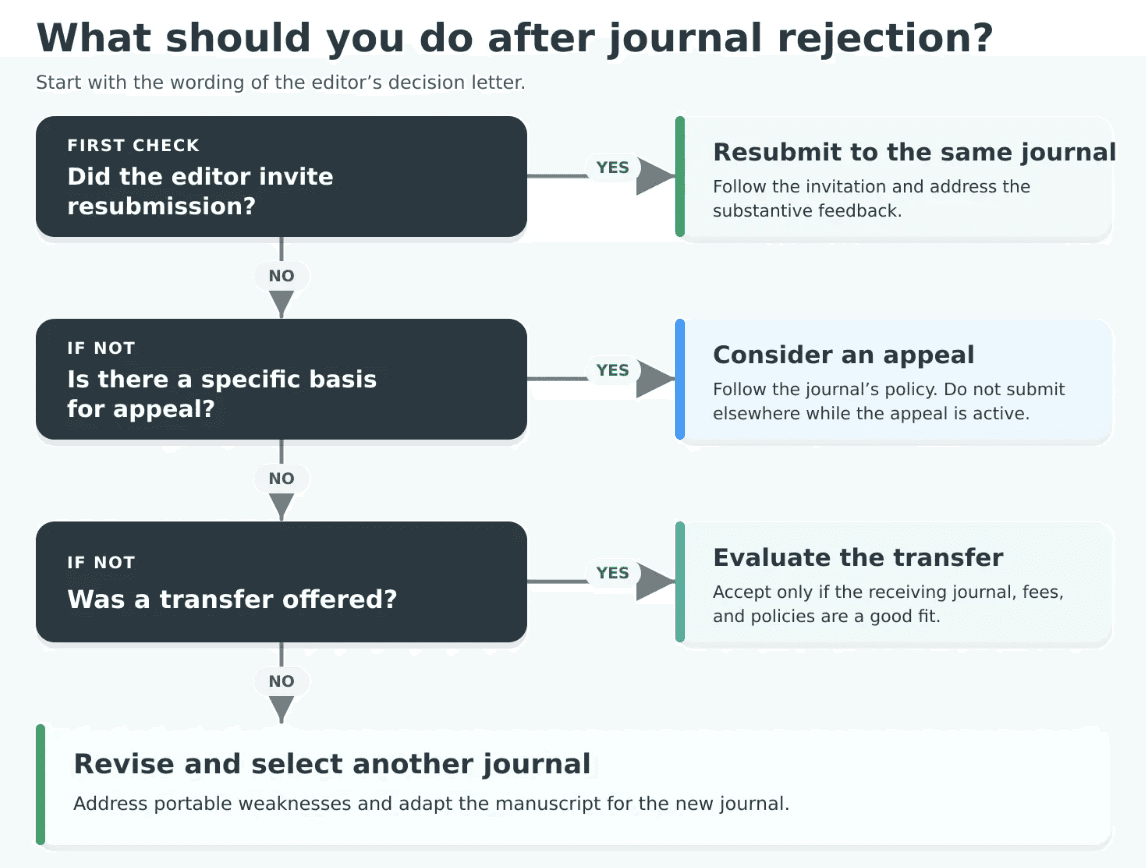
After rejection, the editor’s letter determines whether the next route is resubmission, appeal, transfer, or a different journal.
When Can You Resubmit to the Same Journal?
You should resubmit a rejected paper to the same journal only when the decision letter leaves that route open or the editor approves reconsideration.
The Editor Explicitly Invites a New Submission
When the decision letter invites resubmission, follow the journal’s stated procedure:
• Follow the resubmission instructions in the decision letter.
• Confirm the submission route. Check whether the journal requires a new submission or provides a resubmission process linked to the previous record.
• Include the previous manuscript number wherever the journal requests it.
• Address every substantive editor and reviewer concern.
• Expect another editorial assessment. The editor will decide whether the revised manuscript proceeds to external review.
The Editor Agrees to Reconsider a Substantially Changed Paper
If the decision letter leaves the possibility of reconsideration unclear and you have made substantial changes, contact the editor before submitting again. In your message, include:
The substantive changes: Identify any new data, analyses, methodological work, or other major revisions completed since the rejection.
The current journal fit: Explain how the revised manuscript meets the journal’s scope and editorial criteria.
A direct request: Ask whether the editor would consider the revised manuscript as a new submission.
Major publishers like Elsevier recommend submitting a pre-submission inquiry in these scenarios to save your research team and the editorial board valuable time.
The Rejection Letter Does Not Invite Resubmission
If the decision letter closes the submission, prepare the manuscript for another journal. A rejection based on scope or editorial priority generally points to a journal with a better fit. Appeal only when you can identify a specific factual, technical, or procedural error that could have affected the decision.
Springer Nature advises authors to review a journal’s aims and scope and its recently published papers when assessing manuscript fit.
Can You Submit a Rejected Paper to Another Journal?
Yes. Once the rejection is final and the manuscript is no longer under consideration, you can submit it to another journal.
There is no universal waiting period after a final rejection. Confirm that the first journal has closed the manuscript and that no appeal or revision process remains active. The ICMJE advises authors not to submit the same manuscript to more than one journal simultaneously.
Before uploading files to a new editorial system, take these steps to prepare your submission:
Reassess the fit: Evaluate the new journal’s scope, expected readership, accepted article types, and specific editorial criteria.
Adapt the framing: Update your title and abstract to highlight the contribution most relevant to the new audience.
Refresh the submission package: Write a fresh cover letter, apply the required formatting, and update mandatory ethics or funding statements.
Clean your documents: Remove the former journal’s name, clear all tracked changes, delete margin comments, and scrub file metadata.
Do You Need to Disclose the Previous Rejection?
Follow the receiving journal’s author instructions and submission questions because disclosure requirements vary.
• Provide requested information: Disclose prior consideration or previous reviewer reports when the journal asks for them.
• Check transferred materials: A publisher transfer may include submission files, decision materials, or reviewer reports. Confirm what the receiving journal will receive.
• Consider including prior reviews: The ICMJE notes that previous editor and reviewer comments, together with the authors’ responses, may help expedite review. Follow the receiving journal’s instructions.
Can You Submit the Manuscript Without Changes?
A final rejection allows you to submit the core manuscript elsewhere after the first journal closes its consideration. Update the cover letter, title page, formatting, declarations, and other journal-specific materials. Reassess any scientific, methodological, evidentiary, or framing weaknesses identified in the first review because another editor or reviewer may raise the same concerns. The revision process below explains how to prioritize them.
Should You Appeal a Journal Rejection?
An appeal is most defensible when you can identify a specific problem with the decision or review process and show that correcting it could affect the outcome. Depending on the journal’s policy, strong grounds may include:
A significant factual or technical error in the assessment
A documented competing interest that may have affected a reviewer’s or editor’s objectivity
A serious procedural problem, such as failure to follow the journal’s stated process
Evidence that correcting the identified error could change the editorial decision
Base an appeal on a specific error, documented competing interest, or serious procedural problem. When the journal invites revision or resubmission, address a defensible difference in interpretation through the response to reviewer comments.
Before proceeding, read the journal’s complaints and appeals policy. COPE’s Principles of Transparency and Best Practice in Scholarly Publishing say journals should explain how they handle complaints and appeals. PLOS Biology provides a narrower journal-level example: it considers appeals based on a significant factual error or documented competing interest only when reversal on either ground could change the original decision.
Do not submit the manuscript elsewhere while an appeal is active if the journal continues to treat it as under consideration. PLOS Biology explicitly states that a manuscript remains under formal consideration during an appeal and should not be submitted elsewhere.
If you decide to move to another journal, withdraw the appeal and obtain confirmation that the first journal has closed its consideration.
Should You Accept a Journal Transfer?
Some publishers offer to transfer rejected manuscripts to another journal within their portfolio. A transfer can move files and metadata into a new submission, while the receiving journal conducts its own editorial assessment. Evaluate the suggested journal’s readership, publishing model, and article processing charge (APC) before accepting.
Transfer procedures differ by publisher. Elsevier moves the submission to a destination journal and lets authors revise their files before final submission. Wiley transfers submission files and any available reviewer reports, then allows manuscript and cover-letter revisions. Springer Nature transfers submission files but not prior reviewer reports; the receiving journal assesses the manuscript independently.
Compare the transfer offer with journals you select independently before choosing the next submission route.
Before you and your co-authors accept a transfer offer, evaluate the opportunity using this checklist:
Does the new journal fit the manuscript’s topic and methods?
Is the target readership appropriate for your findings?
Are the publishing model and associated fees acceptable to your funders?
Will previous reviewer reports accompany the transfer?
Can you revise the manuscript and cover letter before finalizing the submission?
Would an independently selected journal be a stronger target?
What Should You Revise Before Resubmitting?
Before revising your manuscript, separate feedback tied to the previous journal’s editorial criteria from weaknesses that could concern another editor or reviewer.
Feedback type | Examples | Appropriate response |
Journal-specific | Scope, readership, editorial priority, article type, word limit, house format | Select a better journal or adapt the submission |
Portable manuscript weakness | Methodological gap, unsupported claim, unclear contribution, section misalignment, overclaiming, difficult figures | Resolve or clearly delimit the weakness before the next submission |
Journal-specific feedback usually changes your journal choice or submission package. A portable weakness affects how another editor or reviewer will assess the manuscript. Identify whether each comment points to a limitation, reporting gap, or mismatch between the evidence and the claims.
Use the editor’s letter as the starting point for revision triage:
Identify the central reason for rejection. Distinguish it from secondary comments and line-level suggestions.
Group overlapping reviewer comments. Several comments may point to one underlying problem, such as unclear methods or an overstated contribution.
Classify each concern as journal-specific or portable.
Resolve issues affecting methods, analysis, evidence, or conclusions first. If a problem cannot be corrected, narrow the relevant claim and state the limitation clearly.
Recheck the title, abstract, introduction, and discussion. Each should present the same contribution, scope, and level of certainty.
Adapt the submission package to the next journal. Update the cover letter, article type, word count, formatting, required statements, and files.
This order keeps surface changes from concealing substantive problems and helps distinguish requests you can reasonably decline from weaknesses that still need attention.
For a detailed process for categorizing feedback, resolving conflicting reports, and documenting changes, see how to respond to reviewer comments.
Once the substantive revisions are complete, thesify Reviewer can assess the revised manuscript for contribution framing, methodological gaps, unsupported claims, section alignment, and difficult figures before the next submission.
Rejected Paper Resubmission Checklist
Before resubmitting a rejected paper, confirm that:
• Final journal decision: The first journal has issued a final decision.
• No active appeal or revision: No appeal, revision, or other consideration remains active at the first journal.
• Permission to resubmit to the same journal: The editor has explicitly invited or approved resubmission if you are returning to the same journal.
• Feedback triage: Journal-specific feedback has been separated from portable manuscript weaknesses.
• Editor and reviewer comments: Every substantive comment has been considered and either addressed or answered with a reasoned explanation.
• Proportionate claims: The claims remain proportionate to the methods, analysis, and evidence.
• Accurate title and abstract: The title and abstract accurately represent the revised manuscript.
• Target journal fit: The target journal fits the topic, methods, article type, and intended readership.
• Adapted submission package: The cover letter and submission files have been adapted to the target journal.
• Clean submission files: Previous journal names, margin comments, tracked changes, and formatting remnants have been removed.
• Current declarations: All required ethics, funding, data availability, competing-interest, authorship, and AI-use statements are current.
• Coauthor approval: Every coauthor has approved the revised manuscript and target journal.
• Final manuscript review: The manuscript has received a final human review or structured pre-submission review.
For a step-by-step submission process, see thesify’s guide to submitting a paper to an academic journal.
Frequently Asked Questions About Resubmitting a Rejected Paper
Can I Resubmit to the Same Journal After a Desk Rejection?
Usually only if the editor invites resubmission or confirms that the journal will reconsider the manuscript. A desk rejection based on scope, readership, or editorial priority generally indicates that another journal would be a better target. If the rejection appears to result from a correctable administrative issue or a misunderstanding of the paper’s fit, contact the editor before submitting again.
What Is the Difference Between “Reject” and “Reject and Resubmit”?
A final rejection closes the journal’s consideration of the manuscript. A “reject and resubmit” decision closes the current submission while leaving a route for a substantially revised version, often under a new manuscript number. The editor then assesses the revised manuscript and decides whether it proceeds to review.
How Soon Can I Submit a Rejected Paper to Another Journal?
You can submit the paper to another journal once the rejection is final and no appeal, revision, or other consideration remains active. There is no universal waiting period. Before resubmitting, however, address any weaknesses that could concern another journal and adapt the manuscript, cover letter, and submission files to the new journal.
Do I Need to Tell the New Journal That the Paper Was Rejected?
Follow the receiving journal’s author instructions and submission questions. Disclose previous consideration, editor correspondence, or reviewer reports when requested. A formal publisher transfer may carry some of this material automatically, so review the transferred record before completing the new submission.
Can I Submit the Same Manuscript to Another Journal Without Revising It?
You may submit the same core manuscript elsewhere after the first journal closes its consideration. Adapt the cover letter, formatting, article type, and required statements to the receiving journal. Review any methodological, evidentiary, or framing weaknesses raised in the rejection because another editor or reviewer may identify the same problems.
Related Articles
Responding to Reviewers: Emotions, Conflicts, and Strategy: This guide focuses on journal reviewer comments in formal peer review. You will learn what editors expect, how to map and prioritize feedback, how to handle conflicting reviewer comments, and how to draft a peer review rebuttal letter that is clear, respectful, and persuasive.
How to Submit a Paper to a Journal (Step-by-Step): Learn more about choosing a journal (fit and scope first) and what happens after submission (editorial screening, peer review, decisions). Learn how to create your own “submission package” by treating submission as a bundle of coordinated files, statements, and metadata.
What Authors Need to Know About Pre-Submission Review vs Peer Review: Learn the differences between pres submission review vs peer review. Get a list of practical ways to arrange for a pre-submission review and a clear definition of peer review practised by journals. Find out more about the purpose of peer review and typical models (single‑anonymized, double‑anonymized, open, post‑publication).