How to Choose the Right Journal for Your Research


To choose the right journal for your research, first define the audience, scholarly conversation, and publishing priorities that matter for the paper. Then build a journal shortlist and compare each candidate for scope, readership, article type, methodological fit, credibility, access requirements, policies, costs, and field relevance before selecting your first target.
Your optimal journal outlet depends on what you want the research to achieve, who should read it, where the contribution belongs within the field, and which publishing requirements your team must meet.
See Your Manuscript the Way Reviewers Will
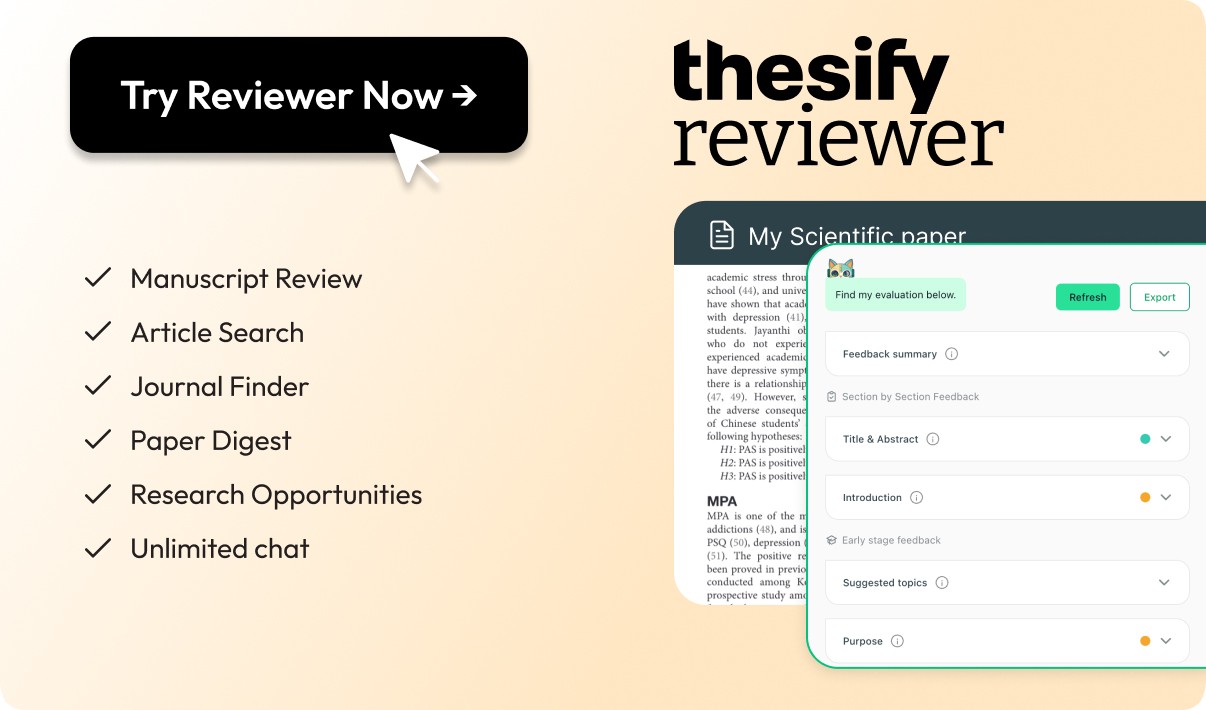
Once you have identified a suitable target journal, review the manuscript before submission. thesify Reviewer provides structured feedback on contribution framing, methodology, evidence support, and manuscript structure so you can address substantive weaknesses.
Review Your Manuscript With thesify
Decide What You Need From a Journal
Before comparing individual journals, decide what matters most for this piece of research. The same study may suit several credible venues, but each journal places the work in a different scholarly context and reaches a different audience.
Define the publication priorities with your coauthors:
Intended readership: Who should encounter and use the findings: specialists, a broader disciplinary audience, clinicians, policy researchers, practitioners, or an interdisciplinary community?
Research positioning: Which literature, debate, or scholarly conversation should the paper contribute to?
Geographic reach: Is the research primarily international, regional, national, or locally specific?
Publishing requirements: Are there funder or institutional requirements for open access, licensing, indexing, repositories, or data availability?
Research-team priorities: Which factors matter most for this paper, such as disciplinary reputation, audience relevance, publication cost, or timing?
Agree on the two or three priorities that should drive the journal choice. You can then apply the same priorities when comparing the shortlist rather than deciding between journals on an ad hoc basis.
Build a Shortlist of Suitable Journals
Build your journal shortlist from evidence that a journal is already publishing work close to your manuscript. Start broad enough to identify credible candidates, then remove journals that do not hold up under closer inspection.
1. Find Journals Publishing the Closest Research
Start with the recent papers your manuscript engages most directly. Look beyond shared keywords and compare:
research question or problem;
population, setting, or dataset;
methodological approach;
type of contribution;
level of specialization.
If the same journal titles recur across several closely comparable papers, add them to your shortlist. This is a stronger signal than one isolated paper appearing in a broadly related journal.
Check Scope, Article Type, and Methodological Fit
Once a journal appears relevant to the research, check whether it is a realistic publication venue. Read the journal’s aims and scope alongside several recent articles rather than relying on the scope statement alone.
Check:
Scope: Does the journal regularly publish research addressing this problem, population, setting, or area of inquiry?
Contribution type: Does it publish empirical, methodological, conceptual, clinical, translational, or policy contributions like yours?
Article type: Does the journal accept and regularly publish your manuscript category?
Methodological fit: Are comparable study designs, analytical approaches, or evidence types represented in recent issues?
Readership: Does its current publication record reach the audience you identified as a priority?
Use the journal’s current author guidance to confirm formal eligibility. If the research is relevant to the journal but the contribution type, method, or article format falls outside its usual publication profile, move it down or remove it from the shortlist.
For how journal fit can affect editorial screening after submission, see thesify’s guide to desk rejection.
2. Check Where the Current Research Conversation Is Happening
Compare the journals publishing foundational work with those publishing relevant research from the past one to two years. In fast-moving or interdisciplinary fields, the center of the conversation may have shifted.
Check whether newer papers are:
appearing in different journals;
reaching a different disciplinary audience;
using newer methods or study designs;
clustering around emerging themes.
thesify’s guide to mapping the conversation can help identify current debates, influential studies, and emerging research directions.
3. Test the Shortlist Against Disciplinary Knowledge
Use your coauthors’ and institution’s knowledge to challenge the initial list. Ask:
Which journals does the intended audience actually read and cite?
Which titles are respected for this type of contribution?
Have your coauthors submitted to, published in, or reviewed for any of them?
Are there journals that are highly relevant in the field but underrepresented in your reference list?
You can also consult colleagues and librarians and search library resources to identify journals that may not surface through citation tracing alone.
4. Check Audience, Geography, and Current Calls
Before keeping a journal on the shortlist, check who it is designed to reach. Decide whether the manuscript is better suited to a specialist or general-interest readership and whether its relevance is primarily international, regional, or local. These distinctions can separate journals that look equally suitable based on topic alone.
Also review current calls for papers and special issues. Check:
whether the theme genuinely matches the manuscript;
which article types are being sought;
the submission deadline;
whether the journal’s broader scope still fits the work.
A relevant call can strengthen a journal’s case as a target journal, but it should not override the wider fit checks.
Aim for around three to five plausible journals as a practical working shortlist, then compare them against the journal selection criteria below.
Compare the Most Important Journal Selection Criteria
Once you have a credible shortlist, separate the journal selection criteria that can rule out a journal from those that help rank otherwise suitable options.
Journal selection criterion | What to check | How to use it |
Research audience and positioning | Does the journal reach the community you want the research to enter, and does it place the paper in the right scholarly conversation? | Core priority |
Scope and current article mix | Does the journal currently publish comparable topics, contribution types, and levels of specialization? | Must fit |
Article type and methods | Does it publish this type of study and research approach? | Must fit |
Access, licensing, and fees | Check the publishing route, APC or other fees, waiver or institutional coverage, license, and funder requirements | Must meet requirements |
Journal policies | Check relevant data, code, preprint, authorship, and AI-use policies | Must meet requirements |
Review model and timelines | Do the stated process and timing suit your priorities? | Compare |
Metrics and reputation | Which indicators carry meaningful weight in your field or institution? | Compare alongside fit |
Verify Journal Indexing and Credibility
Verify indexing through the indexing service itself rather than relying on claims displayed by the journal.
Use the Web of Science Master Journal List where Web of Science coverage matters to your field, funder, or institution.
Use Scopus Sources where Scopus coverage matters.
Use Think. Check. Submit. for a broader framework covering journal identity, peer review, indexing, fees, licensing, and transparency.
For a deeper legitimacy check, see thesify’s guide to predatory journals.
Check Access Requirements and Publication Costs Before Ranking the Shortlist
A journal may fit the manuscript but still conflict with funder or institutional requirements, licensing conditions, or the team’s publication budget.
Confirm:
the available open-access route;
the current APC or other mandatory fees;
waiver eligibility;
any institutional or consortium agreement that could cover the cost;
the permitted license;
any repository or rights-retention conditions on the journal’s current author pages.
Compare Metrics, Acceptance Rates, and Timelines
Treat metrics, acceptance rates, and stated timelines as contextual information.
A higher journal metric does not establish stronger journal fit, and acceptance rates can vary with article type, peer-review model, commissioning strategy, and special issues.
Compare these signals alongside:
readership;
editorial fit;
funder requirements;
publication costs;
the priorities set for the paper.
Rank Your Shortlist and Choose a Target Journal
Once your shortlist contains only suitable journals, return to the publication priorities you defined at the start.
Remove journals that fail a core requirement. Exclude titles with a scope or article-type mismatch, missing required indexing, incompatible funder or policy conditions, or publication costs your team cannot meet.
Return to your research priorities. Identify which two or three factors matter most for this paper, such as reaching a specialist audience, entering a particular scholarly conversation, meeting open-access requirements, or publishing in a journal recognized within the field.
Compare every journal against the same priorities. Make the trade-offs explicit with your coauthors, especially when one journal offers stronger audience fit while another performs better on reputation, access, cost, or timing.
Choose a first-choice target. Keep the remaining suitable journals in ranked order so the team retains an agreed publication strategy if another venue is later needed.
Before submission, recheck fees, policies, indexing, and author requirements. Once you choose a target journal, move to thesify’s guide to submitting a paper to an academic journal.
Journal Selection Checklist
Use this journal selection checklist before committing to your first-choice venue:
Scope and recent publications fit the manuscript.
Readership matches the audience you want to reach.
The journal publishes the relevant article type and methodology.
Required indexing is verified through the indexing service, and the journal’s publisher and peer-review information are clear.
Access, licensing, costs, and relevant policies meet your requirements.
Your team has compared the publishing priorities that matter most for this paper.
You have chosen one target journal and ranked your backup options.
Frequently Asked Questions About Journal Selection
How Many Journals Should You Shortlist?
Three to five journals is a practical working range for most research teams. Treat it as guidance rather than a fixed rule, especially for specialized or interdisciplinary manuscripts.
Should You Choose the Journal With the Highest Impact Factor?
No single journal metric should determine the choice. Use impact factor where it matters in your field or institutional context, alongside journal fit, readership, article type, publishing requirements, and the priorities set for the paper.
Can You Submit the Same Paper to Multiple Journals?
Submit the same manuscript to one journal at a time unless the journal explicitly permits another arrangement. ICMJE states this rule for biomedical journals; always check the target journal’s current submission policy.
Related Articles
Submitting a Paper to an Academic Journal: A Practical Guide: Do you need a cover letter to submit a manuscript? Can you submit the same paper to multiple journals? How long does journal review take? And, what is desk rejection? Get the answers in our comprehensive guide.
How to Improve Your Chances of Journal Acceptance: Improve your chances of journal acceptance with seven checks for fit, reporting, evidence, manuscript alignment, and journal requirements before submitting. Find out how to get a research paper accepted.
Predatory Journals in 2026: Red Flags, Risks and Safe Choices: Predatory journals will continue to evolve in 2026, but you can stay ahead. This guide for researchers shows how to spot predatory journals, recognise new red flags and avoid academic traps. You will learn about the latest growth trends, hybrid schemes, AI‑enhanced scams and a step‑by‑step journal vetting workflow. By the end, you will know how to protect your reputation, what to do if you have already submitted and how institutions can foster ethical publishing.